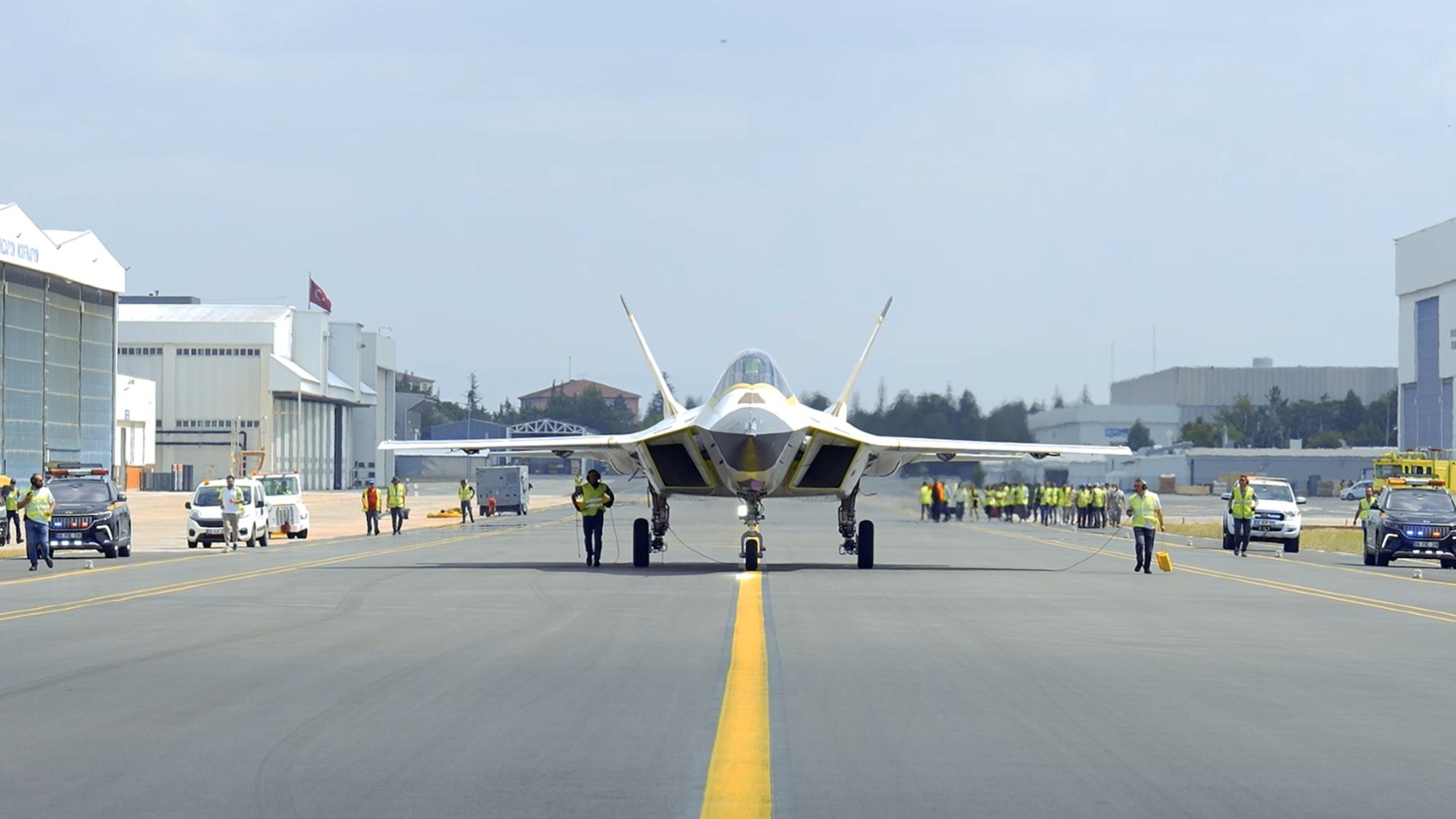
Türkiye's domestically developed fifth-generation fighter jet has successfully completed the pre-flight taxi test of its latest prototype, its developer said Friday. Footage on social media showed the Kaan warplane conducting the ground test, with technical personnel present as the aircraft taxied under its own power. Turkish Aerospace Industries (TAI) said the test was completed successfully but did not disclose additional technical details. Kaan is Türkiye's indigenous fifth-generation multirole fighter being developed to meet the operational requirements of the Turkish Air Force and is expected to replace the aging F-16 fleet over the coming decades. The aircraft made its maiden flight in February 2024, remaining airborne for 13 minutes. It completed its second test flight in May the same year, during which it flew for 14 minutes, reached an altitude of 10,000 feet and a speed of 230 knots. Following the initial flight, the program entered a phase of production of additional prototypes that will continue the aircraft's flight-test campaign. Testing and development activities are continuing with the P1 and P2 prototypes, which feature a more advanced systems architecture. According to TAI, Kaan is designed to provide air superiority through extended beyond-visual-range air-to-air combat capability, precision strike missions using internally carried weapons at high and supersonic speeds, and advanced combat performance supported by AI and neural network technologies. The twin-engine fighter is being developed as a fifth-generation multirole platform capable of conducting both air-to-air and air-to-ground missions. Türkiye plans to deliver the first batch of Kaan jets to the Turkish Air Force by the end of 2028, while a domestically developed engine is expected to power the aircraft in the 2030s.
Türkiye's homegrown Kaan fighter jet completes pre-flight taxi tests
Full Article
Original Source
Read the full article at Dailysabah →KhanList aggregates and links to publicly available news content. We do not host full articles from third-party sources. Always verify important information with original sources.