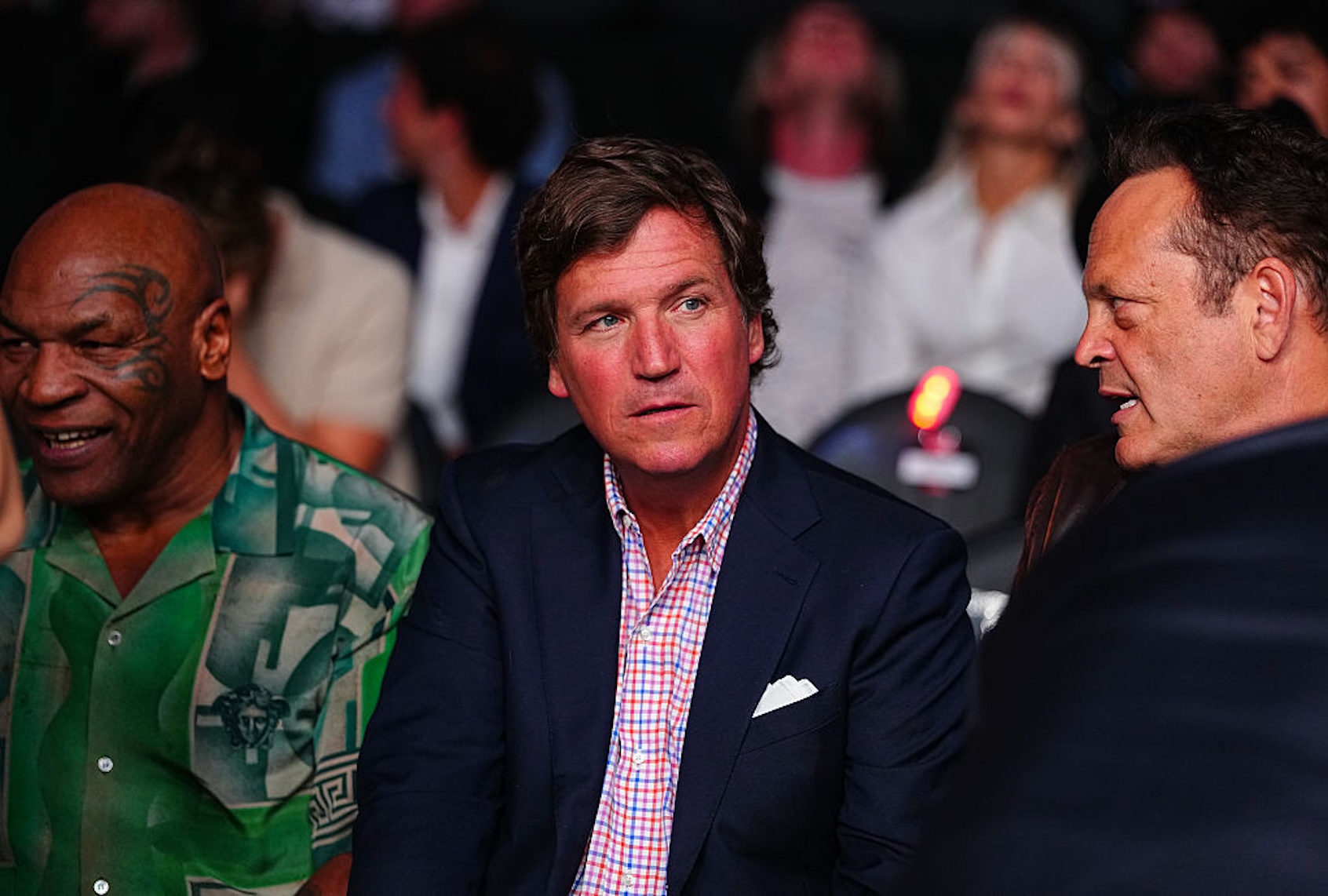
commentary A third-party bid by the disaffected MAGA podcaster would be difficult — and beneficial to Democrats Published August 9, 2026 6:30AM (EDT) Tucker Carlson is rumored to be exploring a third-party presidential bid for 2028 (Chris Unger/Zuffa LLC) Former Georgia Rep. Marjorie Taylor Greene recently posted an odd picture on social media. A group of people were gathered around a large dining table beneath a massive chandelier of antler, a tableau that evoked some kind of Viking summit. Tucker Carlson sat at the head of the table like a preppy Ragnar Lothbrok, and he was surrounded by fellow Trumpist apostates Greene, former Kentucky Rep. Thomas Massie and Joe Kent — the former MAGA cultist who resigned as Donald Trump’s director of counterterrorism — and their respective spouses. “The movement has begun,” Greene captioned the picture. Their new political movement began to take shape on Wednesday when he revealed the 10-point manifesto during a livestream. While he was vague about the specific form he expected this movement to take, it was later reported that Greene, Massie and Kent had visited Carlson’s Maine estate to urge him to run for president in 2028. The manifesto would seem to be the first step toward a third-party bid, since all these people are persona non grata with the GOP establishment, and have attempted to seize the MAGA mantle with varying degrees of success. Considering the split in the Republican Party these days between the MAGA cultists, the MAGA populists and what is now a rump establishment, the timing does seem ripe for a third-party to form from the right, and Carlson is a likely candidate to lead it. Considering the split in the Republican Party these days between the MAGA cultists, the MAGA populists and what is now a rump establishment, the timing does seem ripe for a third-party to form from the right, and Carlson is a likely candidate to lead it. After having debased himself for years by behaving as a Trump toady while trying desperately to maintain something of an original persona, Fox News fired him in ignominious fashion in 2023. Shortly after, he retreated to Maine to reinvent himself as a podcaster and the leader of the populist, isolationist right. Carlson has had quite a bit of success in that role, which was massively enhanced when Trump went to war with Iran and tightened the already symbiotic relationship with Israel. The opening is here, and Carlson seems ready to seize the opportunity. The problem, of course, is that third-party presidential bids in American politics never win, and they often end up being spoilers for one of the two main parties, although they can have quite a lot of influence on the agendas of both. The most successful — those that earned the largest shares of the popular vote — signal a discontent with one or both parties that can serve as a wake-up call that the country is looking for change. Four third-party campaigns have resulted in double-digit vote counts, starting with Teddy Roosevelt’s Bull Moose Party in 1912. By then a former president after passing the baton to William Howard Taft, a decision he came to regret, Roosevelt got 27.4% of the vote, showing that progressive ideas around workers’ rights, business regulation, constitutional reform and conservation, among other things, were potent political issues among voters who had been buffeted by an unregulated financial system and exploited by the Gilded Age barons. Roosevelt’s campaign shook the system, earning 88 electoral votes and dooming Taft’s reelection campaign in favor of the Democrat Woodrow Wilson. Twelve years later, although he received 16.6% of the popular vote, the third-party run of progressive Robert LaFollette was less consequential; he only carried Wisconsin and its 13 electoral votes. In 1968, George Wallace, the Southern populist, racist and former governor of Alabama, received 13.5% of the popular vote and 48 election votes, carrying all five states of the Deep South. In 1992, wealthy businessman Ross Perot seized the public imagination with his economic nationalism — “that giant sucking sound of jobs going overseas” — and fiscal conservatism seemed to speak to disaffected members of both parties who felt that the country had abandoned the average worker. Despite his great wealth, Perot had a homespun approach and used the media very effectively. When he ran in 1992, he received 18.9% of the popular vote, support that most pollsters said came equally from both parties, but garnered no electoral votes. Four years later, Perot garnered a respectable 8.4%, and his Reform Party lasted until 2000, when Donald Trump made a brief attempt at a run under its banner. Third-party presidential bids have perversely had the greatest impact in moments where the country has been closely divided between the two parties. The 2000 election comes to mind. The national popular vote was almost equally divided, with Vice President Al Gore receiving 500,000 more votes than George W. Bush, the Republican governor of Texas, but the presidency was decided by a series of events in Florida, where the tally ended up being 537 votes for Bush, giving him the state’s 25 electoral votes. But without the presence of Green Party candidate Ralph Nader, Gore would have won Florida — and the presidency. Nader’s 97,488 votes in the Sunshine State, which would have likely been cast for Gore had he not been in the race, made sure it went for Bush, and consigned the country to years of war and economic distress. Start your day with essential news from Salon. Sign up for our free morning newsletter, Crash Course. In the lead-up to 2028, you can already see the influence of Carlson’s faction of the right putting pressure on the GOP. His manifesto is an eccentric amalgam of populist right-wing nationalism, woo-woo Make America Healthy Again anti-science beliefs, isolationism, anti-elitism, natalism, degrading education and xenophobia, and ideas of “beautifying” the country and rebuilding manufacturing and farming. Carlson side-stepped the issues of abortion, religion, and diversity, equity and inclusion initiatives, which is surprising since he’s been in the middle of those culture war issues for years. At the same time, Vice President JD Vance has been laying the groundwork for his own run by releasing “Communion,” a book focused on his religious faith and conversion to Catholicism. He has also been trying to thread the needle between the anti-elite message, which is at the center of the present populist movement, and his devotion to Trump, the most corrupt president in American history. Vance seems to be trying out a strategy in which he will portray himself as the great crusader against fraud in day care centers and hospice care, for which he blames the so-called scourge of immigrant labor. The vice president is coming to the defense of those who are economically disadvantaged in this economy, which he has said shows that “40 years of bipartisan economic policy has failed.” (The Trump years, which the president insists have been the greatest economy the world has ever known, evidently don’t count.) Vance has even taken to social media to position himself against a Trump-supporting elite. Responding to right-wing columnist Marc Theissen’s rude “cry me a river” response to a college kid lamenting that “a burrito shouldn’t cost $20,” Vance responded with a Trumpian insult, saying, “I’m surprised to hear Mark say this. If you’ve ever met him in person, it’s quite obvious the man has never missed a burrito.” I guess this is supposed to endear him to the MAGA folks while subtly acknowledging that the affordability crisis is real. Vance seems to know that such a magic trick will be difficult, if not impossible, to pull off in 2028. He will have to defend Trump’s economy, which will be necessary to attract the hard-core cultists who still love the president despite the nation’s sluggish economy. Carlson, meanwhile, sitting outside the administration, has a much better chance of snagging this populist right-wing movement that’s evolved from Trump’s original “America First” movement, which could serve as a way for many disillusioned Trump voters to maintain the fiction that they really only cared about policy all along. This fissure has every chance of splitting the GOP and helping Democrats take back the White House. Go, Tucker, go. Related Topics ------------------------------------------ Related Articles
Tucker Carlson could derail the GOP’s 2028 plans
Full Article
Original Source
Read the full article at Salon →KhanList aggregates and links to publicly available news content. We do not host full articles from third-party sources. Always verify important information with original sources.