
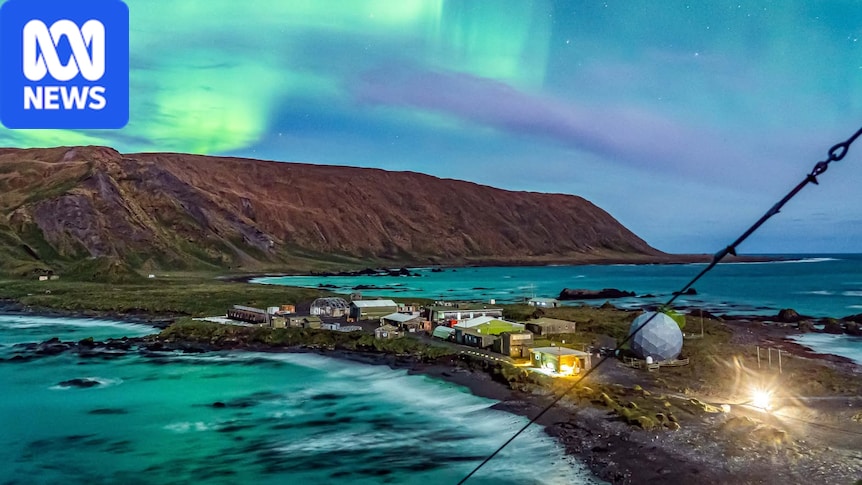
Emergency services in Australia will have less time to respond to tsunamis from the Southern Ocean because the Macquarie Island seismic station is currently not operating, internal government documents reveal.In late August, the federal environment department made the unprecedented decision to withdraw personnel from the island, 1,500 kilometres south-east of Tasmania, because of concerns about a potential H5 bird flu outbreak."This decision is a sensitive one that is likely to attract criticism — including because it would be taken ahead of a mortality event," a briefing prepared by the Australian Antarctic Division (AAD) said at the time.The briefing note said if the Nuyina was needed for a later evacuation of the island, it would impact the season's resupply and science missions. (Supplied: AAD/Christopher Mooney)The briefing, released to the ABC under freedom of information laws, warned that unless expeditioners were extracted, they could be exposed to "psycho-social hazards" from living and working amongst dying and dead baby elephant seals for several months.But the briefing also noted the decision would have "significant implications" on critical monitoring programs conducted by the AAD and other government agencies.One of them is Geoscience Australia, which has a seismic observatory on the island.The tsunami shelter for expeditioners, high up on Wireless Hill at Macquarie Island. (Australian Antarctic Division: Nick Cartwright)The observatory monitors earthquakes in the highly volatile region, which is on the boundary of the Pacific and Australian tectonic plates.But since the removal of expeditioners in early October, the island has been without power, meaning the seismic observatory has not been able to operate.An email obtained by the ABC shows an official from Geoscience Australia outlined the "impacts of loss of real-time data" several weeks before the team was extracted."[There will be] reduced overall coverage in the region that modelling shows will impact in the timeliness and sensitivity of earthquake detection in the region," the email said.When the seismic observatory was operational, it would take eight minutes to detect an earthquake in the region.But now that it is offline, it takes an estimated 10 minutes — delaying alerts for potential tsunamis by an additional two minutes."A reduction in the ability of the seismograph network to support these alerting timelines in this region would directly result in less response time for emergency services in preparation for tsunami reaching Australia's south-eastern coasts," the email said.Offline seismic station is a 'major gap', expert saysThere have been at least nine earthquakes in the region larger than magnitude 7.5 since 1900, according to the US Geological Survey.One of them was an 8.2-magnitude quake in 1989, and another was an 8.1-magnitude quake in 2004.Location of the ocean-bottom seismometers deployed at different depths on the Macquarie Ridge Complex, surrounding Macquarie Island. Five seismometers were also installed along the length of the island. (Supplied: CSIRO)Both reportedly triggered minor tsunamis of between 15 and 30 centimetres by the time they reached Tasmania and parts of the south-eastern mainland.But Professor Hrvoje Tkalčić, a seismology and geophysics expert at the Australian National University, said much bigger tsunamis were known to have occurred many years before."Historically, we have evidence from paleo tsunami deposits that in the last several thousand years, there are some devastating tsunamis coming from that area," he said.The Macquarie Island seismic observatory is one of more than 100 stations that form part of the Australian National Seismograph Network.But Professor Tkalčić said it was significant that it was not operating."It leaves a major gap on that plate boundary, with the closest station more than 1,000 kilometres away."Alerts will still be issued within 'required timeframes'Geoscience Australia told the ABC the situation was expected to result in "slower and less sensitive" detection of earthquakes that occur to the south of Australia and New Zealand."However, it is expected that alerts will continue to be issued with the required timeframes to support tsunami warning," it said.That required timeframe is within 10 minutes of an earthquake occurring.Geoscience Australia said it had attempted to automate its seismic observatory on Macquarie Island during the October drawdown, but was unable to do so because of bad weather."Due to strong winds during the drawdown period, the installation of solar panels on the roof, which are required to power the observatory, was not able to be undertaken safely," it said.It is now working with the AAD to return to Macquarie Island early next year to complete the automation plans.The island withdrawal has also impacted other monitoring services, including weather and wildlife observations, plus a system that detects nuclear explosions in other parts of the world.The station sits amongst a seal colony. (Supplied: AAD)Environmental concerns flagged in documentsThe internal documents also show another agency — the Tasmania Parks and Wildlife Service (PWS) — raised potential issues regarding the island's aging infrastructure."One item potentially overlooked to date is the legislative obligations of the AAD," a PWS official said in an email sent a fortnight after the withdrawal decision was made.They noted that if the station's deteriorating infrastructure caused habitat destruction, pollution to breeding colonies or disturbance to threatened species, it could breach conservation rules."I would consider if the AAD knew the station presented environment risks, removed the capacity to manage those risks, and failed to implement sufficient mitigation measures beforehand [a range of legislative acts] could be potentially engaged," they said.An AAD spokesperson told the ABC it had worked with PWS to identify and mitigate any potential environment hazards prior to the withdrawal.This included boarding up windows and barricading doors on all buildings and draining fuel and oils from engines and plants."These efforts have done much to reduce the environmental risks associated with the temporary withdrawal," the AAD spokesperson said.They said preparations were underway to send the RSV Nuyina to Macquarie Island in March next year to retrieve 185,000 litres of diesel from the station's bulk fuel farm.Macquarie Island is far to the south-east of Tasmania. (Supplied: Maggie Smith)Expeditioners wanted to stayThe decision to withdraw from the island was opposed by multiple expeditioners, who said they were prepared to remain there regardless of the AAD's concerns about psychosocial risks.But the internal documents show the AAD considered the risks were impossible to mitigate to an "acceptable level"."In these circumstances, we consider it highly likely that expeditioners would seek unscheduled earlier retrievals from the island," the briefing said.If an evacuation was required during the summer months, it said it would have compromised the Nuyina's scheduled resupply voyages to Antarctica, as well as some science projects."Diverting RSV Nuyina from the approved season plan would likely result in the majority of the season objectives not being achieved and could have flow-on effects on funded science activities for up to three years."The briefing said cost of chartering a different vessel to retrieve the expeditioners would have been about $4 million and taken at least 10 weeks to mobilise.It said that given the "significant uncertainties involved" expeditioners were not expected to return to live on Macquarie Island before April or May 2028.
Tsunami response window shorter after staff pulled from remote island
Full Article
Original Source
Read the full article at Abc →KhanList aggregates and links to publicly available news content. We do not host full articles from third-party sources. Always verify important information with original sources.