
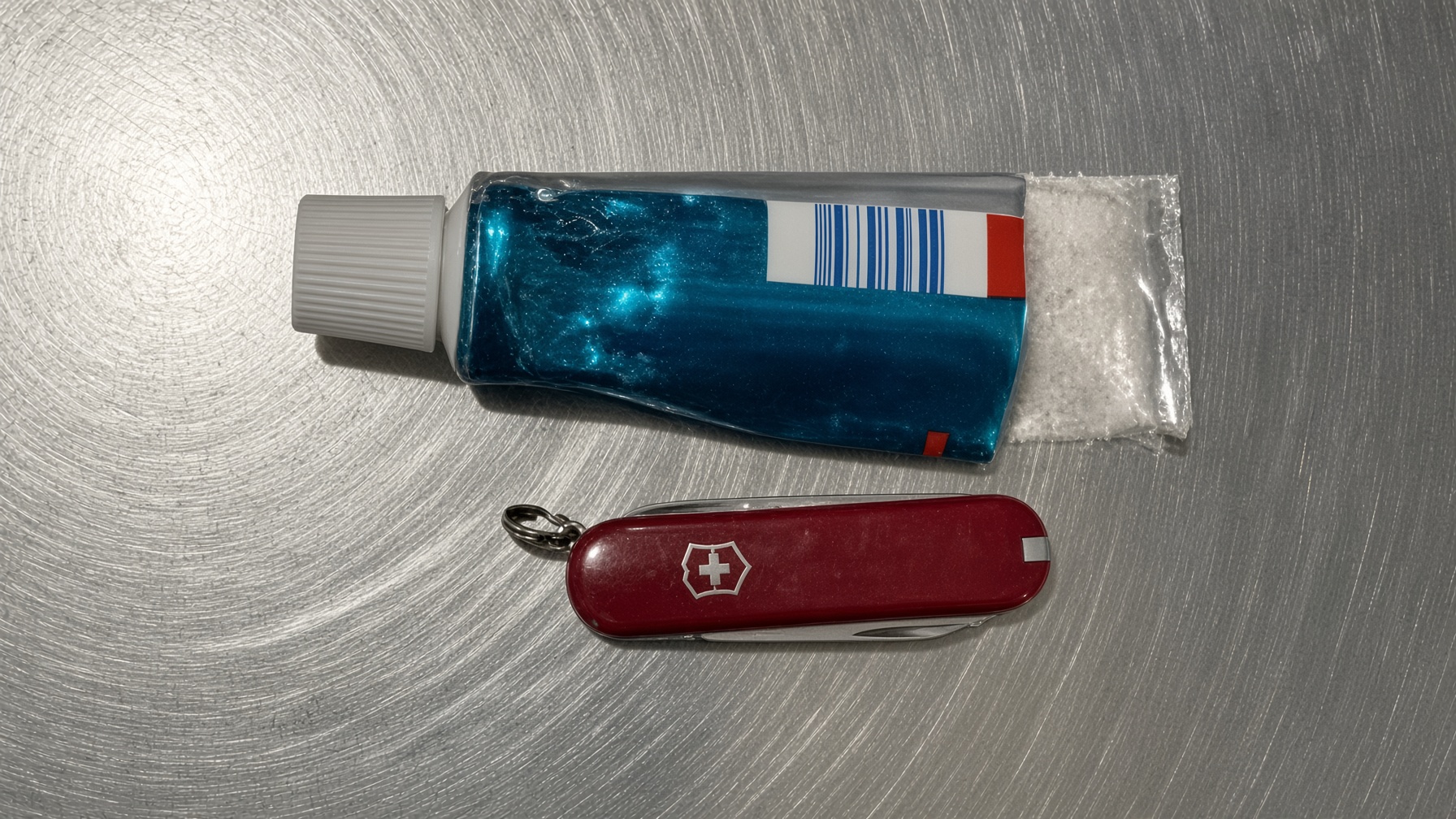
A married couple hid a small pocketknife inside a toothpaste tube at Dallas Love Field. When TSA found it, they said their son had suggested the idea. They surrendered the knife and went on to their flight. Now the agency is celebrating the discovery, even though the agency once argued that allowing small knives would help it focus on more serious threats. My first thought looking at the photo was that this is a pretty small knife. Hiding it was stupid, but wanting to bring a pocketknife on a trip doesn’t mean someone planned to do anything nefarious. And calling this a success story tells us very little about how often airport screening actually works. According to TSA’s account of the September 22 incident, a screener spotted what looked like metal near toiletries on the X-ray and asked their training instructor to search the bag. He initially couldn’t find anything amiss, but a second pass through the machine helped narrow the search, and he discovered the knife inside the tube. The couple said their son had told them to conceal it there to get it through security. They were consciously trying to evade the rule! TSA’s local leadership praised an “excellent catch.” Federal Security Director Amy Williams called it “exactly the type of threat our officers are trained to identify and resolve.” The traveling couple voluntarily surrendered the pocketknife to TSA and was allowed to continue to their flight. The officers followed through on something they’d spotted and enforced the rule. That’s literally what they’re supposed to do. TSA Already Allows Larger Scissor Blades The photo shows a small red Swiss Army-style pocketknife, folded closed. TSA doesn’t provide its model or blade length. But TSA allows scissors with blades less than four inches long, measured from the pivot to the tip. However, an ordinary pocketknife is prohibited regardless of how short the blade is. A scissor blade approaching four inches can go through security, while a much shorter pocketknife blade can’t. TSA began allowing small scissors in December 2005. The idea was to focus more attention on explosives. A Government Accountability Office review found no reported onboard security incidents involving those newly permitted items. TSA Tried To Allow Small Knives, Too In March 2013, TSA announced that small pocketknives would be allowed beginning April 25. Its published specifications required: Blades no longer than 2.36 inches, or six centimeters. Blades no more than half an inch wide. No locking or fixed blades, and no molded grips. Then-administrator John Pistole explained his reasoning in a letter to Congress: the agency needed to concentrate on threats that could bring down an aircraft. Reinforced cockpit doors and other changes had altered the risk. He wanted TSA to “focus our efforts on mitigating risk, rather than trying to eliminate it.” Pistole also pointed to the scissors policy. He said more than three billion passengers had flown in the United States already since that change without a single reported disruption involving the newly permitted objects. Flight attendant unions objected, along with other labor groups, airlines and lawmakers. Their argument was that keeping someone out of the cockpit didn’t prevent them from attacking passengers or flight attendants, though it’s unclear how much extra risk a small pocketknife creates when other sharp objects were already permitted. TSA delayed the change and abandoned it on June 5, 2013. Congress later barred TSA from authorizing knives beyond its plastic and butter-knife exception in 2018. TSA Trumpets Catching Something Fairly Benign, Won’t Disclose Its Broader Effectiveness It’s not clear that the TSA is actually very good at stopping threats. . We learned that its own past testing found significant shortcomings: In 2015, we learned about failures in 67 of 70 tests involving mock explosives or prohibited weapons, widely described as a 95% failure rate. In 2017, another report found an 80% failure rate. That’s not today’s screening performance. The Department of Homeland Security inspector general conducted another round of checkpoint testing and issued a report in November 2025. Past results were embarrassing. Subsequent results have remained classified. TSA can find enough prohibited items to generate a steady stream of publicity even if it misses a substantial share of them. This incident tells us nothing about whether TSA is actually doing much to contribute to safety. And they’re trumpeting as success catching a knife the agency itself said wasn’t a significant risk, and that focusing on would distract screeners from identifying real threats. Topics on this page
TSA Celebrates Finding A Pocket Knife Hidden In Toothpaste
Full Article
Original Source
Read the full article at Viewfromthewing →KhanList aggregates and links to publicly available news content. We do not host full articles from third-party sources. Always verify important information with original sources.