
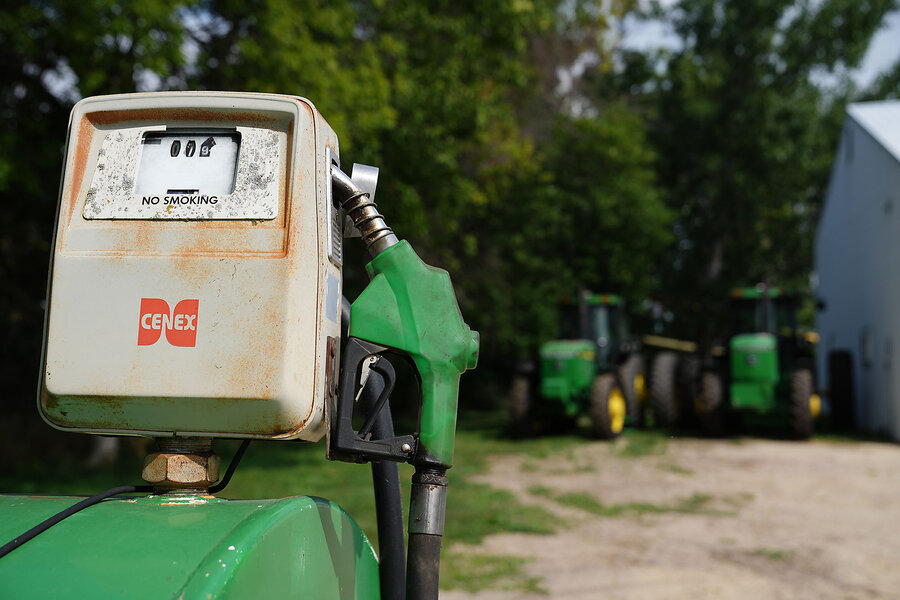
When President Donald Trump announced a diesel-supply deal with Russia last Friday, he was reaching for a policy lever in a last-ditch effort to lower prices for Americans and salvage Republican prospects in next month’s midterm elections. High pump prices for diesel and other fuels have become a major drag on his party’s candidates, including in agricultural states such as Kansas and Iowa. And high energy prices continue to drive inflation, running at 3.7% in September, the Bureau of Labor Statistics reported on Wednesday.The president’s deal with Moscow has drawn strong criticism from Democratic and some Republican lawmakers, who slapped sanctions on Russian exports after Russia invaded Ukraine in 2022. Mr. Trump has blamed Ukrainian attacks against Russian oil refineries for driving up global diesel prices, though energy analysts say reduced flows from the Middle East amid the U.S.-Israeli war with Iran have been a far bigger factor.And, so far, the promise of Russian diesel hasn’t eased the upward price pressure; wholesale prices for diesel in California hit a new high this week. Diesel futures also rose on Tuesday and remained high on Wednesday, reflecting the view of traders that short-term domestic prices are more likely to rise than to fall. Any relief that does come in the form of increased supply would likely be after November’s midterms, since it takes weeks for cargo vessels to arrive by sea. At the same time, the amount of Russian diesel that Mr. Trump claims will become available represents only a modest share of daily U.S. consumption. And many farmers have already bought their diesel for fall crop harvesting. Amid public frustration over high fuel prices, the White House has tried pulling other policy levers. The Strategic Petroleum Reserve has been drawn down to its lowest level in decades. Mr. Trump signed a recent executive order allowing trucks to use a tax-exempt diesel fuel normally reserved for farm equipment. But the effect of these measures has been marginal, at best, in holding down prices for diesel, gasoline, and jet fuel. The same applies to heating oil – which is an issue in Maine, where Republicans are defending a crucial Senate seat.All of which underscores an economic and political reality: Fuel prices can have a dramatic impact on voter sentiments, and presidents’ hands are mostly tied when it comes to addressing them. SOURCE: U.S. Energy Information Administration | Jacob Turcotte/Staff “There’s very little a president can do to influence energy prices,” says Lucas Davis, a business professor at the University of California, Berkeley, who studies energy markets.Mr. Trump is not the first president to have his political fortunes linked to oil prices. Past administrations have taken drastic measures in response to external energy shocks. The Strategic Petroleum Reserve was created after the 1973 oil embargo by Arab producers led to shortages and contributed to years of stubborn high inflation. The U.S. subsequently adopted conservation measures, most notably a 55 mph speed limit on highways and fuel economy standards for automakers. As in the 1970s, global energy markets have been roiled in recent years by conflicts: Russia’s war with Ukraine pushed up natural gas prices and stoked global inflation. Over the past year, Ukraine has successfully used drones to strike Russia’s oil industry, including refineries that produce diesel. In July, Russia banned diesel exports to prioritize its domestic market amid shortages at gas stations and concerns over summer harvests.In the U.S., diesel prices had already been surging since the start of the Iran war. While the U.S. has managed to partially reopen the Strait of Hormuz, allowing oil tankers to pass through, Iranian strikes against refineries in the region have slashed exports of diesel and other refined fuels.Polls show many voters blame Trump administration policies for the sticker shock at the pump.“There’s a direct line from the Iran war ... to the high prices we’re facing right now,” says Dr. Davis. He doubts that Russia can supply enough diesel to settle markets. “This is another intervention that is going to have only a very modest impact on prices. It’s just not enough diesel to make that big of a difference.”It also comes with a geopolitical cost that Mr. Trump’s critics say undermines U.S. policy aimed at curbing Russia’s resources to wage war on Ukraine. A bipartisan statement by members of the Senate Foreign Relations Committee said that suspending U.S. sanctions on Russian diesel runs counter to a 2022 law that banned Russian energy. “Congress was clear: the U.S. should not import oil from Russia until it ends its aggression against Ukraine and ceases threats against our NATO Allies,” read the statement, put out over the weekend by three Democrats and four Republicans – including GOP Sen. Susan Collins of Maine, who is locked in a tight reelection race. Deepen your worldviewwith Monitor Highlights.Politics with respectGet political stories with respectful analysis.There‘s a world of new ideas in everyBooks newsletter.There‘s more to life, enrich yours withCulture & Learning weekly.Follow humanity‘s discoveries withScience & Nature stories in your inbox.Gain a spiritual perspectivefrom the stories in your inbox.Want to understand the deeper impact of critical events? Learn the Monitor‘s insight.Already a subscriber? Log in to hide ads. Last month, Mr. Trump signed a law named for the late Sen. Lindsey Graham of South Carolina, an ally of the president, that tightened sanctions on Russia’s oil industry. The law penalizes countries that buy significant amounts of Russian oil by applying 500% tariffs to their exports. U.S. diplomats have also been putting pressure on European countries to buy less natural gas from Russia.Some Republicans have defended Mr. Trump’s U-turn on his own administration’s foreign policy as an emergency measure. Mr. Trump “has to make tough decisions,” said Sen. John Barrasso of Wyoming on CBS News’ “Face the Nation” on Sunday. “He’s balancing his effort to stop and end [Vladimir] Putin’s war in Ukraine and lowering prices for American families.” ALREADY A SUBSCRIBER? LoginReal news can be honest, hopeful, credible, constructive.The Christian Science Monitor was founded in 1908 to lift the standard of journalism and uplift humanity. We aim to “speak the truth in love.” Our goal is not to tell you what to think, but to give you the essential knowledge and understanding to come to your own intelligent conclusions. Join us in this mission by subscribing.
Trying to curb soaring fuel costs, Trump finds his hands mostly tied
Full Article
Original Source
Read the full article at Csmonitor →KhanList aggregates and links to publicly available news content. We do not host full articles from third-party sources. Always verify important information with original sources.