
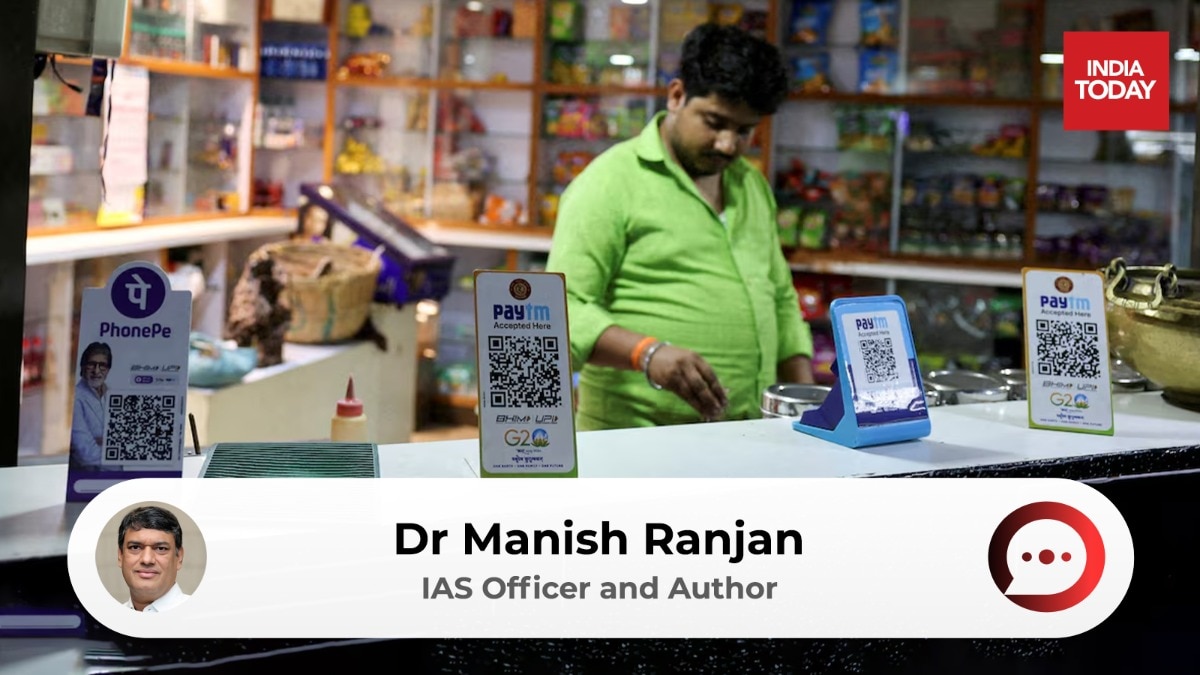
On 25 September, Reuters revealed how a bank in Milan lost €95 million to a message and a voice. The then chairman of Fideuram, the private banking arm of Italy's largest bank, received a WhatsApp message that seemed to come from Carlo Messina, chief executive of the parent bank, Intesa Sanpaolo. A call followed from a senior partner of a well-known law firm, except that the voice on the line had been copied by AI. More than a third of the money is still missing. If a bank chairman in Milan can be fooled like this, think of a pensioner in Ranchi.India saw this coming. Under the amended IT Rules, in force since 20 February, AI-generated content must carry a visible label and permanent data showing where it came from, and platforms must act on takedown orders within three hours instead of 36. The principle is simple: what is illegal offline is illegal online. I read the notification twice, once as a citizen, gratefully, and once as an administrator of twenty-four years, with some questions.We acted early because the old certainty, seeing is believing, has stopped working, and Indians found this out sooner than most. Sam Altman of OpenAI told a Federal Reserve conference last year that AI has “fully defeated” most of the ways people now prove who they are. The World Economic Forum's latest Global Risks Report ranks misinformation as the world's second-biggest short-term risk.Look at what our cyber cells record. Retired people held captive in their own drawing rooms by fake officers on video calls, a fraud so common that the Hon’ble Prime Minister warned against “digital arrests” in Mann Ki Baat. Young women who find their faces stitched onto pictures they never posed for. A father who hears his son's voice, breaking, begging for money the son never asked for. In September, Tamil Nadu police arrested a man over deepfake videos in which Chief Minister C. Joseph Vijay seemed to offer cash to anyone who sent a WhatsApp message. None of these victims was foolish. In a 2022 study in PNAS, Sophie Nightingale and Hany Farid found that people picked out AI-made faces only 48 per cent of the time, no better than a coin toss, and trusted the fakes more. Indians lost over Rs 22,800 crore to cyber fraud in 2024, the Home Ministry has told Parliament, three times the 2023 figure. Call it what it is: a tax, collected by liars. In my book AI and the War for Truth, I called this a double corruption. The first is believing the lie. The second, and far worse, is no longer believing the truth. The law professors Bobby Chesney and Danielle Citron called it the liar's dividend: once fakes are everywhere, any awkward fact can be waved away as one more fake. A man caught on tape simply shrugs. When evidence stops counting, courts, newsrooms and even families start running on empty.As district collector of Hazaribag and later Garhwa, I saw how one evening rumour could shut a weekly haat, or keep two mohallas awake all night watching each other. What worked was a voice people already trusted, reaching them before the lie did. Much of administration, I came to feel, is the management of belief. What has changed since then is the speed. The rumour now travels through optical fibre, wears a familiar face and speaks in a familiar voice. So, with respect, deleting fakes will not be enough. In 2018, MIT researchers writing in Science traced some 126,000 stories on Twitter. False ones were 70 per cent more likely to be shared, and true ones took about six times as long to reach 1,500 people. The forger has to succeed once; the platform has to succeed every time. A three-hour rule is a referee who arrives after the race is over.India has solved problems like this before, twice. When fake identities were draining welfare, we did not hire more inspectors. We built Aadhaar, and checking who someone was took seconds. When cash fraud plagued small traders, we built UPI, which handled a record 2,451 crore transactions in August alone, and trust began to travel with the money. That is the Indian way. When a problem is too big to police, we build a public system that makes honesty the easy choice.For truth, we need three things, and none of them needs new science. First, every photo and video should carry a birth certificate. Cameras, editing software and platforms can sign content when it is made, so that any citizen can long-press a video and see where it came from. The standard, Content Credentials, already exists, and the government should lead by signing everything it publishes. Second, a free public checking service in every scheduled language, where a journalist in Guwahati or a magistrate in Madurai can test a doubtful clip in a minute. Third, a quick human appeal for genuine content that automated filters wrongly strike down, because in our republic the last signature on a citizen's fate must belong to a person. Denmark has gone further: since March, its law gives every citizen a copyright-like right over his own face and voice.Systems need habits to go with them, and India knows that habits can spread. Swachh Bharat built over 11 crore toilets, and a 2024 study in Scientific Reports estimated that it was averting 60,000 to 70,000 infant deaths a year. That lesson from the street now has to reach the phone. Finland, living next to a large propaganda machine, put source-checking into every school subject from 2016 and has topped Europe's Media Literacy Index ever since. We could put doubt on our timetable too: hold every forward for three seconds and ask where it came from.What worries me most is something quieter than fraud: the citizen who grows so tired of guessing what is real that he stops trying, and simply accepts whatever his phone tells him. Multiply that by a billion, and a country can lose its hold on the truth without a shot being fired.For three hundred thousand years, almost everything we built- the court, the bazaar, the newspaper, the family- rested on one simple trust: that our eyes and ears would not lie to us. The machines have broken that trust. India has answered with law. Now it must build the public systems that let every citizen check before believing. We wrote Satyameva Jayate on our national emblem as a prayer. This decade gives us the tools to make it a working promise.(Views expressed in the piece are those of the author)- Ends
Truth needs a UPI moment
Full Article
Original Source
Read the full article at Indiatoday →KhanList aggregates and links to publicly available news content. We do not host full articles from third-party sources. Always verify important information with original sources.