
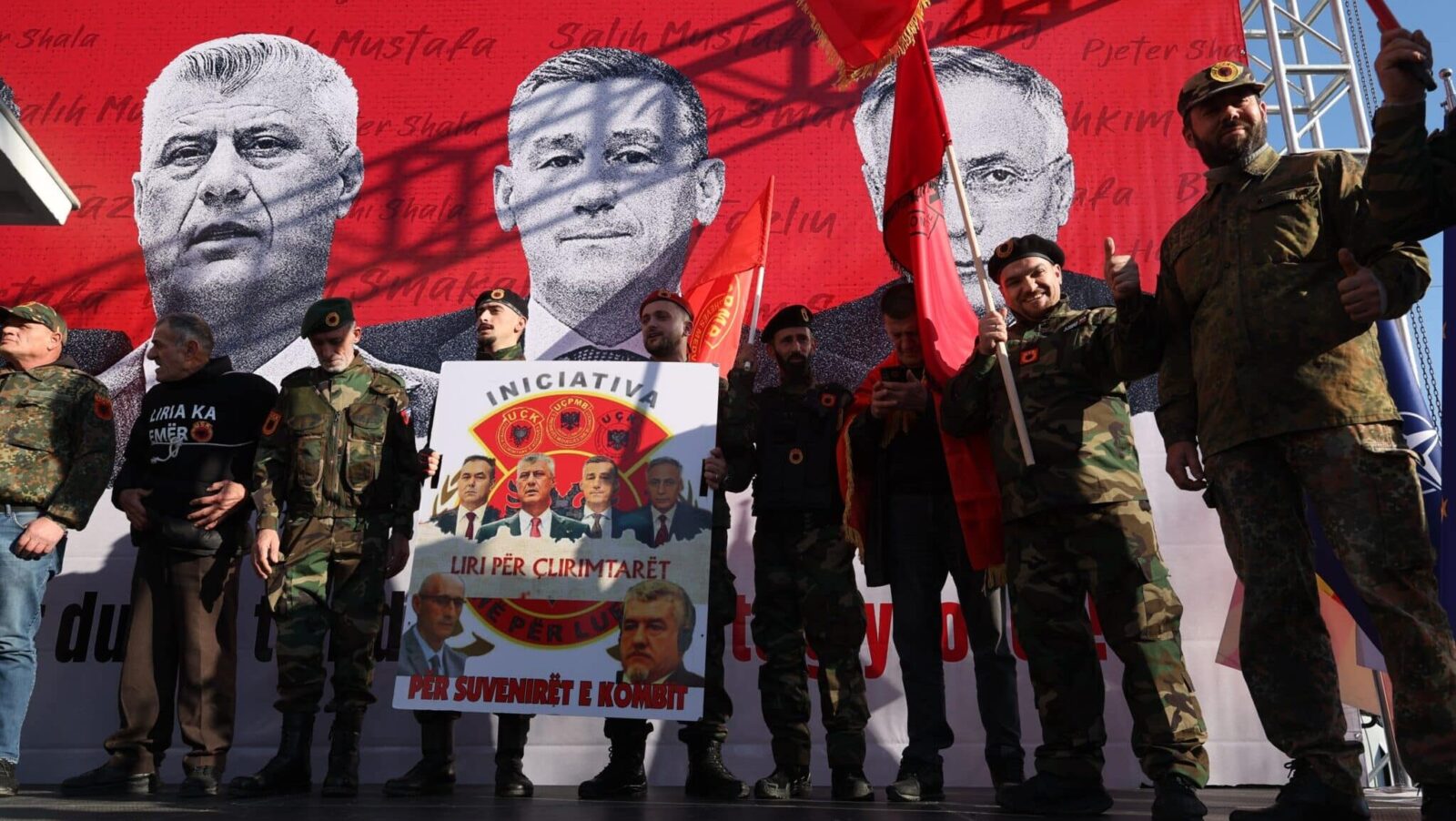
On September 16, the Kosovo Specialist Chambers in The Hague will pronounce its long-awaited verdict in the case against Hashim Thaci, former president of Kosovo, and three other former commanders of the Kosovo Liberation Army, KLA – Kadri Veseli, Jakup Krasniqi and Rexhep Selimi. Each was charged by the Specialist Prosecutor’s Office with multiple counts of war crimes and crimes against humanity, allegedly occurring in 1998-2000 during and shortly after the brutal war with Serbian forces. The case, followed widely, is currently the world’s only “senior leadership” war crimes trial. The verdict, whatever it might be, will have profound consequences for numerous stakeholders: the accused, Kosovo at large, the victims, the prosecution, and the court itself; and also for the European Union and its related organisations, given the extraordinary amount of time and resources invested: 18 years [2008-2026] and a jaw-dropping 500 million euros. Of course, factors such as time and money should not influence the court’s decisions. But Edward Joseph, an attorney and professor at Johns Hopkins University, and an expert on Kosovo and the Balkans, raised thought-provoking questions in an article in Kosovo Online on July 5, 2026, worth quoting in its entirety: “Like everyone else, I am simply observing. I would say that I am concerned. I will not make predictions, but I am concerned that there could be, consciously or unconsciously, a motivation for this court to convict the defendants,” Joseph wrote. “Otherwise, how would they justify this years-long and extremely expensive process, their high salaries, their staff, and all of the institutional support? They have a substantial budget, and then you take former President Hashim Thaci, remove him from office, bring him there, and in the end you have nothing? Not a single conviction? That is why I am concerned that this could become a conscious or unconscious motivation.” To properly understand the enormity of the investment, and to consider answers to these questions, it is important to recall the benchmarks of time and money over the years. The investment of time Supporters of the former KLA leaders hold images of Hashim Thaci and Kadri Veseli during a rally in Pristina, February 2026. Photo: EPA/Georgi Licovski.The seed for the Specialist Chambers and Specialist Prosecutor’s Office was planted in 2008. Carla Del Ponte, former chief prosecutor at the International Criminal Tribunal for the Former Yugoslavia, ICTY, wrote in her memoir, Madame Prosecutor, of heinous crimes committed by members of the KLA against Serbs, minority Kosovars, and Albanian collaborators, including rampant human organ-trafficking. Her stunning claims spawned a two-year investigation from 2008-2010 by the Parliamentary Assembly of the Council of Europe, PACE, headed by Swiss senator Dick Marty, resulting in a report titled ‘Inhuman treatment of people and illicit trafficking in human organs in Kosovo’. The Marty Report corroborated many of Del Ponte’s accusations, and named some of the alleged perpetrators, including Hashim Thaci and Kadri Veseli, who were among the founders of the KLA. The alleged crimes included murder, abductions, torture, forced disappearances, and involvement in organised crime; there was also mention of a “handful” of organ trafficking cases, far fewer than claimed by Del Ponte. The alleged victims, again, included Serbs, members of ethnic minority groups and political enemies of the KLA. Though it lacked evidence, the Marty Report was adopted in its entirety by a resolution of PACE in January 2011, which mentioned organ trafficking eight times in its three pages. PACE urged the EU’s rule-of-law mission in Kosovo, EULEX, to ensure the perpetrators were held to account. EULEX then authorised an extensive criminal investigation by the EU’s Special Investigative Task Force, SIFT, headed by Clint Williamson, the former US ambassador-at-large for war crimes. In 2014, Williamson reported that SIFT had enough evidence to indict certain unnamed senior KLA officials for the crimes described in the Marty Report. Williamson agreed that there were only a handful of trafficking cases, but insufficient evidence for an indictment. He recommended a special international court for filing the indictment. The EU and the US, strongly agreed, seeing it as far better to prosecute “big fish” like Thaci, Veseli and other prominent KLA figures in a neutral out-of-Kosovo location, free from political interference and witness intimidation, and staffed entirely by internationals. In 2014, there was then an exchange of letters between Kosovo’s president and the EU to create a specialised court in The Hague. But Kosovo, which strongly opposed the court, had to agree, and did so only under relentless pressure from the EU and US in mid-2015. A constitutional amendment had to be passed permitting such a court, then a law establishing the court, both of which referred to PACE’s resolution as its justification. The court would only target KLA veterans, not Serbian forces, thereby creating distrust and resentment within Kosovo society from the very beginning. The Specialist Chambers would be hybrid – part of Kosovo’s justice system but also internationalised. It opened for business in The Hague in July 2017. Thaci, as foreign minister in 2015, initially supported the court; he later changed his position and referred to its creation as an “historic injustice”. The Thaci case Former Kosovo president Hashim Thaci appears before the Kosovo tribunal together with Rexhep Selimi (R) in The Hague, April 2023. Photo: EPA/Koen van Weel/Pool.The case required another three years of further investigation by the Specialist Prosecutor’s Office, headed by US prosecutor Jack Smith, before the indictment was finally filed in early November 2020. In June of that year, Smith publicly announced, contrary to procedural rules, that an indictment was under review, just as Thaci was on his way to Washington for a meeting with Serbian President Aleksandar Vucic and US President Donald Trump. Thaci turned around and returned home, and the meeting, which Trump had billed as historic, never took place. The indictment charged Thaci, who resigned as president, along with Veseli, Selimi and Krasniqi, with war crimes and crimes against humanity, including many of the crimes initially alleged in the Marty Report. It made no reference to organ trafficking. The four accused surrendered to the court voluntarily and were immediately remanded to detention, where they have remained ever since – nearly six years. The perceived unfairness of their detention has become one of the rallying cries behind Kosovo’s opposition to the Specialist Chambers, with many recent protests across Europe. Then there were an additional two and a half years of pre-trial proceedings before the trial commenced on April 3, 2023, concluding on February 18, 2026, nearly three years later. The prosecution must prove beyond a reasonable doubt that the four defendants are individually criminally responsible for numerous serious crimes, committed by subordinates, as a result of their “command responsibility” within a structured KLA hierarchy, and participated in a “joint criminal enterprise” intended to silence KLA critics in Kosovo and northern Albania, including about 100 murders. The prosecution is seeking sentences of 45 years in prison for each of the defendants, all of whom have vehemently denied the charges. There were 234 trial days and 134 in-court witnesses: 125 for the prosecution, two for the 156 victims, and seven for the defence. There were also 118 prosecution witnesses testifying in written form. The defence called its seven witnesses to undermine the prosecution’s claim of command responsibility and joint criminal enterprise, hopefully creating a reasonable doubt. They were all high ranking, highly respected US and European officials with personal knowledge of the wartime KLA and its operations. US General Wesley Clark, who led the NATO air strikes that drove Serbian forces from Kosovo by June 1999, took the stand, as did former US Assistant Secretary of State James Rubin, and both told the court that Thaci was a political spokesperson, not a military commander. All these witnesses testified that the KLA was a loosely structured fighting force of citizen soldiers, built from the ground up, and said the defendants had no command responsibility and did not engage in a joint criminal enterprise. But this extraordinary investment of time is not the only commitment. As of June 2025, the EU, as the court’s primary benefactor, had spent some 400 million euros in financial support, with another 106 million committed up to June 2027 – a massive financial investment by anyone’s definition. With 20 international judges, roughly a dozen prosecutors, and some 280 international support staff – none of them from Kosovo – the magnitude of the operation cannot be overstated. The trial panel’s task Judges Fergal M. Gaynor, Guenael Mettraux, Charles L. Smith III and Christoph Barthe in court in The Hague, April 2023. Photo: EPA/Koen van Weel/Pool.The trial panel’s obligation is to carefully evaluate all of the evidence, make findings of fact for each defendant and for each charge, and render a decision for each defendant and each charge, a herculean task given the complexity of the case and the vastness of the evidence. The presiding judge is Charles Smith III of the US state of Iowa, who is highly experienced and respected, and can be expected to carefully carry out the court’s responsibilities. The panel has multiple options: it can find all the accused guilty of all charges, guilty of some and not guilty of others, or not guilty of all charges. And the verdicts could vary, defendant to defendant and charge to charge; there are numerous possible combinations. The court has shown little leniency for the accused. If one reads the panel’s decisions regarding continued detention, numbering 26-28 depending on which defendant, it is not difficult to surmise the lack of trust held for them. For example, as recently as August 10, Thaci was once again ordered to remain in detention (# 28) because he was still deemed likely to obstruct the proceedings and commit further crimes. Similar decisions have been issued for the other defendants. Also not to be ignored is Thaci’s concurrent trial for offences against the administration of justice in his war crimes case – leaking confidential information about prosecution witnesses and trying to influence their testimony. Closing statements were delivered just days before the verdict is to be pronounced in the war crimes case. This is an odd confluence of two related cases that could be seen as influencing each other. Regardless, the consequences of the various options in the war crimes case can easily be elucidated. Guilty verdicts If one or more of the accused are found guilty of the most serious charges, such as command responsibility and joint criminal enterprise, the EU’s monumental investment will be validated; the EU, the prosecution, and the victims and their families can claim that holding war criminals to account is well worth the time and expense. In other words, a spectacular victory. The defendants would likely receive lengthy prison sentences, perhaps up to 45 years, which would equate to life sentences, given their ages, even with credit for time served. But to reach guilty verdicts, the panel would have to completely disregard the testimony of the esteemed defence witnesses, which could be viewed as creating a reasonable doubt. For Kosovo, guilty verdicts will be perceived as rewriting history and undermining the strongly held narrative of the glorious rebellion against Serbia, fought by the revered KLA war heroes who often gave their lives in the cause of freedom. A humiliating defeat, and the verdicts would be reviled, possibly triggering violent protests. Serbia will be able to characterise Kosovo’s fight, smugly, as nothing more than a joint criminal enterprise, perpetrated by lawless rebels and murderers, with many Serb victims. Relations between the two countries, always highly fraught, could suffer further. Not guilty verdicts Not guilty verdicts will be perceived by the EU and others as a horrendous waste of time and money, with no tangible results, including the failure of accountability and the absence of empathy for the victims. A spectacular defeat. And Kosovo’s fight for freedom, and the ongoing, strong opposition to the Specialist Chambers, will be validated. The defendants could return home just as they left it, as war heroes and liberators. Either way, the verdicts will not bring about reconciliation between Kosovo and Serbia, which was one of the stated objectives for creating the court; indeed, the opposite result of increased tension and reciprocal provocation and disparagement is more likely. The countdown Verdict countdown monitor installed in Pristina city centre in August 2026. Photo: BIRN/Islam Berisha.The capital Pristina and the town of Ferizaj/Urosevac, among others, have installed clocks counting down the days; the mayor is optimistically anticipating verdicts of not guilty and a new day of freedom, followed by a massive celebration. And Thaci himself, in an interview which was broadcast on August 27, said he expected to be acquitted of all the charges, along with his co-accused. If so, as an experienced and popular politician, Thaci could re-enter politics as a member of the opposition Democratic Party of Kosovo, PDK, and perhaps assist with the formation of a new government and the nomination of a president, which has proved elusive even after three elections over the last year and a half, and the possibility of yet another in the near future. As for the Specialist Chambers itself, the verdicts will demonstrate, in the sphere of transitional justice, the value, or lack thereof, of a targeted, extremely expensive and time-consuming hybrid court, created and existing against a background of intense opposition and conflicting objectives – accountability and reconciliation. The time of reckoning is fast approaching. Judge Dean B. Pineles is a graduate of Brown University, Boston University Law School and the Kennedy School of Government at Harvard University. He served as an international judge with EULEX from 2011-13. In addition to Kosovo, he has extensive rule-of-law experience in other countries. His book, ‘A Judicial Odyssey, From Vermont to Russia, Kazakhstan and Georgia, then on to War Crimes and Organ Trafficking in Kosovo’, was published by Rootstock Publishers, Montpelier, Vermont (2022). The opinions expressed are those of the author and do not necessarily reflect the views of BIRN.
Truth and Consequences: Kosovo Special Court to Deliver High-Stakes Verdict
Full Article
Original Source
Read the full article at Balkaninsight →KhanList aggregates and links to publicly available news content. We do not host full articles from third-party sources. Always verify important information with original sources.