
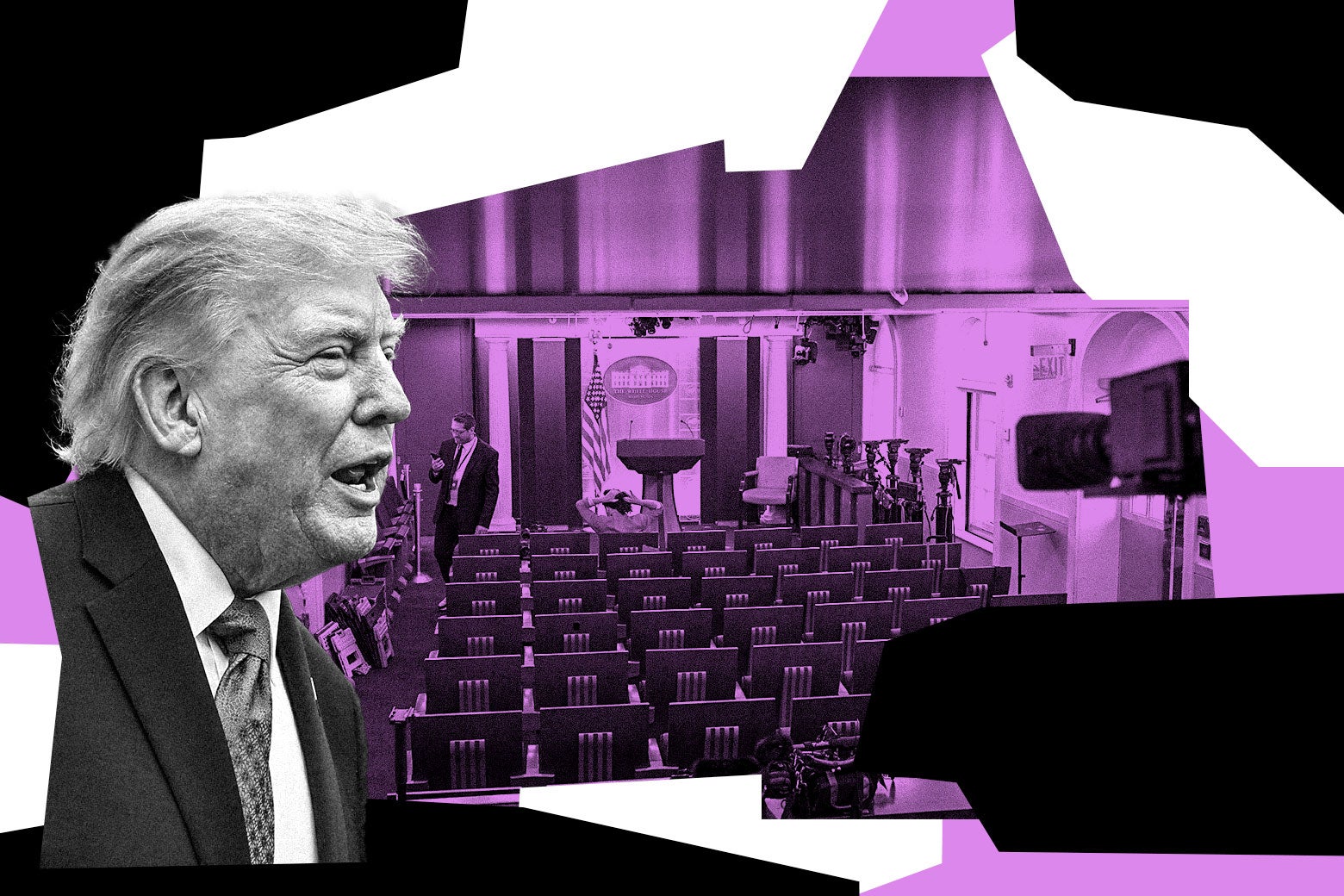
Jurisprudence Donald Trump’s attacks on the First Amendment have been relentless. Photo illustration by Slate. Photos by Oliver Contreras/AFP via Getty Images and Brendan Smialowski/AFP via Getty Images. Sign up for Executive Dysfunction, a weekly newsletter that highlights one under-the-radar story about how Trump is changing the law—or how the law is pushing back—and keeps you posted on the latest from Slate’s Jurisprudence team. This is the third in a series of articles, “Try, Try Again?,” drawn from my new book—Great and Dangerous Offences: The Case For (and Against) Impeaching Trump a Third Time—due out in early 2027. The speech, press, and assembly protections of the First Amendment are central pillars of our constitutional order. Without a robust press scrutinizing the workings of government, an unrestricted prerogative of speech including speech critical of government, and a right in the people to gather and voice their grievances to the state, a healthy democratic republic would be impossible. As the Supreme Court has held, the government may not “use the power of the State to punish or suppress disfavored expression.” Since returning to office in 2025, Donald Trump has mounted an accelerating assault on the First Amendment. He has aggressively and repeatedly sought to silence his personal and political critics in government, the media, academia, civil society groups, and the public at large, and to monopolize the flow of information to the American people. The famous constitutional phrase “Treason, Bribery, or other high Crimes and Misdemeanors,” which defines impeachable conduct, includes—as founder George Mason was at pains to emphasize—“attempts to subvert the Constitution.” Trump’s attack on the First Amendment is an attempt to subvert a cornerstone of the Constitution and is impeachable on that basis. Trump’s campaign has taken multiple forms: abuse of private litigation, use of federal regulatory power against media critics, abuse of federal regulatory authority to place media outlets under politically favorable ownership, exclusion of critical media outlets from access to public information and spaces, suppression of independent media voices within government, legal attacks by the government on individual regime critics, attacks by the Trump administration on law firms, and attacks on universities and academic researchers. Abuse of Private Civil Litigation Between Trump’s November 2022 announcement that he would run for reelection and late summer 2026, he filed a sequence of personal lawsuits against both traditional media outlets and social media companies like YouTube, Meta, and X. Trump sued a pollster for issuing allegedly false predictions about the 2024 election in Iowa, as well as the Des Moines Register for publishing the pollster’s findings. He even sued the board that awards Pulitzer Prizes because it conferred 2018 Pulitzers on the staffs of the New York Times and Washington Post for their reporting on Russian interference in the 2016 presidential election. The media defendants fought these cases, which most experts viewed as legally meritless. Then Trump won the 2024 election, and the implicit threats to use the retributive powers of the presidency against these outlets became more concrete. At this point, many outlets folded, paying Trump $117 million in settlements during 2025 alone. Last month, Trump threatened a new lawsuit, taking the intimidation campaign to a new level. On Aug. 16, a personal lawyer for Trump sent a letter to the Center for American Progress (a liberal think tank) threatening that Trump would sue the group if it did not retract and apologize for a report that concluded that Trump’s deployment of National Guard troops to cities around the country had little effect on reducing violent crime. Unlike Trump’s earlier lawsuits against the media, this threat lacked even the fig leaf of supposed defamation of Trump’s personal character. It was instead a straight-up threat to embroil a nonprofit organization in exhausting and expensive litigation because it had the temerity to study, analyze, and cast doubt on the efficacy of a Trump administration policy. The government cannot sue for defamation. Trump’s defenders might argue that he cannot be impeached for suits he filed in his personal capacity. But the use of private means to upend the constitutional order hardly absolves a president of responsibility. If Trump, before or after his reelection, had used his personal money to hire private thugs to beat up journalists and editors in retaliation for negative coverage, that conduct would certainly be impeachable. Moreover, a private lawsuit by even an as-yet-unelected presidential contender carries with it the implicit threat of official retaliation for an aggressive defense on the merits. The settlements secured after Trump’s election were plainly extorted under the implied threat of the exercise of official government power. All these cases are part of an unconstitutional campaign to suppress both reporting and speech critical of Trump and his government. Use of Federal Regulatory Authority Against Media Critics Since his return to the White House, Trump has used the power of the executive branch to intimidate media critics. Perhaps the most flagrant example is his campaign against ABC and NBC News. Trump has repeatedly called for ABC and NBC to lose their broadcasting licenses because he does not like their coverage of him. In August 2025, Trump said on social media that ABC and NBC were “two of the worst and most biased networks in history.” He went on to claim that 97 percent of the stories they broadcast about him were “BAD STORIES” and intimated that both were arms of the Democratic Party. He concluded that he was “totally in favor” of having “their licenses revoked by the FCC.” In September 2025, after ABC late-night host Jimmy Kimmel made remarks about the death of MAGA influencer Charlie Kirk of which Trump disapproved, he repeated the claim that unspecified networks were “97 percent against me” and said, “Maybe their license should be taken away.” In November 2025, after an ABC reporter asked Trump about the Jeffrey Epstein scandal, he said licenses of ABC broadcasting affiliates should be “taken away.” In December 2025, Trump posted on Truth Social that networks that “are almost 100% Negative to President Donald J. Trump, MAGA, and the Republican Party” should have their “very valuable Broadcast licenses … terminated.” In July 2026, Trump again called for the revocation of ABC’s and NBC’s licenses, this time because they elected not to carry a Trump speech. In April 2026, the Federal Communications Commission, headed by Trump appointee Brendan Carr, called for an early review of the broadcast licenses of all local stations owned by ABC, a step never before taken by the FCC. Carr’s actions, taken on Trump’s behalf, make the president impeachable. Exclusion of Media Representatives From Access to Public Information and Spaces The second Trump administration has from its inception attempted to exclude representatives of media outlets it deems unfriendly from access to information and from government spaces. Last week, Trump decreed that reporters from MS NOW, CNN, and Politico could no longer enter the White House grounds. Trump unapologetically characterized the move as a “ban on the free press.” Though by no means the worst of Trump’s offenses against a free press, this and similar orders are unconstitutional standing alone and constitute parts of Trump’s autocratic scheme of information control. Abuse of Government Regulatory Authority to Place Media Outlets Under Ownership Politically Aligned With Trump Trump and his administration have waived or bent normal application of antitrust laws to approve takeovers of significant media outlets by Trump allies. The most recent instance of this behavior is the sequence of mergers begun in 2025 when Skydance Media and Paramount Global merged to form a new conglomerate led by CEO David Ellison, son of billionaire Larry Ellison. Both Ellisons are political allies and big-money backers of Trump. Despite the evident anticompetitive effects of the union, Trump’s FCC approved it. The newly created Paramount-Skydance behemoth is now trying to take over Warner Bros. Discovery. Once again, the Trump administration is offering no opposition; in June 2026, the Justice Department’s Antitrust Division gave its approval. Should this deal go through, a single company closely allied with Trump and the Republican Party would control CBS News and CNN, along with 28 local CBS television licenses in some of the country’s largest markets, plus two of Hollywood’s biggest studios and streaming platforms. Suppression of Independent Media Voices Within Government Most media organizations attacked by Trump have been outside the government. However, he has also sought to kneecap or muzzle government-supported media with track records of honest reporting—the U.S. Agency for Global Media and its outlets Voice of America, Radio Free Europe, Radio Liberty, the Office of Cuba Broadcasting, and Radio Free Asia, as well as the Stars and Stripes newspaper for the military. All of these are formally associated with the federal government, but all are the beneficiaries of congressionally enacted guarantees of substantial reportorial and editorial independence. During Trump’s time out of office, the drafters of Project 2025 declared that the USAGM should abandon “so-called journalistic independence” or be “defunded and disestablished.” Immediately following Trump’s second inauguration, he fired six of the seven members of the International Broadcasting Advisory Board, established by Congress in 2020 in response to Trump’s failed first-term efforts to politicize the USAGM. On March 14, 2025, Trump issued an executive order directing that the USAGM “be eliminated to the maximum extent consistent with applicable law.” The VOA and its sister outlets are not yet dead. But the vast majority of USAGM staff has been fired or placed on leave, with its outlets either silenced or reduced to faint echoes of their former selves. As one remaining staffer is reported to have said, “Now we’re just rewriting press releases from the Administration.” A similar tragedy has played out at the Stars and Stripes, the newspaper for U.S. military personnel first published during the Civil War. The paper is partially funded by congressional appropriations and has a long tradition of reporting stories and perspectives unflattering to administration policy and the military brass. To protect its independence, Congress, in the 1991 national Defense Appropriations Act, created the office of ombudsman at the paper. In April 2026, Trump Secretary of Defense Pete Hegseth fired Stars and Stripes ombudsman Jacqueline Smith. The firing followed a January social media post from Defense Department spokesman Sean Parnell declaring that the paper would be “modernize[d]” and its content “refocus[ed] away from woke distractions that syphon morale.” In August, the Pentagon fired the paper’s publisher, its editor, and a longtime reporter, evidently for defending the publication’s tradition of independence from the military command structure. Legal Attacks by the Government on Individual Regime Critics The Trump DOJ has ordered that investigations be launched and indictments brought against Trump “enemies,” such as former FBI Director James Comey and New York Attorney General Letitia James, despite little or no evidence of indictable crime. The second of two cases against Comey alleged that he made a criminal threat against Trump by posting photographs of seashells arranged on a beach. Trump openly proclaimed that these actions were retribution for his supposed wrongs. The D.C. U.S. attorney’s office tried (and failed) to indict six members of Congress for posting a video reminding members of the military of their obligation to refuse illegal orders. The Justice Department has also commenced criminal investigations into many other Trump “enemies.” To be sure, all these phony investigations are abuses of the rule of law (and separately impeachable on that ground), but they are also direct attacks on the First Amendment. Back at the White House, Trump set the stage for further weaponization of federal law enforcement against critics and supposed ideological opponents. In a September 2025 memorandum (dubbed NSPM-7), Trump sought to suppress First Amendment–protected freedom of speech by characterizing political opponents—those who espouse “anti-Americanism, anti-capitalism, and anti-Christianity; support for the overthrow of the United States Government; extremism on migration, race, and gender; and hostility towards those who hold traditional American views on family, religion, and morality”—as “terrorists” subject to criminal investigation and prosecution. The administration has now created something called the NSPM-7 Joint Mission Center, staffed from agents across the government specifically tasked with operationalizing Trump’s directive by tracking dissent and, one can only assume, referring matters for prosecution or other law enforcement action. The plain objective is to punish and suppress political speech, the activity at the core of the First Amendment. Legal Attacks by the Trump Administration on Law Firms Since returning to office, Trump has signed a series of executive orders imposing sanctions and disabilities on major law firms that in the past represented persons or causes of which Trump disapproved. The sanctions included denial of security clearances to firm attorneys necessary to work on litigation involving the government, denial of access to government buildings, bans on hiring law firm employees, and termination of contracts for legal representation. The supposed sins of the law firms included such things as representing Hillary Clinton and being involved in election law litigation, as well as representation of clients involved in litigation over transgender issues and immigration restrictions. Nine of the firms targeted by Trump have entered settlements to avoid adverse effects on their businesses. However, others sued to block implementation of Trump’s orders, maintaining that they violated constitutional rights to free speech and counsel, the separation of powers, and the due process of law. All the firms who sued to block Trump’s attack on lawyers who represent people and ideas he deplores have won. The capitulation of the cowardly does not alter the fact that the assault represents another solid component of a case for impeachment based on violation of the First Amendment. Attacks on Universities and Academic Researchers The Trump administration has engaged in a wide-ranging assault on American universities and colleges based on their perceived liberal orientation. Trump threatened funding cuts and other actions against universities that allow what he called “illegal protests,” by which he seems to have meant any demonstration favoring the rights of Palestinians and protesting the conduct of Israel in Gaza and the West Bank. These threats implicate the First Amendment’s protection of freedom of assembly as well as of freedom of speech. Although some institutions have capitulated and entered settlements with the administration to avoid debilitating funding cuts, others, like Harvard and the University of California, have fought back in the courts, securing rulings finding the Trump administration in violation of the First Amendment, the 10th Amendment, the Civil Rights Act, and the Administrative Procedure Act. Trump immigration officials have also attempted to deport students and others who protested on campuses in support of Palestinians or against Israel’s conduct of the war in Gaza. Judges in both Massachusetts and California have found these deportation efforts to violate the First Amendment. All presidents wrangle with their critics in and out of the press. Some presidents have taken steps to restrict or burden critical or disagreeable speech. But Trump is unique in American history in that he is systematically and intentionally employing every tool made available by his own vast wealth and his command of the executive branch to suppress dissent and reorient the American information sphere to favor him and his allies. In so doing, he is actively attempting to undercut a bedrock principle of our political system embodied in the first, and most important, amendment to the Constitution. This is an impeachable offense. Donald Trump Impeachment Jurisprudence Try, Try Again?
Trump’s White House Press Ban, Other Attacks on Free Speech Are Impeachable
Full Article
Original Source
Read the full article at Slate →KhanList aggregates and links to publicly available news content. We do not host full articles from third-party sources. Always verify important information with original sources.