
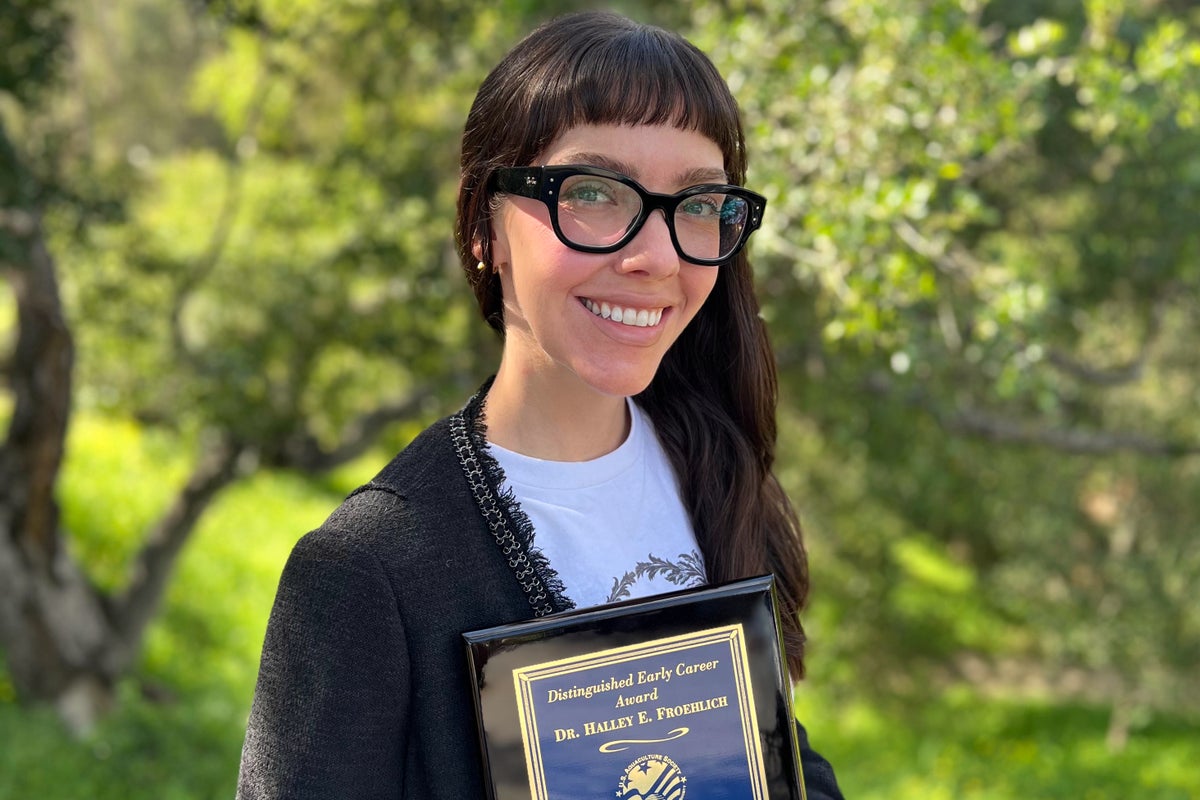
Halley Froehlich never expected to leave the United States, where her family lineage stretches back to the 1700s, to pursue her scientific career. Yet, faced with stalled federal grants and growing uncertainty over the country's research environment, she packed her life into boxes and relocated to Finland alongside her husband and daughter. She now studies how climate change affects edible fish, shellfish, and seaweed at the University of Helsinki.Her departure reflects a wider trend. When the Trump administration began reshaping the American scientific sector last year by altering the federal grant distribution process and seeking greater political influence over funded projects, foreign academic institutions recognized an opportunity. This photo, provided by Halley Froehlich, shows Froehlich holding a U.S. Aquaculture Society award in Santa Barbara (Halley Froehlich)Many introduced dedicated schemes designed to entice U.S.-based scholars by offering stable financial support and academic freedom.A growing number of academics have accepted these international offers. Though comprehensive nationwide data remains difficult to aggregate, university officials, researchers, and professional associations describe the ongoing shift as clear, unprecedented, and concerning."You can almost talk to any vice president for research at a university and they will tell you of one or two top faculty that they’ve lost," said Tobin Smith, senior vice president of government relations and public policy for the Association of American Universities.White House spokesperson Liz Huston said Trump is "ending waste" and is "committed to keeping America the world leader in scientific innovation, and that means funding real science."When the Trump administration began upending U.S. scientific research last year, dismantling the federal grant-giving process and attempting to exert more political influence over what projects get funded, foreign universities saw an opportunity (Getty)Despite those assurances, an April report from the Business for Federal Research Funding Coalition revealed that more than half of U.S. states have lost scientists to recruitment programs in other countries. Survey data from last March indicated that early-career biomedical scientists were about 20 percentage points less likely to say they wanted to stay in the U.S. "now" than they did six months earlier. Furthermore, figures from the American Institute of Physics show that physics Ph.D. graduates in 2025 departed the U.S. at the highest rate observed in 30 years.Institutions in nations such as Canada, France, Belgium, and Finland are publicly advertising their success in drawing scholars from U.S. organizations. For a country that far and away leads the world in Nobel prizes for medicine, physics, and chemistry, researchers view this as a disturbing and surprising development."It used to be the shining city on the hill where we all want to go," said Christine Stawitz, now at the University of Birmingham in England. "That reputational loss, I think, is hard to quantify, but also really damaging."Immigrants have historically won 40% of U.S. Nobel Prizes in science (Reuters)Stawitz stepped down from her job at the U.S. National Oceanic and Atmospheric Administration last year to become a research software engineer in the United Kingdom. She noted that NOAA no longer aligned with her values, particularly after receiving directives to strip websites of references to climate change and diversity, equity and inclusion topics.She added that the state of American science has become a recurring topic of conversation at international gatherings. "People talk about the U.S. at conferences in the U.K. now like, I don't know what's going on there. It's not good," she said.For Froehlich, the choice to relocate developed over time. Already concerned by issues surrounding school safety and gun violence in the U.S., she watched as the national research landscape was overturned. At the University of California, Santa Barbara, grant postponements and cancellations left colleagues struggling and student researchers in tears. Doubts regarding future federal backing for her climate-focused research mounted."The cumulative effect of those things ultimately ended up making us really serious about, I don’t think here is our home anymore," said Froehlich. Director of the U.S. Office of Management and Budget Russell Vought (L) attends a Columbus Day event in the East Room of the White House (Getty)She ultimately accepted an offer through an initiative by the Research Council of Finland, securing five years of guaranteed funding totaling about $3 million. She moved into a flat by the Baltic Sea in Helsinki and is taking university-sponsored Finnish lessons.Foreign researchers who were drawn to the U.S. for its reputation as a global leader in science are also seeking different places to do their work.Married biologists James Letts, who is Canadian, and Maria Maldonado, who is Argentinian, left their academic positions at the University of California, Davis to join Australia's Monash University. Both earned their doctoral degrees in New York and spent over a decade doing science in the U.S.Grant-related uncertainty—including laying off a staff scientist while waiting for stalled funding—motivated them to make the move."All I want to do is do great science and make discoveries, but I want my work to mean something as well. And the opportunity to do that seemed very difficult in the U.S.," Letts said.Immigrants have historically won 40 percent of the U.S. science Nobel Prizes. However, Omar Yaghi, a 2025 Nobel Prize winner for chemistry, departed his position at the University of California, Berkeley this year to direct an artificial intelligence lab at China’s Tsinghua University.The U.S. remains a science powerhouse, full of institutions with robust research communities and well-resourced facilities that attract foreign talent. The Trump administration has cut or frozen up to $174 billion in federal grants since the president's second term began (AP)Even if every European country threw open its doors, there still would not be enough capacity to accommodate every American scientist. Many researchers are choosing to stay, searching for new sources of funding or pivoting to industry positions.Nevertheless, concerns persist regarding the ongoing erosion of reputation and talent. The Trump administration has cut or frozen up to $174 billion in federal grants since the president's second term began, according to tracking data compiled by the States United Democracy Center and Grant Witness. Additionally, a proposed rule from the Office of Management and Budget could accord political appointees more control over which future projects are funded, though a resolution approved by Congress has delayed a final decision on the rule until December.Scientists who have moved away and those remaining in the U.S. are worried about what lies ahead. They warn that the next generation of scientists may face fewer graduate programs, diminished funding, and reduced mentorship—effects that could take a decade or longer for the U.S. scientific enterprise to fully feel.Major research institutions accepted 15% fewer applicants for fall 2026 doctoral programs compared to last year, according to admissions data collected by the Association of American Universities. One of the impacted students was a mentee of Smith's."What is one of my pieces of advice to that young man? Next year, look in Canada," he said.
Trump’s war on science sparks American brain drain as top researchers flee overseas
Full Article
Original Source
Read the full article at Independent →KhanList aggregates and links to publicly available news content. We do not host full articles from third-party sources. Always verify important information with original sources.