
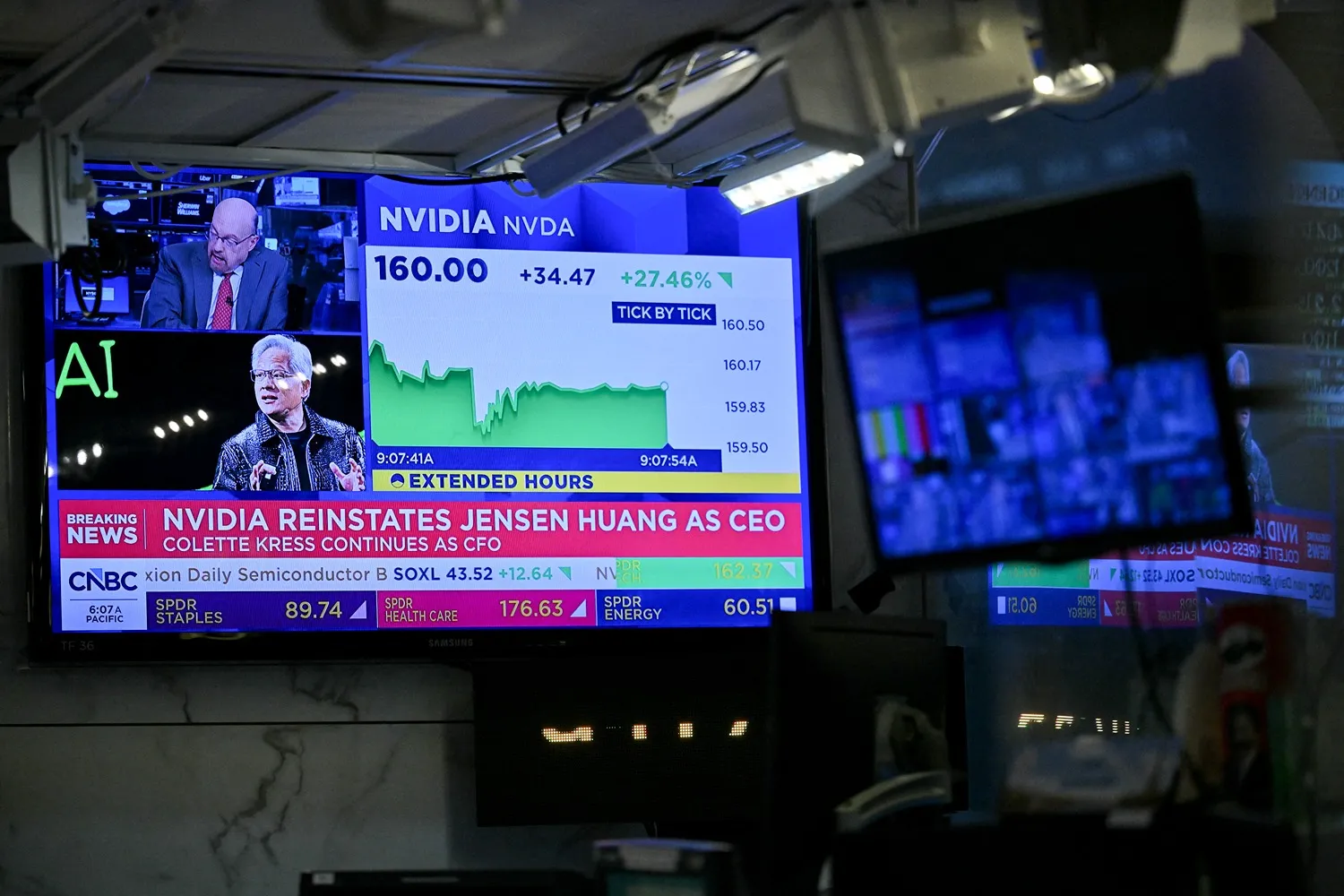
Jensen Huang was reinstated this week as CEO of Nvidia, a semiconductor manufacturer that’s a linchpin of the global artificial intelligence economy. That occurred only after U.S. President Donald Trump personally intervened to persuade Nvidia’s board—despite allegations that Huang’s affair with an alleged Chinese spy, and his efforts to sell Nvidia’s chips to China in contravention of U.S. policy, may have undermined U.S. national security. Was Huang’s reinstatement initiated by Silicon Valley or D.C. elites? What levers did Trump use to pressure Nvidia’s board? Does Huang, or Nvidia more generally, qualify as “too big to fail”? Jensen Huang was reinstated this week as CEO of Nvidia, a semiconductor manufacturer that’s a linchpin of the global artificial intelligence economy. That occurred only after U.S. President Donald Trump personally intervened to persuade Nvidia’s board—despite allegations that Huang’s affair with an alleged Chinese spy, and his efforts to sell Nvidia’s chips to China in contravention of U.S. policy, may have undermined U.S. national security. Was Huang’s reinstatement initiated by Silicon Valley or D.C. elites? What levers did Trump use to pressure Nvidia’s board? Does Huang, or Nvidia more generally, qualify as “too big to fail”? Those are just a few of the questions that came up in my recent conversation with FP economics columnist Adam Tooze on the podcast we co-host, Ones and Tooze. What follows is an excerpt, edited for length and clarity. For the full conversation, look for Ones and Tooze wherever you get your podcasts. And check out Adam’s Substack newsletter. Cameron Abadi: Was Huang’s reinstatement initiated by Silicon Valley tech elites or by D.C. political elites—or an entwinement between the two? Adam Tooze: Some reporting suggests that the rally around Huang really began in Silicon Valley itself. So it was a key group of people who were close to him: Uber founder Travis Kalanick, a bunch of venture capitalists like Gavin Baker, who’s been tweeting very effusively about this, Brad Gerstner and Marc Andreessen, who we’ve discussed on the show before. Heavy hitters. Apparently, there’s some Goldman Sachs interest as well. None of those people have really been willing to comment. But there was a rallying around Jensen Huang and the need to bring him back in. I think, basically, it was a combination of their influence plus a sell-off in the market that really prompted Trump to act. The venture capitalists have good connections to [Vice President] J.D. Vance, because he had that little foray in Silicon Valley finance by way of Peter Thiel. And they seem to then have been able to act on figures inside the Trump administration. Jensen Huang is, after all, very well known to Trump. The two have been seen together a lot in public. And then there was some last-minute fig leaf-style conversations with the attorney general just to confirm that they’re not actually supporting a figure that is currently under investigation by the American judicial authorities. So apparently the attorney general, Todd Blanche, signed off on this. And that was really then the decisive moment when Trump then intervened with the board, which seems to be a remarkably weak institution. For a company of Nvidia’s size and significance, its corporate governance is schoolyard. It comes out of the era when it was a scrappy manufacturer of accelerator chips for video games rather than the biggest company in the world and the backstop to AI. So it seems to just be this incredible kind of jury-rigged, duct tape—you know, people refer to duct-tape empire—kind of setup that we’re dealing with here. And truly dramatic in its impact then on the market, though questions are being asked, I think, about how long the rebound can really last given the underlying questions about AI and the broader economy. CA: What are the mechanics by which a leader of the U.S. government overrides a corporate board? And are there any precedents for a U.S. president personally intervening in a boardroom decision like this? AT: I don’t think he has very many direct levers, other than his public sway. As corporate America has demonstrated across the board during his second term, no one wants to be on his wrong side. So if he told this weak corporate governance body at Nvidia that, you know, this is the way to go, and there really were no legal objections, at least at the level of espionage, then presumably they felt it was in the shareholders’ best interest to just do as they were told. It’s not entirely without precedent. The most recent instance would be the Obama administration’s move against the leadership of General Motors in the spring of 2009 when the federal government did a bailout for General Motors. And they removed Rick Wagoner, who they didn’t feel that they could work with. Then beyond that, you have to go further back in history to the Cold War-era presidencies. So there’s action by the [Franklin] Roosevelt administration against the Ford Motor Company leadership when they were deeply worried during the wartime about the succession of Henry Ford and deaths within the Ford family. There’s Truman intervening in the steel industry in the early 1950s. There’s a moment when Kennedy also intervenes at U.S. Steel in ’62. But, you know, the fundamental difference here is that we’re not in a state of war. This is not a matter of urgent national security or of macroeconomic pressure like in the early 1950s during the Korean War. This isn’t the aftermath of the 2008 financial crisis. Nvidia is not on the receiving end of a federal government bailout. You know, the analogies quite rapidly break down and leave one feeling that in some senses, this truly is an unprecedented intervention. This is the most valuable company in the world at various points. And it just basically doesn’t appear to have any serious corporate governance whatsoever. CA: The intervention on behalf of Jensen Huang seemed to be motivated by a sense that he was somehow essential, not only to the success of the company, but through the company, to the success of the American economy overall. In what sense could Huang be considered to be “too big to fail”? AT: Well, that term comes out of banking. And within the banking sector, since the Dodd-Frank reforms and other global financial stability reforms in the aftermath of 2008, designations as GSIB, so globally systemically significant banks and financial institutions, are formalized and have been formalized. And they do actually have a relatively formal or quantitative definition. I mean, you can look at bank balance sheets and just trace networks of interconnection and risks that arise from those. And there’s a quite serious study of those kinds of risks. And one could do the same for Nvidia. And there has been a great deal of speculation along these lines, or not just speculation, but investigation. And it’s quite clear that the circular financing mechanisms that we’ve also discussed on the show going back awhile now all center on Nvidia. And so questions have been asked about the stability of the Nvidia financing structure. But I think the question was always, should they not be subject to some kind of oversight? Right now, there is no risk of failure, right? In some senses this invocation of failure in the worst-case scenario—you know, she’s a spy and Nvidia is going to fail and therefore, you know, we must do x or y, or not do x or y, or bring him back or shove him out or whatever—the whole discourse is massively exaggerated. I mean, they’re a very successful tech business, which right now is in the middle of a boom in AI, which does have some bubble characteristics. But the financing of this is extended and ramified, but it’s the cloud providers, not necessarily Nvidia, that anyone thought of as being immediately in trouble. And even those are some way away from outright failure. And so this, you know, this language of exigency and this language of crisis, you know, it has a historical root and there are some structural reasons why one might worry about Nvidia, but it doesn’t justify the current action one way or the other. And the fact that the company is as poorly structured as it is such that so much revolves around one man is prima-facie reason for, you know, some serious rethinking and some serious structural governance. But that would require market pressure. And you know, the financial markets right now are bonkers. That they would reprice the company by 30 percent of a trillion dollars on the basis of this kind of news is, in itself, you know, profoundly delegitimizing. So to my mind, like, it’s an absolute disaster of American public discourse, because the allegations appear to be hugely exaggerated, the damage done to the market suggests that the corporate governance is terrible, the reporting by the American media has been shambolic, the president’s intervention is unprecedented and bonkers, and now the markets vindicate the whole thing by raising the value of Nvidia by 30 percent. I mean, it feels like everyone’s kind of lost their minds in some ways. And yet, as someone famously said, whilst the music plays, you dance. Because if you’re not on the Nvidia train, you’re not doing as well as other people. And all of these boosters are saying this is a vindication of the American success story and Jensen Huang is the latest character in that ongoing narrative. It all feels a bit delirious, to be honest.
Trump’s ‘Unprecedented Intervention’ in Nvidia
Full Article
Original Source
Read the full article at Foreignpolicy →KhanList aggregates and links to publicly available news content. We do not host full articles from third-party sources. Always verify important information with original sources.