
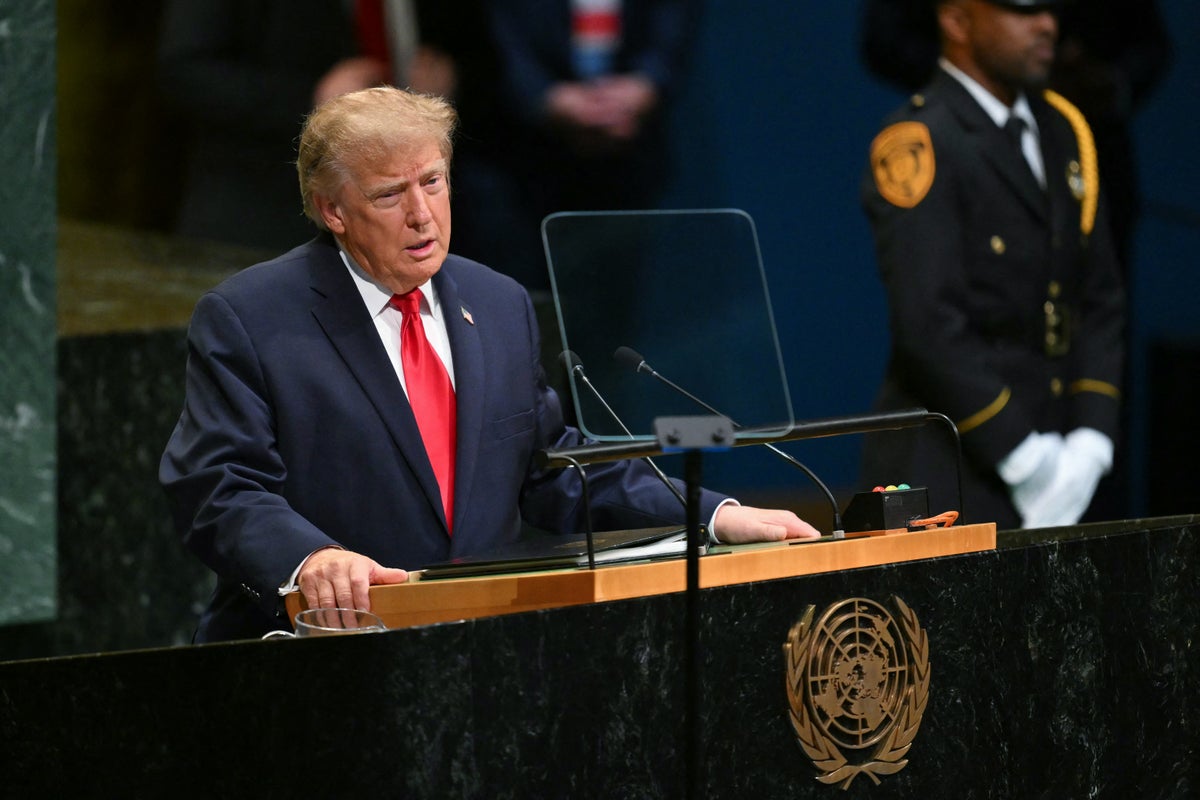
Nobody had high hopes for Trump’s speech at the UN General Assembly, and as the president ambled out to the lectern and tiredly began ranting about how “I can report to you with pride that America is back and our country is better than ever before,” most diplomats and journalists alike settled in for a proto-rally. The vintage Trumpian claims came thick and fast. “Our economy is the envy of the world,” he told the gathered world leaders, who looked decidedly unenvious. “We are leading in virtually everything,” he added, as though the prime ministers and presidents of Canada and France and the U.K. and South Korea were actually going to applaud it, much less believe it.It took less than five minutes for Trump to get into his own personal achievements: how many jobs he took credit for creating, how Washington, D.C., has “bustling restaurants” again, how “I sent our crime-busters into Memphis, Tennessee and New Orleans, Louisiana.” The previous administration got a kick in the pants from him, of course, during a long aside that ended with: “Two years ago, our country was dead, and now we have the hottest country in the world.” The childish word choice felt strange and out-of-place among the pomp and ceremony of the flag-draped United Nations building, the gathered leaders with their interpreter headphones, the seriousness of the occasion. But who cares about that, because America is risen from the dead and hot as hell — a steaming, boiling reanimated corpse! Hell yeah!Or perhaps we might’ve said, “hell yeah,” if only the president hadn’t looked like he was about to fall asleep.It took less than five minutes for President Donald Trump to get into his own personal achievements as he spoke before the UN General Assembly in New York Tuesday (AFP/Getty)Needless to say, turning up to the UNGA to boast about having “the hottest country in the world” is a bit like turning up the PTA to boast about how, in your unbiased opinion, your kid is the cleverest kid in the school, but emotional intelligence has never been one of Donald’s strong points. Superintelligence, however, was absolutely on the agenda — and that’s the new word for AI, by the way, which the president announced in a roundabout way during a conspiracy-laden couple of paragraphs about globalism.Evil people have tried to “construct a globalist scheme” to control AI, the president said, which by the way isn’t even called AI now because he’s “changing the name” to super intelligence. “In other words,” he added, “welcome to the new world of super intelligence — SI.” He said the “dash” part out loud, presumably reading too faithfully from the piece of paper in front of him.There was no explanation provided for why we’re now supposed to call the technology SI instead of AI; or rather, the only explanation Trump offered was “Let’s see if I have any power. Maybe I do and maybe I don’t.” Unfortunately, even he didn’t seem entirely comfortable with the new label, later adding that “whoever wins AI, you have to remember — uh, whoever wins SI” will lead the world. And by the way, “we’re leading over China by a lot and everyone else… We’re going to keep it very straight and very strong.”This ramble about AI/SI was punctuated by occasional nods to a “Ukraine hoax,” climate change, “open borders” and “transgender mutilization,” a strange combination of both mangled English and uneasy bedfellows that were presumably mentioned because they comprise the Republicans’ midterms attack strategy. But at the UN, the whole thing seemed like word soup. Slipping in transgender culture wars points while talking about keeping AI “very straight” gave the bizarre impression that he was hoping to keep the coming super intelligence revolution heterosexual.On the side of the word soup came the regular stuff about how faceless bureaucrats and their grand conspiracies will never stop America (these include the “evil” globalists of the International Criminal Court who conduct “show trials by an anti-American tribunal”, activists seeking a carbon tax, and UNESCO) and promises that he won’t bring in any regulation on AI — sorry, SI — because that would “stifle growth.”Trump took time out to praise first lady Melania Trump’s global children’s efforts for a moment of applause on the world stage that relied largely on members of his cabinet for the actual clapping (Reuters)In between, we were treated to a too-long, surprisingly gushing bit about Melania, where he paused for applause once and then tried unsuccessfully to get the room to applaud again. In this way, Trump’s speech trundled on, ending around 45 minutes in, which is short by the standards of his usual efforts. It had the flavor of a State of the Union speech, although he did stop to thank the UN Security Council twice for some resolutions that had gone his way in the past year. He offered up some fairly subdued words about Gaza, for which he thanked the gathered countries for helping usher through America’s peace plan.There was only one moment which drew sharp intakes of breath, and that was when he mentioned Iran. “They were the bully of the Middle East but they’re the bully no more,” he began, which was fairly standard; he then boasted a little about military triumphs and pointed out that Iran is now suffering from out-of-control inflation. But now, the president intimated, “I have a big decision to make. Will a deal be made with Iran” that would make them “one of the greatest countries in the world”? He paused for effect, before taking a suddenly dark turn: “Or do I annihilate the Islamic Republic, and do it quickly?”As the gathered heads of state took stock of this wording, Trump added, “Do I drive them to hell with no chance of survival?” and murmurs started up in the room.“They’re waiting to see how I do in the midterm elections,” the president claimed of Iran, as if what’s top-of-mind for him might be top-of-mind for another country that’s being summarily decimated. He quickly added another revealing tidbit: “The Republican party is running… but I am not running.” And anyway, “the cowards and traitors love to say ‘The United States is low on munitions’ but that’s not true.” He did a funny voice for the cowards and the traitors.It was a strange digression, from which the U.S. president then moved swiftly on and returned to what passes for statesmanlike when it’s him talking: he thanked the UN a couple of times, he didn’t threaten the organization with its own destruction, and he didn’t belligerently storm through an hour and a half of extra content. He seemed tired throughout; he gripped the lectern, leaned on it at times, and his energy seemed to be ebbing even at the beginning. He called out Mark Rutte by name, but seemed to be aware that he was not especially among friends.The fact that he was not as combative as he could have been seems to imply that he’s realized he needs more allies. Approval of the war in Iran is at an all-time low, with Republicans in particular getting sick of the conflict and nobody buying the “I wouldn’t call it a war” rhetoric currently popular among Trump administration officials. The midterms are just around the corner, little more than six weeks away, and the president is already distancing himself from the results and the people who are running in them. Efforts to redefine words as an exercise in ego-stroking are perhaps interesting to psychologists but uninteresting to anyone who actually wants to talk about AI and what it might do to the planet. They’re about as useful as renaming Lake Ontario and about as popular as the “Gulf of America”.In other words, the bar is on the floor for Donald Trump. And so, considering the expectations, he didn’t entirely alienate people today. He also looked — under the bombast and the boasting, dredged up from clearly diminishing reserves of enthusiasm and verve — like he might, just might, be running scared.
Trump’s UN speech went from campaigning to denial — and then it took a dark turn
Full Article
Original Source
Read the full article at Independent →KhanList aggregates and links to publicly available news content. We do not host full articles from third-party sources. Always verify important information with original sources.