
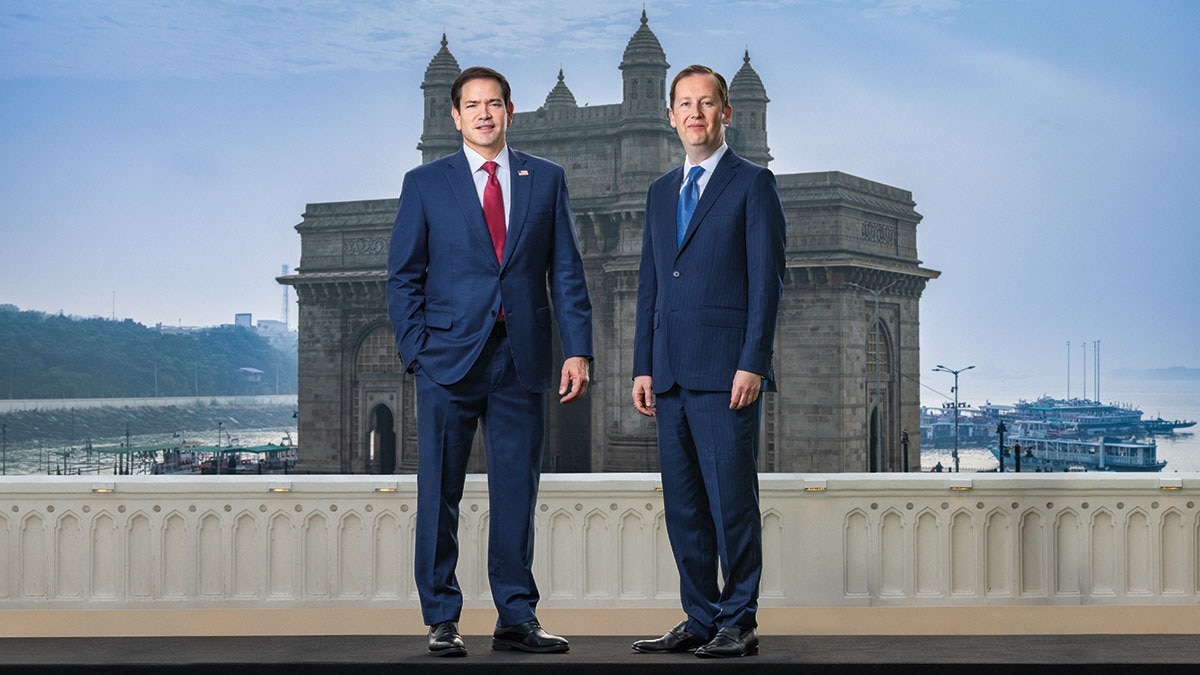
US Secretary of State Marco Rubio and US Ambassador Sergio Gor discuss the trade, energy, defence, tech and immigration imperatives that make the India-US relationship a crucial one(Photograph by Bandeep Singh)ISSUE DATE: Nov 2, 2026 | Oct 24, 2026 15:28 ISTThe setting carried its own message. At the Taj Mahal Palace hotel in Mumbai, the epicentre of the 26/11 attacks, US Secretary of State, Marco Rubio, and Ambassador to India, Sergio Gor, sat down together for an exclusive joint interview with india today. They are the two most important faces representing President Donald Trump’s administration to the region. Rubio, who is also National Security Advisor, is the administration’s seniormost foreign policy hand. This was his second visit to India this year. Gor, a long-time Trump confidant, ran White House personnel before being sent to New Delhi with a brief to bring “the highest levels of our government” to India.Their task is repair work. The ambitions of the February 2025 Modi-Trump summit—with its $500 billion (Rs 47.3 lakh crore) trade target, a 10-year defence framework and a clutch of initiatives on tech, critical minerals and AI—had soon been buried under a pile of grievances. These included a punitive 50 per cent tariff, penalties for buying Russian oil, Trump’s repeated claims to have brokered the India-Pakistan ceasefire, Washington warming to Pakistan Field Marshal Asim Munir, and a $100,000 (Rs 95 lakh) fee on new H-1B visas that hurts Indians the most. A February 2026 interim trade agreement cut the tariff to 18 per cent, and a US Supreme Court ruling later forced a reset of the baseline to 10 per cent. Yet the trade deal is still unsigned, and Trump has only now waived provisions of the Sanctioning Russia and Iran Act, which gives him powers to impose tariffs of up to 100 per cent on buyers of Russian and Iranian oil. It is against this backdrop that Trump’s two principal troubleshooters arrived in Mumbai. A WARM WELCOME: Rubio meets foreign minister S. Jaishankar at the Taj Mahal Palace hotel, Mumbai, Oct. 20. (Photo: Reuters) Asked to rate US-India ties on a scale of one to 10, Rubio declined to give a number. “In five years,” he said, “we’ll look back and say it’s one of the strongest relationships in the world.” That forecast frames everything that followed. Set aside the diplomatic courtesies, and the interview shows an administration that has quietly moved from coercing India to courting it on commerce. The clearest sign of a thaw came on trade, which has caused the most damage to bilateral confidence. Asked whether Washington was prepared to give India the competitive tariff advantage it sought, Rubio indicated that the long-awaited interim agreement was almost done.More revealing was the Secretary of State’s response to India’s concerns about recurring tariff revisions. The purpose of an agreement, Rubio said, was to establish certainty, allowing businesses to invest, knowing the rules governing bilateral commerce. It’s an important shift in emphasis. The earlier American approach had relied heavily on tariffs as leverage to extract concessions. Rubio was now stressing predictability as the foundation of a sustainable economic partnership. Gor, meanwhile, reinforced the economic argument by pointing to the expanding two-way investment relationship. He cited Essar’s multibillion-dollar investment plans in the US and the presence of American technology companies in India. The message was unmistakable: the Trump administration wants a relationship that creates jobs and industrial capacity in both countries. Investment, not just trade volumes, is increasingly becoming an important measure of the relationship’s success.An even more consequential adjustment appears to be under way in energy policy. For months, India’s purchases of discounted Russian crude had been a major irritant. Washington viewed the purchases through the prism of its efforts to pressure Moscow over Ukraine. New Delhi countered that affordable and reliable energy was a national necessity, especially for an economy serving more than 1.4 billion people. The Iran conflict and disruptions to shipping through the Strait of Hormuz and Red Sea have dramatically altered that calculation. With global energy supplies under pressure, Washington has temporarily relaxed certain restrictions affecting Russian oil flows, mainly because rising diesel prices could affect the Republican Party’s chances in the US mid-term polls. Rubio’s explanation was strikingly pragmatic. American foreign policy, he argued, had to consider the global economic consequences of its decisions rather than judge every issue through the lens of a single conflict. More importantly, he reframed Washington’s expectations of India. The objective was no longer to make India buy less Russian crude. It was to encourage India to buy more American, Venezuelan and other western hemisphere oil. He even acknowledged that India’s efforts to diversify its energy portfolio were driven by its own interests, rather than American threats.There is a critical qualification, though. Rubio did not offer India a permanent exemption from Russian oil sanctions. The temporary relaxation reflects the pressures of an extraordinary global energy situation. His visit to Reliance’s Jamnagar refinery fitted directly into this emerging strategy. Rubio praised the facility’s scale and sophistication and linked it to Reliance’s investment in refining capacity at Brownsville, Texas, which he hoped would be operational by 2029.A BALANCING ACTOn Pakistan, the limits of Washington’s accommodation were more evident. Islamabad’s military leadership has regained its diplomatic relevance in Washington, particularly with its role in regional diplomacy involving Iran. For India, which has long sought to predicate its strategic partnership with America on a clearer gap in the latter’s bilateral ties with Pakistan, this renewed engagement is unsettling. Rubio sought to reassure New Delhi, but without retreating from US policy. “In no way does the relationship with Pakistan come at the expense of our relationship with India,” he said. He argued that engagement with Islamabad increased Washington’s ability to influence Pakistani decisions, while emphasising that the US shared India’s concerns about terrorism.On defence, Gor emphasised continuity, pointing to the presence of US manufacturers such as Lockheed Martin and Boeing in India, ongoing co-production, joint military exercises and the participation of advanced American aircraft in exercises with Indian forces. His argument was that defence cooperation had already moved far beyond a conventional buyer-seller relationship. Joint training and industrial partnerships were creating a level of familiarity and trust that would have been difficult to imagine two decades ago. Yet it’s still shy of India’s central demand of deeper technology transfer and genuine joint development.The more substantial strategic issues concerned the Quad grouping. Rubio identified secure supply chains as a central objective. But rather than explicitly framing the initiative as a campaign against China, he argued that neither India nor America should depend excessively on any single country for critical products and technologies.The sharpest reminder that national interests still diverge came over H-1B visas and skilled immigration. The Trump administration’s higher visa costs and tighter restrictions have created considerable anxiety among Indian workers, employers and students. Asked how America could seek closer technology cooperation while making it harder for Indian professionals to work there, Rubio offered no special dispensation. The changes, he insisted, were global rather than directed against India.The larger significance of the india today interview lies in what it reveals about the changing terms of India-US engagement. The relationship is no longer sustained simply by shared strategic aspirations or the personal friendship between its leaders. Increasingly, it is being judged by whether the two sides can deliver tangible benefits to each other.- Ends
Trump's troubleshooters
Full Article
Original Source
Read the full article at Indiatoday →KhanList aggregates and links to publicly available news content. We do not host full articles from third-party sources. Always verify important information with original sources.