
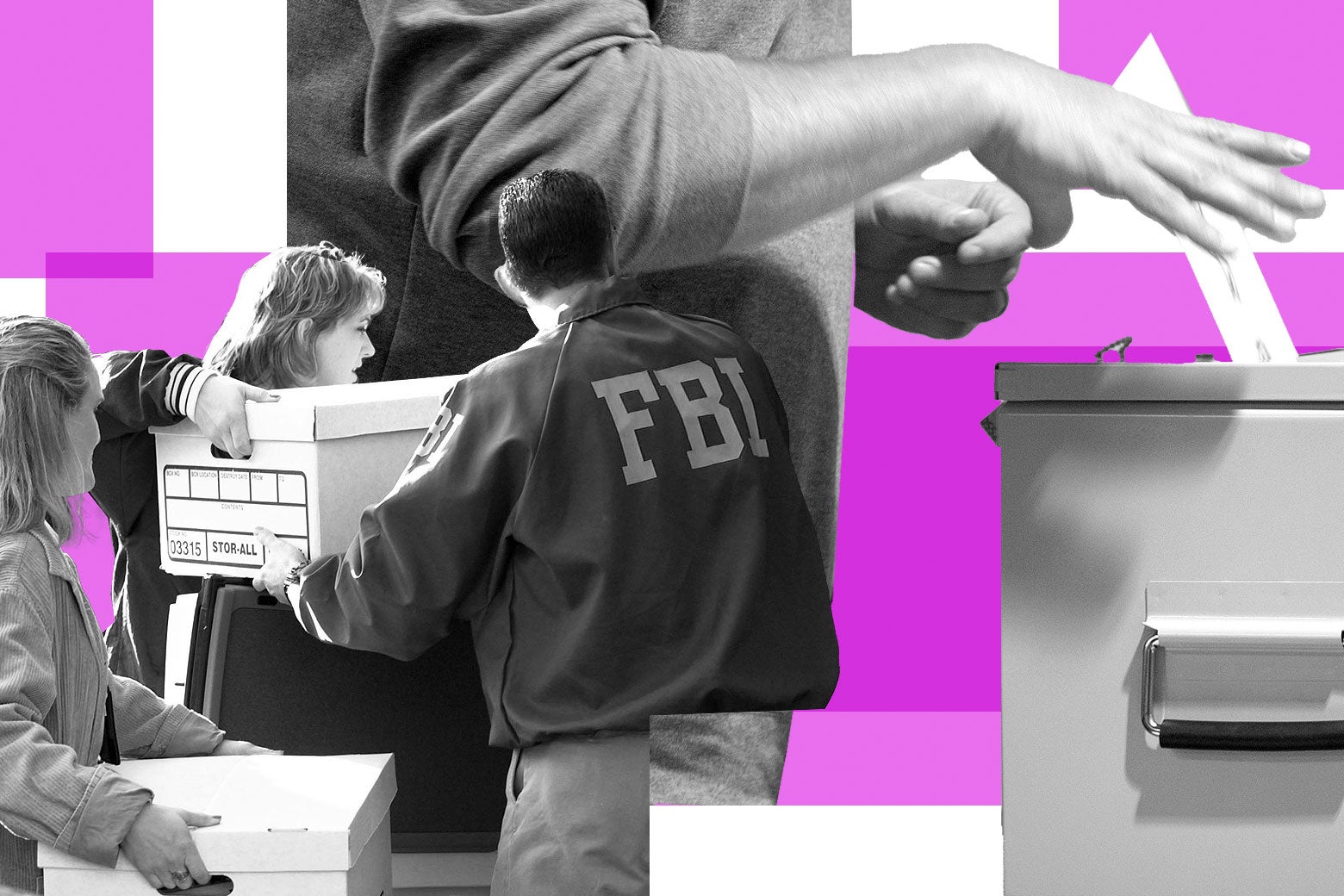
Jurisprudence By Enter your email to receive alerts for this author. Sign in or create an account to better manage your email preferences. Unsubscribe from email alerts Are you sure you want to unsubscribe from email alerts for Dahlia Lithwick? Sept 23, 20264:36 PM If Trump is dumb enough to send ICE agents to the polls, we need to be out in the streets protecting voters. Photo illustration by Slate. Photos by Alex Wong/Newsmakers and Scott Olson/Getty Images. Sign up for Executive Dysfunction, a weekly newsletter that highlights one under-the-radar story about how Trump is changing the law—or how the law is pushing back—and keeps you posted on the latest from Slate’s Jurisprudence team. The Trump administration’s efforts to demobilize and delegitimize the upcoming midterms hardly began or ended with the Hail Mary efforts to take over voting by mail. Indeed, even as the Supreme Court seems to have halted that attempt in its tracks, there are hydralike tentacles of election subversion that have risen up in its stead. On this week’s Amicus podcast, Dahlia Lithwick spoke with one of her ride-or-die elections experts, professor Richard Hasen of the University of California, Los Angeles School of Law, about what’s coming next and how to calibrate panic vs. preparedness dials in the upcoming weeks as we look forward to more election threats while still trying to get this democracy thing right. Hasen is the founding director of the Safeguarding Democracy Project and the author of Election Meltdown: Dirty Tricks, Distrust, and the Threat to American Democracy. A portion of their conversation, which has been edited and condensed for clarity, appears below. Dahlia Lithwick: Last week the Supreme Court finally pulled the plug on Donald Trump’s mail- voting shenanigans. There was some real fear that this would go the other way, but it seems to be a fairly conclusive, very brief order by the court that essentially says the application for the stay that was presented to the court is denied, right? Should we worry that two of the nine justices legitimately thought not only that the administration should have won, but that this was an emergency that should have forced, as you wrote, every state to not be able to do mail voting? Rick Hasen: Well, the first thing to say is that even though the unsigned majority opinion was only three sentences, those sentences packed a punch. I filed a brief with three other law professors, and we focused on what’s called the balance of the equities, which is this idea that when you’re talking about a preliminary injunction or a stay, something that’s going to have to be done in the interim until the court can take a full look at the case, not only do you look at which side’s likely to win on the merits (i.e., does the post office have the authority to do this?); you also look at: What’s the harm going to be to the other side, and what’s the public interest here? The brief that we wrote basically said that you don’t even need to look at whether the U.S. Postal Service has the authority to do this. On the one hand, the government said that there was a problem with voter fraud but did nothing in the district court to prove it, and the district court made a finding that this wouldn’t help stop any voter fraud. On the other hand, you have literally millions of people that would be disenfranchised and election administrators that had run out of time. Ballots have already gone out in some states. There’s just no time. This is so lopsided. What’s notable is, not only did the court say that the equitable factors here didn’t support a stay, they also said the government was likely to lose on the merits. That was unnecessary to reach their decision. That indicates that there are at least five, and up to six, justices who believe that on the merits, the post office is going to lose. That’s really good news. Samuel Alito did not even mention the disenfranchisement risk—and it can’t be that he didn’t know about it; it was our whole brief, and the state of California’s brief did it, and the League of Women Voters’ brief did it. The government itself in its brief didn’t address this at all. Alito just erases the voters. The voters are just not in his calculation of the balance of the equities. That is terrible. But we can take some solace. We can celebrate the good news that there are only two justices who are willing to sign on to this. And even Justice Brett Kavanaugh, who said he kind of agreed with the merits about the USPS’s power to do this, said that on these facts, at this time, this stay cannot be put into place. The president has never been one to take his losses sitting down. Are we going to get an end run around the court? Are we going to see another attempt to thwart the ability to vote by mail in November? I’m much more worried about other things. Let me say this: I think voting by mail is going to be protected in this election, and we’ll have to see what happens in elections going forward. But if you are a person who can easily vote early in person rather than by mail, I’d suggest doing that just because, putting aside all the Trump stuff, you’re more likely if you vote by mail to not have your ballot counted because you forgot to include your signature or you put the wrong date on the ballot. Or in some states you need to have a witness, or you might have filled it out wrong. If you were in a polling place, voting in person, if your ballot is rejected, you can fix it. So, all else being equal, voting early in person is a little bit of a safer way to vote. That has nothing to do with the Trump administration, but it does have to do generally with how people vote, and in some states you’re not told if your ballot doesn’t count, so you would never know. I’m mindful of the fact that there is such a fine line between what we’re calling catastrophizing and what is explaining possible scenarios and really trying to see around corners and do a little disaster planning. I can’t tell you how many conversations I’ve had where someone says, “Even mentioning this can stir up fear and doubt.” I’d like you to take us out of this conversation on the same note you just sounded about mail-in voting, which is that there are things that not just judges, not just poll watchers, and not just election officials but ordinary people can and should do, and you don’t have to think much further back than the people of Hungary who went out to the polls, despite lots of threats, and removed an authoritarian who had access to the levers of government. What are you telling ordinary people who are careening back and forth with the news cycles and really deeply afraid in ways that only serve to cast doubt on whether elections can ever be conducted fairly? Take me on to the side of the line that is information and not catastrophizing, and talk about what it is that people who are worried can and should be doing right now. I should say, first of all, that I don’t think we should just not talk about it. I think that the public discussion about the USPS rule and the mass disenfranchisement it would have caused had the Supreme Court ruled the other way brings attention to this issue for the court. It put pressure on the court so they can’t just do it, the way they did a year ago last summer, when they all of a sudden put the Voting Rights Act up for grabs in an order they issued late on a Friday in August. We have to pay attention, and we have to make sure the public’s paying attention. That said, I think there’s a whole industry out there of what my colleague Justin Levitt calls election law porn. And he’s talking about all of these stories: Mike Johnson is going to seize power! He’s going to not seat Democrats! Or It doesn’t matter what you say because Trump is going to call out the military and declare a national emergency! You hear a lot of this stuff, and the fact is, Trump doesn’t have these powers. He’s not omnipotent. He’s no election genius. In fact, I think if this Postal Service rule had come in, it would actually have been the Democratic cities that would have been much better at getting voters to vote in person than the rural areas. It would have been rural voters most hurt by a rule that shut down mail balloting. So how do you walk that fine line? I think it’s about resilience, right? Not catastrophizing but resilience. Let’s get past this Trump era. That’s what we need to do. We need to put our heads down, hold two more fair elections, and maybe things will be better after that. That means we’ve got to pay attention to all the shenanigans. This is what I do for a living, and I can’t even keep track of all the litigation, but there are lots of great lawyers out there doing the work in the trenches; fighting the Department of Homeland Security rule that’s trying to create an unreliable list of citizens being used to disenfranchise voters. Support those lawyers who are doing this work—there are some great public interest law firms doing this kind of work. And support your local election administrator. Be ready to volunteer as a poll worker. Be an election observer. If you’re not worried about your state, maybe go to a neighboring state. There are lots of opportunities to be involved. First and foremost, make sure you’re registered and that you vote. That’s the way to stick it to people who want to disenfranchise you: to actually vote. And so many people might not think that it matters, but it does matter. One person’s vote is probably not going to make a difference, but if we all had that attitude, we wouldn’t have a democracy. People need to get off their couches and go and vote. And if it’s voting by mail, you might even be able to do it from your couch. But cast that ballot, and do it as soon as you’re ready to make a decision. As I was trying to convince people we were on the ledge in 2020 when we were talking, back during our election meltdown series, I’m now trying to talk some people off the ledge. I think we should not give Trump the power that he does not have. I think we should recognize that we have three bulwarks of protection against attempted election subversion. No. 1, we have the courts, and the courts haven’t done a great job on voting rights, but they’ve done a pretty good job stopping election subversion, in stopping the actual stealing of elections. And the USPS order is the most recent good example of that. Second, we’ve got the states. We have a decentralized election system that causes a lot of problems. I’ve pointed them out in the past. But when it comes to an authoritarian trying to assert control, decentralized power helps. And the third is us, the people. We’re the bulwark. If Trump is dumb enough to send ICE agents to the polls, we need to be out in the streets protecting voters and making sure they can cast their ballots. We’re going to get through this. Donald Trump Jurisprudence Supreme Court Voting Voting Rights Judiciary 2026 Midterms
Trump’s Threats Against the 2026 Election Are Far From Over
Full Article
Original Source
Read the full article at Slate →KhanList aggregates and links to publicly available news content. We do not host full articles from third-party sources. Always verify important information with original sources.