
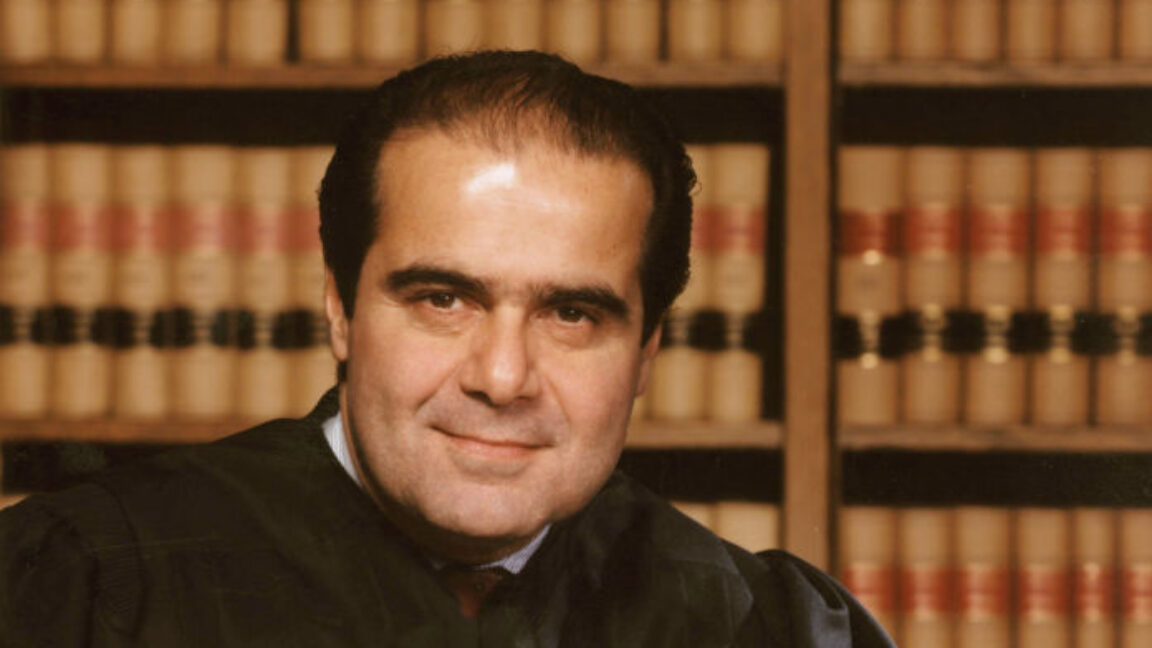
Dismissing accidental deaths Trump adopts Scalia’s ire for feds protecting populations of endangered animals. Last week, The New York Times reported that an internal memo had been quietly distributed across US Fish and Wildlife Service (FWS) field offices, directing staff to radically reinterpret the Endangered Species Act (ESA) in a move that blindsided conservationists. Staffers were essentially asked to start looking the other way when private interests cause preventable deaths of vulnerable animals. Instead of prohibiting habitat modifications that injure animals or cause accidental deaths, the ESA will now only prohibit actions “specifically intending to target an animal,” FWS Director Brian Nesvik instructed staff in the September 14 memo. “A vessel that inadvertently strikes a whale has not taken it because the vessel’s course was not set against the whale,” Nesvik’s memo said. “Felling a tree is not a take of the bats roosting in it unless the tree is felled for the purpose of killing or capturing them.” FWS did respond to Ars’ request to clarify if this rule change has already taken effect, but environmental advocates are alarmed because it follows a rule change earlier this year that removed the destruction of habitat from the ESA’s definition of harm. At that point, the administration insisted the goal was to prevent extra costs to landowners when animals weren’t in danger. But the more recent rule change goes much further, allowing the animals to be killed as long as that’s not the landowners’ motivation for taking an action. Ben Levitan, a senior attorney for legal conservation nonprofit Earthjustice, told the nonprofit news organization Stateline that advocates felt they were falsely reassured when the definition of harm was changed and that the administration would not use that change to justify a policy of ignoring preventable deaths. “This is an incredibly sneaky and disingenuous way of going about things,” Levitan said. Such incidental takings are the most common way that endangered animals die, the NYT reported, so advocates fear the move largely guts the ESA. Previously, businesses had to conduct environmental reviews to identify critical habitat, then either take steps to preserve it or get permits to offset any accidental killing by donating to conservation funds elsewhere. Stripping that protection could immediately threaten not just individual animals but entire populations, as Supreme Court justices acknowledged in 1995 when it was first ruled that the ESA prohibited harm by preventing the modification of critical habitats. But Donald Trump believes that 1995 opinion was invalidated by a more recent Supreme Court decision to kill the “Chevron doctrine,” which justices found had previously given agencies too much authority to reinterpret ambiguous laws when Congress’ intent wasn’t clear. At least one judge weighing the 1995 case characterized the secretary’s reading as “a proper application” of the Chevron doctrine, the majority noted in their opinion. According to the Times, Trump is so intent on flipping the ESA that the dissent in that 1995 ruling is now serving as the “blueprint” for how his FWS plans to enforce the law. So it’s worth revisiting that 1995 dissent as courts revive the decades-old debate in today’s legal landscape. Penned by the late Justice Antonin Scalia, the dissent takes jabs at threatened slugs for not having feelings while envisioning a world where the ESA has nothing to do with protecting endangered populations and the government can do little to prevent accidental deaths. Protecting populations snubbed as “simplistic” Back in the ’90s, some small landowners and logging companies and their families sued to block the secretary of the Interior from reading the ESA as prohibiting “significant habitat modification or degradation where it actually kills or injures wildlife.” Claiming that the secretary was exceeding his authority, they said they would be financially harmed if they were forced to avoid modifying habitats of a then-endangered species, the red-cockaded woodpecker, and a threatened species, the northern spotted owl. They asked the court to prohibit the secretary from preventing habitat modification—even when businesses or landowners knew that an activity would result in the extinction of a listed species by destroying its habitat. The majority rejected that logic, and they did so based not on an interpretation of the secretary’s authority under the law but on a textual reading of the law, Patrick Parenteau, an emeritus professor at the Vermont Law and Graduate School, told the Times. But Scalia clearly sided with the landowners, as did Clarence Thomas and William Rehnquist. In his dissent, Scalia argued that the ESA was written narrowly to prohibit the intentional hunting and killing of vulnerable animals, not to broadly protect species at the population level. He seemed to find it particularly preposterous that the ESA would protect animals’ breeding grounds. Scalia argued that the majority imposed “unfairness to the point of financial ruin—not just upon the rich, but upon the simplest farmer who finds his land conscripted to national zoological use.” As he saw it, the majority was being overly “simplistic” in assuming that anything that furthers the mission of protecting endangered species should be covered by the ESA. He even took time in a footnote to mock Sandra Day O’Connor for writing in her concurring opinion that destroying breeding grounds could be considered an injury to animals. Animals not capable of “painful sentiments” Saying that she didn’t find it as “easy” as Scalia to “dismiss the notion that significant impairment of breeding injures living creatures,” O’Connor argued that “to raze the last remaining ground on which the piping plover currently breeds, thereby making it impossible for any piping plovers to reproduce, would obviously injure the population (causing the species’ extinction in a generation).” And it would injure individual animals, she suggested. “By completely preventing breeding,” unchecked developments on critical habitats “would also injure the individual living bird, in the same way that sterilizing the creature injures the individual living bird.” Further, animals could suffer in other ways from loss of breeding habitat, she wrote: The regulation has clear application, for example, to significant habitat modification that kills or physically injures animals which, because they are in a vulnerable breeding state, do not or cannot flee or defend themselves, or to environmental pollutants that cause an animal to suffer physical complications during gestation. Breeding, feeding, and sheltering are what animals do. In a footnote, Scalia said O’Connor’s ESA interpretation was “imaginative,” suggesting that if she was advocating against “psychic harms,” why not include “the psychic harm of not being able to frolic about?” “Assuming, of course, that the animal in question, perhaps an endangered species of slug, is capable of such painful sentiments,” Scalia wrote. Insisting that lines must be drawn, Scalia argued that an animal should not be considered injured under the ESA simply because its ability to breed had been impaired. And the Secretary back in 1995 had no authority to evaluate what was harmful habitat modification in such a “willy-nilly” way, he said. Under the ESA, an animal is only injured when “a class of acts (not omissions)” is “done directly and intentionally (not indirectly and by accident)” to “particular animals (not populations of animals),” Scalia argued. The only way the US could protect a species was by paying landowners to acquire land, not by imposing costs on private landowners, Scalia argued. In Scalia’s view, Congress drafted the ESA to clearly distinguish “taking” an animal from disrupting its habitat. Lawmakers chose to prohibit the killing or injury of a threatened species or else require a permit to offset the imbalance from any incidental takings. That interpretation of the ESA is the one the Trump administration is moving toward. “Only action directed at living animals constitutes a ‘take,’” Scalia wrote. Legal experts defend the ESA Not everyone expects that the death of the Chevron doctrine will allow Trump to gut the ESA. In 1995, the majority held that Congress clearly intended to include habitat modification in the ESA under the definition of “harm” and suggested that Scalia cherry-picked his dissent to cite only legislative history supporting his position. In the opinion drafted by late Justice John Paul Stevens, he wrote that not only does the “broad purpose of the ESA” support the secretary’s reading, but so does the fact that Congress requires permits for presumably otherwise illegal incidental takings. Perhaps most notably, when drafting the ESA, lawmakers “stated that ‘the broadest possible terms’ were used to define restrictions on takings,” specifically to ensure that they included “harassment, whether intentional or not,” Stevens wrote. “Under the dissent’s interpretation of the Act, a developer could drain a pond, knowing that the act would extinguish an endangered species of turtles, without even proposing a conservation plan or applying for a permit,” unless the developer was “motivated by a desire ‘to get at a turtle,’” Stevens wrote. The Trump administration is already facing lawsuits, including one from a coalition of 21 attorneys general over changes to the ESA, so it’s unclear if the Scalia dissent’s lens on the ESA will ever be widely adopted by wildlife officials previously dedicated to protecting all vulnerable animals. A spokesperson for the FWS defended the changes to Inside Climate News, saying that “these lawsuits seek to preserve a decades-old regulatory overreach that expanded the Endangered Species Act beyond the authority granted by Congress. The Department will vigorously defend its authority to implement the law according to its plain text.” A spokesperson for the Interior Department told NYT that the ESA “continues to prohibit take of endangered wildlife, including actions that harass, pursue, hunt, shoot, wound, kill, trap, capture or collect listed wildlife, or attempts to do so.” At least some environmental legal experts seem confident that this dispute over the ESA isn’t about who has the authority to interpret the statute, though. Rather, it’s about what the statute says, and in 1995, the court found that simply knowing that a protected species could be injured or killed when taking an action was enough to violate the ESA. Andrew Mergen, a law professor at Harvard University who previously supervised ESA legislation for the Department of Justice, told the NYT that the FWS memo’s directive “is really an assault on the act like we’ve never seen before.” “What the administration is proposing to do is take all of the force out of what we have all understood the act to mean: Don’t kill endangered species,” Mergen said. “What they seem to be saying in this document is ‘it doesn’t matter if you killed an endangered species if you didn’t mean to.’” Parenteau, the Vermont law professor, told the Times that he expects FWS will struggle to defend the policy. “To say that the law is settled in favor of Scalia’s dissent?” Parenteau said. “Absolutely not.” Ashley is a senior policy reporter for Ars Technica, dedicated to tracking social impacts of emerging policies and new technologies. She is a Chicago-based journalist with 20 years of experience. 16 Comments
Trump’s sneaky plan to gut Endangered Species Act draws from 1995 Scalia dissent
Full Article
Original Source
Read the full article at Arstechnica →KhanList aggregates and links to publicly available news content. We do not host full articles from third-party sources. Always verify important information with original sources.