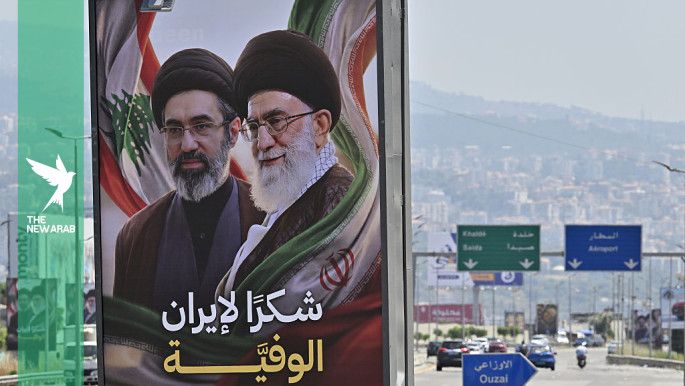
Billboards featuring the late former Iranian leader Ali Khamenei and his son Mojtaba Khamenei, who were killed in U.S. and Israeli attacks against Iran on February 28. [GETTY]Barely three weeks after Iran and the United States signed the Islamabad Memorandum of Understanding (MoU), the two countries are at war again. Since the truce collapsed on July 8, Iran has attacked tankers in the Strait of Hormuz, the US has bombed ports and cities in the south of Iran and reimposed its naval blockade, and traffic through the world’s most important oil chokepoint has ground to a halt. The rhetoric from Tehran appears to match the escalation. In his message on the last day of his father’s funeral, Supreme Leader Mojtaba Khamenei pledged that revenge for the “pure blood” of the martyred leader “must definitely take place”. A week later, he declared that the repeated violations of the MoU by Washington had “once again proven to everyone just how worthless and invalid the signature of the US president is”. The conclusion seems obvious: the hardliners who denounced the MoU from the outset have won, and diplomacy is dead. The reality is different. The technocratic-economic wing of the ruling bloc in Iran remains in command, and the current war is not the repudiation of its strategy but its continuation. Unhealed fractures As I have previously argued, the MoU was engineered by Iran’s real ruling bloc: the military-bonyad complex that fuses the Islamic Revolutionary Guard Corps (IRGC) and the security forces with the sprawling revolutionary foundations that dominate the economy and, increasingly, politics for the past two decades. The complex is riven by a fracture far older than the 2024 presidential election, in which Mohammad Bagher Ghalibaf personified its technocratic-economic wing and Saeed Jalili its ideological-maximalist rival. The preceding 40-day war papered over the cracks, but the MoU blew them open, above all through its articles on the Strait of Hormuz, the nuclear programme and the proposed $300bn reconstruction and development fund. For the technocratic-economic wing, the regime’s survival depends on economic recovery and reintegration into the global economy through sanctions relief. Its strategy pairs a decisive pivot towards China and Russia with just enough engagement with the West to keep confrontation at bay. No one embodies this approach better than the leading politician of this faction, Mohammad Bagher Ghalibaf, whose career tracks the complex’s own ascent: head of the IRGC’s Khatam al-Anbiya construction conglomerate, mayor of Tehran, parliamentary speaker, and now both the establishment’s chief negotiator with Washington and its special representative for China. For the ideological-maximalist wing, organised around the Paydari Front, the truth is the opposite. The US cannot be trusted, engagement with Washington is futile, and Western investment is a Trojan horse that mortgages the country’s sovereignty and threatens the regime’s survival. Politically, the military-bonyad complex has operated under the banner of “principlism”, but the labels the two wings use for each other reveal how deep the fracture runs. Ghalibaf’s camp has branded itself “Neo-principlism”, defining its members as pro-revolutionary pragmatists who believe the survival of the Islamic Republic depends on economic development and measured foreign policy rather than ideological performance. The Neo-principlists disparagingly dismiss its rivals in the ideological-maximalist wing as “super-revolutionaries”, categorizing them as a performative fringe who, in Ghalibaf’s own words, “haven’t taken a slap in the face for the revolution, haven’t suffered, haven’t done anything, and just shout.” The first line of defence of the ruling bloc was to scapegoat President Masoud Pezeshkian while shielding Ghalibaf, the man who actually led the negotiations with US Vice President JD Vance. That shield is now cracking. On July 18, hardline commentator Foad Izadi called the MoU “the fraud of the century” and warned that “the danger of a pro-Western Principalist is greater than that of a pro-Western reformist”, the most direct attack on Ghalibaf that the hardline camp has yet allowed itself. But noise is not power. Two developments show that the ideological maximalists are institutionally weaker today than at any point since the war began. Purging the insider critics First, when parliament elected its commission leadership on 14 July, the influential National Security and Foreign Policy Commission removed its first deputy chairman, Mahmoud Nabavian, and its spokesperson, Ebrahim Rezaei, the chamber's two most vocal opponents of diplomacy with Washington. Nabavian was no outside sniper. He sat on the first negotiating team in Islamabad and later turned against the deal, even citing confidential correspondence from the supreme leader to argue that the negotiators had exceeded their mandate. His removal was the system expelling an insider dissenter. Raja News, a pro-Paydari Front outlet, denounced the reshuffle as the “dictatorship of the memorandum”. Meanwhile, other hardline pundits simply called it a “soft coup”. The hardliners still command loyal networks across the media and state institutions. Yet in the one parliamentary body charged with overseeing war and diplomacy, they were voted out by their own colleagues, who chose leadership aligned with Ghalibaf. The second and more crucial development is the resumption of the war itself. Far from being the victory of the ideologues over the negotiating track, the fighting resumed because the military-security establishment concluded that, without control of the Strait of Hormuz, Iran holds no real leverage in the negotiations meant to follow the MoU. The MoU stipulated that the strait would be fully open under Iranian arrangements. Yet on 27 June, the Joint Maritime Information Center, overseen by the US Navy, announced a widened corridor hugging Oman’s coast, a “Southern Highway” designed to let shipping bypass Iranian waters altogether. In Tehran, this was read as an attempt to strip Iran of its last card. The Revolutionary Guard insisted that only Iran could decide which routes ships take, and Iranian forces began attacking tankers using the American route. This is a war over the Strait of Hormuz. Washington wants to force Iran out of it; Tehran wants to entrench its permanent control over it. Ghalibaf himself framed the logic in a statement on July 15. Asserting that Iran had “never welcomed war”, he argued that “separating and choosing either negotiation or war as the only solution is a strategic error”, while maintaining that “Iranian arrangements” in the Strait of Hormuz remain essential to national security. For the technocratic wing, the war is negotiation by other means: once Iran’s control of the Strait of Hormuz is an established fact, it can return to the table from strength. The Supreme Leader’s hedge The supreme leader’s rhetoric fits this pattern. Mojtaba Khamenei is running his father’s playbook: permit diplomacy, but never own it. His statements attribute the MoU to “the presidents of Iran and America”; Ghalibaf, who negotiated it, is never named. If the strategy delivers, the triumph will belong to Ghalibaf, to whom he is close. If it collapses, the leader can stand with the base and say that America's signature was always worthless. Hardliners have seized on his words as vindication, but they read selectively. The same 17 July message that damned Washington also warned critics of officials not to “commit an injustice against the innocent” and not to damage “unity and social cohesion”, a rebuke aimed at his own camp’s attack dogs, not an endorsement of them. The gamble, of course, may fail. The escalation could spiral into a region-wide war; Oman’s two-corridor proposal may yet be imposed by exhaustion; and if Iran cannot make its terms in the Strait of Hormuz stick, the ideological maximalists will claim vindication, and the balance inside the ruling bloc could tip. But for now, the men who signed the MoU are the same men waging this war, and they are waging it in order to come back to the table holding the Strait of Hormuz. Whoever controls the Strait of Hormuz will control the next round of negotiations, and with it, the direction of the Islamic Republic. Kayhan Valadbaygi is a Research Fellow at the International Institute of Social History (IISH) in Amsterdam and CEO of Middle East Risk & Reform Advisory. Have questions or comments? Email us at: editorial-english@alaraby.co.uk Opinions expressed in this article remain those of the author and do not necessarily represent those of The New Arab, its editorial board or staff.
Trump's renewed attacks aren't a victory for Iran's hardliners
Full Article
Original Source
Read the full article at Newarab →KhanList aggregates and links to publicly available news content. We do not host full articles from third-party sources. Always verify important information with original sources.