
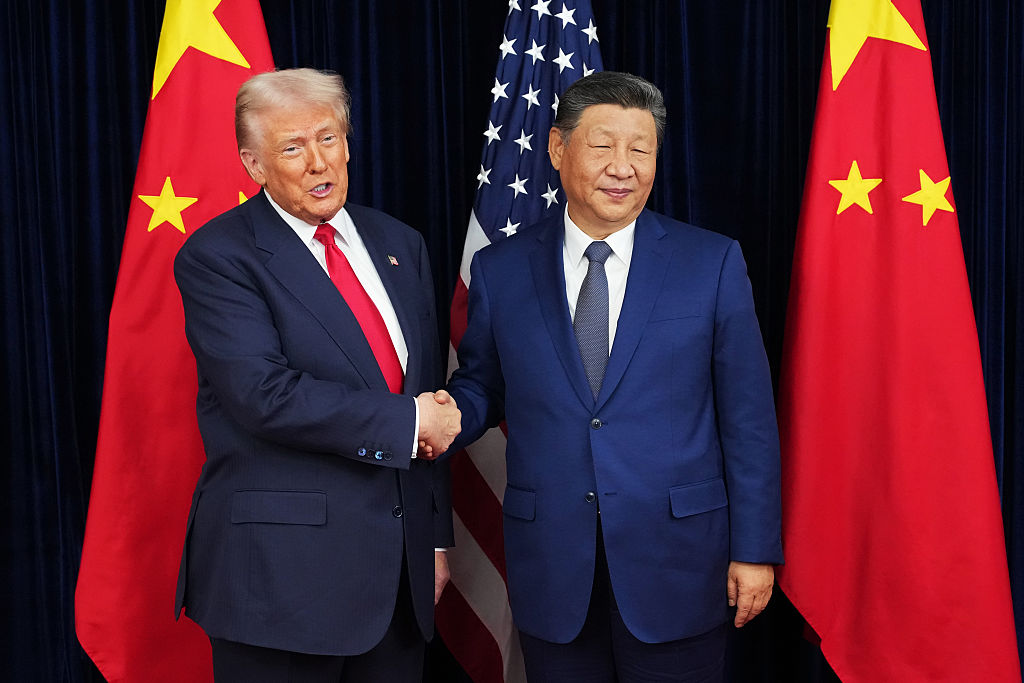
China There’s one part of the world where U.S. diplomacy is working. (Andrew Harnik/Getty Images) Support for President Donald Trump’s foreign policy has dropped to a record low. A Quinnipiac poll released last week found that just 33 percent of Americans approved of Trump’s handling of the issue—the worst figure recorded across either term. And little wonder. More than six months of war with Iran have jacked up prices for everything from gas to groceries, severely decreased the Pentagon’s munitions stockpiles, and left thousands dead—including 18 U.S. service members—without achieving any of the president’s stated objectives. An escalating trade war with Canada, our second-largest economic partner, threatens to spiral out of control. The fighting in Ukraine rages on (despite Trump’s pledge to end it in his first 24 hours on the job). And we have settled on a kind of trigger-happy neoimperialism in Latin America, where Secretary of State Marco Rubio rules Venezuela like a Roman proconsul and an invasion of Cuba seems perpetually in the offing. But there is one place—and a rather important one at that—where the administration’s foreign policy efforts have been crowned with success. This is the Indo-Pacific, where a deft mix of realism and rapprochement is being applied to the management of the world’s most important geopolitical dynamic: the U.S.–China relationship. The administration’s aim here is strategic stability, a modus vivendi that preserves peace between the two most powerful countries on earth while ensuring that the interests and security of both are provided for. “A balance of power in the Indo-Pacific that allows all of us to enjoy a decent peace,” as the National Defense Strategy puts it. And so far, the approach appears to be working. “Trump has made some very positive moves when it comes to U.S.–China relations,” Jennifer Kavanagh, a senior fellow and director of military analysis at Defense Priorities, told me. “The most important have been prioritizing stability over confrontation and shifting the frame of the relationship from security to economics.” Deemphasizing the security dimension has been particularly successful in stabilizing the relationship. The administration has carefully avoided needless provocations over regional basing, joint military exercises, or arms transfers to Taiwan, all without ceding ground we already hold. It has pursued the expansion of military-to-military dialogue with Beijing, and spoken respectfully of China’s position and influence in what is, after all, its own backyard. And instead of being sucked into the zero-sum logic of security competition over stakes—like the outcome of territorial disputes in the South China Sea or control of the Senkaku Islands—that are ancillary to our core national interests, the White House is devoting more attention to the economic relationship, which has a real and undeniable impact on everyday Americans. All this marks a major departure from the previous administration. During the Biden years, U.S. policy toward China seemed predicated on a values-driven, “autocracy vs. democracy” framing, and was punctuated by a series of aggressive, destabilizing moves. The U.S. committed to providing Australia with nuclear submarines through the AUKUS pact and dramatically expanded its basing footprint in the Philippines. Then-Speaker of the House Nancy Pelosi made a shock visit to Taiwan, enraging the Chinese and giving the appearance that we were swinging away from adherence to the “One China” policy. Perhaps most damaging of all, Biden himself repeatedly suggested the United States had dropped strategic ambiguity on Taiwan, and would go to war with China if it made a move on the island. The China policy of Trump II also differs from the approach taken during Trump’s first term, which was characterized by a more bellicose tone, and internally shaped by inveterate China hawks like Mike Pompeo and H.R. McMaster. This time around, more reasonable figures are at the helm. One of the most important of these is Elbridge Colby, the undersecretary of defense for policy. Although Colby—who is by general acknowledgement the most committed foreign policy realist with a major Pentagon portfolio—has taken some Ls in other theaters, in the Indo-Pacific it is his vision that appears to be winning out. Colby is a proponent of realpolitik, and his essential goal is to balance diplomatic engagement with the maintenance of a strong denial defense along what strategists refer to as the “first island chain” (the string of islands stretching from the Japanese archipelago through the Ryukyus, Taiwan, and the Philippines). As he put it during a tour of Southeast Asia last month: Our driving and abiding purpose is to maintain a favorable balance of power in the Indo-Pacific. From a defense perspective, as [the National Defense Strategy] makes clear, this requires us to maintain a posture of deterrence by denial along the first island chain... But, to be clear, this strong and focused approach is fully consistent with an active and creative diplomacy aimed at promoting strategic stability and reducing pressures toward conflict. To many today in Washington and the elite commentariat, this seems hard to wrap their heads around. But it is simple common sense, and indeed in the best traditions of American foreign policy. Dwight Eisenhower, Richard Nixon, and Henry Kissinger, and, yes, Ronald Reagan all sought to strengthen America’s military position while simultaneously engaging actively at the highest levels with our potential opponents. As Winston Churchill himself put it, “it is better to jaw jaw than war war.” On the economic front, the strategy is admittedly a little less clear. Following a brief but intense tariff war last spring, the United States and China have been observing an uneasy trade truce. Each possesses unique sources of immense leverage—critical minerals for China, AI chips for the United States—that could be exploited to wreak havoc on the other’s economy. But the fact that this commercial ceasefire has thus far held is positive, and it is reasonable to hope for the conclusion of a grand bargain—perhaps as part of Xi Jinping’s planned visit to the United States later this month. Of course, this has led to criticism from those who would prefer a return to the bellicosity of yore. The New York Times editorial board, for example, has accused the president of going wobbly on China (the Gray Lady would instead prefer “a version of the strategy that prevailed in the long 20th-century struggles against fascism and Communism”). Hawkish carping aside, though, it’s true there is room for improvement. Some of the economic measures—allowing American chipmakers to export advanced AI tech to China, for example—arguably tilt too much in Beijing’s favor. And more might be done to stabilize the security relationship. Kavanagh, for example, worries that the maintenance of a strong forward military presence will doom efforts to achieve lasting strategic stability. “Having something like 80,000 U.S. troops concentrated so close to China’s shores will never lead to a ‘decent peace,’” she said, because Beijing will always view this as “inherently threatening.” Subscribe Today Get daily emails in your inbox Another analyst I spoke with, Evan Sankey of the CATO Institute, suggested that Trump’s focus on commercial matters could lead to the neglect of the political sources of U.S.–China tension, particularly the status of Taiwan. “Washington is primed to return to a hardline China policy when Trump leaves office,” he said, and Trump’s successor “may not have enough political gravitas to be a China dove when U.S. interests call for it.” Still, it is a marked and dramatic improvement on what came before. And given what is at stake—nothing less than peace between the world’s first and second strongest powers—we should all be rooting for its continued success. It’s also worth asking why the administration’s China strategy has been so much more sophisticated and reasonable than, well, any other aspect of its foreign policy. The answer seems to be that Trump sees Xi as an equal and China as a geopolitical peer. The president accepts that Beijing has legitimate interests, and is working toward an arrangement that accommodates those while also obtaining a favorable outcome for his own country. Call it the art of the deal.
Trump’s Quiet Foreign Policy Success? Relations with China
Full Article
Original Source
Read the full article at Theamericanconservative →KhanList aggregates and links to publicly available news content. We do not host full articles from third-party sources. Always verify important information with original sources.