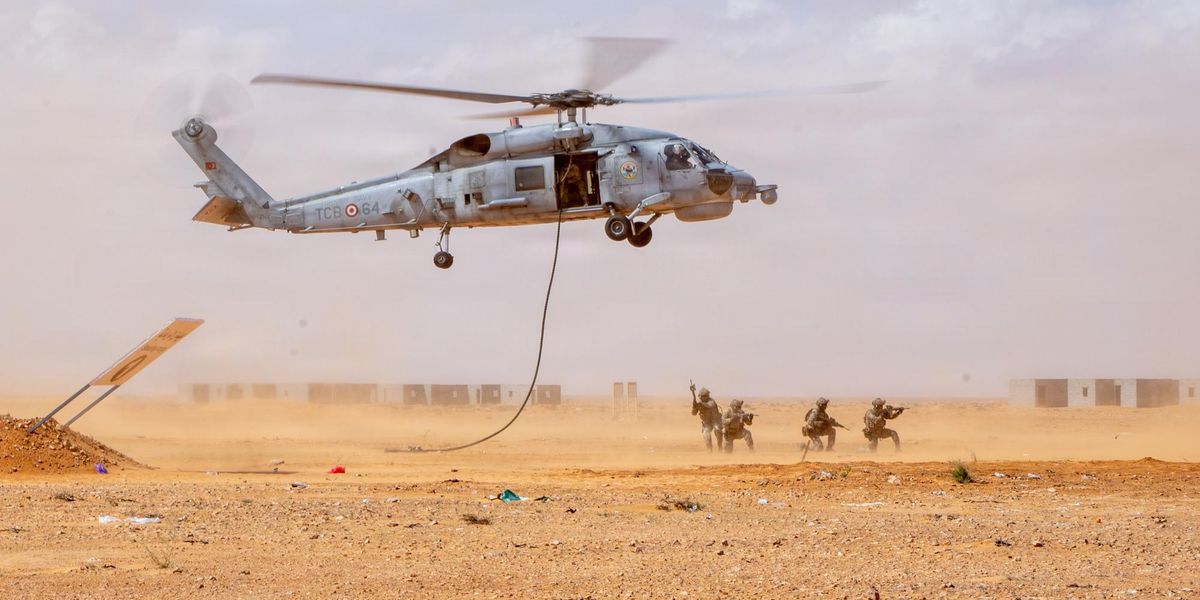
Donald Trump’s foreign policy features chaotic decision-making and bombastic rhetoric. But some of his half-baked ideas could have lasting consequences, creating escalation pathways that his successors may be unwilling to close. West Africa provides a crucial case study. Trump ordered strikes in Nigeria in December 2025 and May 2026, and his team has reportedly considered striking Mali. These moves are drawing West Africa deeper into the ceaseless “War on Terror.” U.S. Africa Command (AFRICOM) – which was rumored to be on the chopping block early in Trump’s second term – may emerge from these years as a bureaucratic winner, with dangerous implications for the future.West Africa has always been part of the War on Terror, but with limitations. After 9/11, as Washington argued that further threats were likely to emerge from geopolitical peripheries, the Bush administration created the Pan-Sahel Initiative, a counterterrorism training program. The broader Trans-Sahara Counterterrorism Partnership followed in 2005, and then AFRICOM in 2007. None of those programs forestalled the crises they were meant to prevent. In 2009-2010, the Boko Haram sect in Nigeria transformed into a mass insurgency that continues to trouble that country today. In 2012, a rebellion in Mali produced the first large-scale jihadist takeover in West Africa and gave way to a multi-sided war that still roils the Sahel. Amid those developments, the U.S. avoided direct and overt confrontation with jihadists in West Africa but stepped up its involvement there: the U.S. logistically supported France’s intervention in Mali in 2013; increased its engagement with militaries in Nigeria and the Lake Chad Basin, particularly after Boko Haram’s infamous 2014 kidnapping of nearly 300 schoolgirls; and constructed a $100 million drone base in Niger starting in 2016, from which it conducted surveillance flights. Occasional scandals and shocks – the strangling of a U.S. Green Beret in Mali in 2017 by his colleagues, and a jihadist ambush that killed four American soldiers and five Nigeriens in Niger the same year – hinted at more “kinetic” U.S. presence in the region than was officially acknowledged. Yet in the Sahel and Nigeria, the U.S. avoided the kind of cyclical strikes that unfolded in Somalia, Yemen, Libya, and elsewhere. Trump’s moves in Nigeria and potential moves in Mali are breaking down longstanding limits on applications of U.S. military power in a delicate region. For Trump, short-term political expediency may be a driver of these decisions. Striking Nigeria in the name of defending Christians caters to significant constituencies and organizations in the United States. Boasting that U.S. forces killed “ISIS Terrorist Scum” reinforces Trump’s brand of toughness. The president and his political appointees may not have a long time horizon in mind.But these short-term decisions, intermittent strikes, and leaked debates over opening new fronts all have long-term implications – especially for AFRICOM and for overall U.S. counterterrorism policy. Early last year, amid the Trump team’s initial fervor for cutting and reorganizing federal agencies, outlets reported that the administration was considering folding AFRICOM into European Command, effectively reversing the process that created AFRICOM in 2007. Yet AFRICOM not only survived but has played a significant role. Bureaucratic survival has allowed AFRICOM to continue deepening long-term relationships and institutional investments on the continent. The military command has pursued an old, failed model of counterterrorism, courting the would-be Libyan strongman Khalifa Haftar and cultivating ties to West Africa’s civilian authoritarians in Cote d’Ivoire, Benin, and elsewhere. After being expelled from the drone base in Niger by that country’s new military government in 2024, AFRICOM simply pivoted to seeking new sites for drone bases nearby – a search that seems to be continuing under Trump. Meanwhile, strikes in Somalia have increased in 2025-2026, underscoring AFRICOM’s multifaceted diplomatic and kinetic role. As the White House’s 2027 Pentagon budget request sets a record, at well over $1 trillion, AFRICOM stands to grow along with the rest of the military. Trump’s successor will likely inherit an AFRICOM engaged in at least periodic strikes in both East Africa and West Africa.AFRICOM presents itself as vital to core American interests. In the command’s 2026 posture statement, Gen. Davgin Anderson insisted that the Sahelian jihadist group JNIM (an affiliate of al-Qaida) “has the ambition to threaten the Homeland and conduct attacks on U.S. personnel and facilities.” Yet JNIM, formed in 2017, has never attacked a target outside of northwest Africa, not even in France. Anderson also offered a selective account of what the drone base in Niger had facilitated, trumpeting a 2020 hostage rescue operation in Nigeria as proof of the need for surveillance of the Sahel. Anderson did not mention that other American hostages in the region have had very different outcomes. Another American, kidnapped in 2016 in Niger, was released in 2023 after negotiations. Also unmentioned was the fact that violence in the central Sahel nevertheless steadily increased even at the peak of U.S. surveillance from Niger, which coincided with a high tempo of French counterterrorism operations that killed numerous JNIM and Islamic State commanders.Meanwhile, Anderson offered no detailed plan for success or even drawdown, but rather made a set of generic assertions about the difference that AFRICOM supposedly makes, for example: “Through traditional military operations and a focus on innovation, defense economics, and information operations, we amplify our impact and meet strategic objectives.” The command clearly looks to Africa as a long-term theater of operations: in the posture statement, Anderson twice referred to 2050, adding in one instance, “Africa’s vast resources, strategic geography, and growing population make it critical to U.S. national security.” Strikes in West Africa are all too easily folded into a portfolio that contains many activities but few off-ramps.Africa also features prominently in Trump’s new counterterrorism strategy, released in May. The document includes a section on Africa that purports to end “decades of forever wars” and “failed counterterrorism policies under President Biden,” but the rhetoric reframes and escalates previous approaches, rather than meaningfully breaking with them. In an effort to square the disavowal of “forever wars” with the reality of an open-ended, heavy-handed commitment to training missions, dubious bilateral partnerships, and direct strikes, the document resorts to the same kinds of conflations and expansive language that have recurred throughout the War on Terror: “We are set on bringing home our troops and downsizing our global footprint. This, however, does not mean we will ignore threat groups in Africa capable of External Operations which seek to attack our interests.” The two key words here are “capable” and “interests” – any militant group is potentially “capable” of attacking the United States, and U.S. “interests” are often so broadly defined that any instability anywhere can be construed as a threat to “interests.”The next presidential administration may not continue the Trump White House’s polarizing rhetoric characterizing Christians as “the most persecuted people on earth” or condemning past U.S. policies as “globalist left-wing cultural hegemony.” But the next president will likely build upon some of the precedents Trump has set. This combination – the normalization of strikes in West Africa, and the underlying maintenance, from administration to administration, of sweeping, unfalsifiable rhetorical justifications for military involvement in Africa – is particularly dangerous.
Trump's quick hits allow for AFRICOM comeback on continent
Full Article
Original Source
Read the full article at Responsiblestatecraft →KhanList aggregates and links to publicly available news content. We do not host full articles from third-party sources. Always verify important information with original sources.