
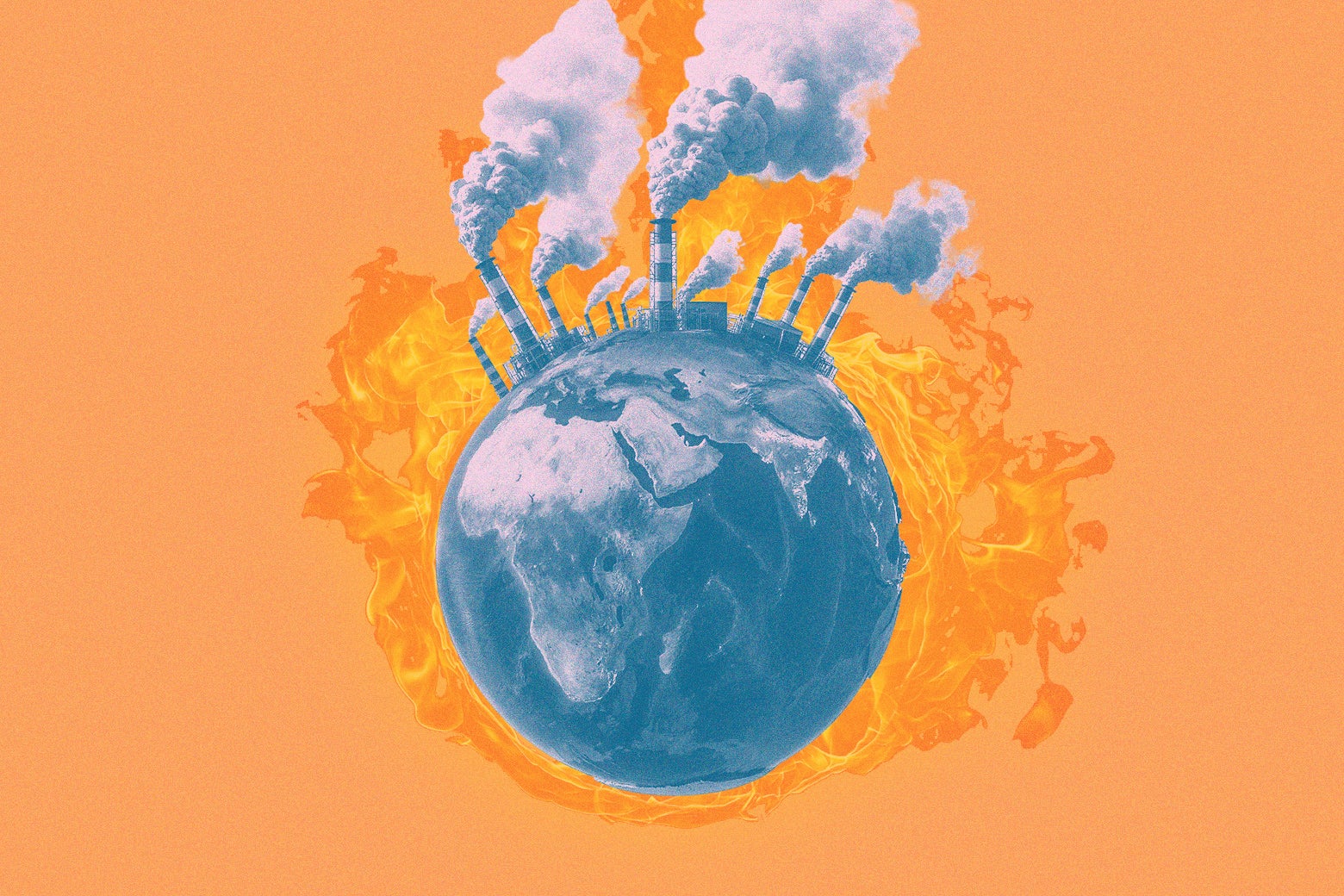
The Slatest Trump to Planet: Let Me Cook New Trump administration rules undercut efforts to reduce climate pollution from power plants. Photo illustration by Slate. Photos by Diego/Adobe Stock and Lyudmila Polichenko/Adobe Stock. This story is adapted from the Slatest newsletter. You can sign up here to get it in your inbox every day. It’s a great day for people who hate the idea of a livable planet. For everyone else, not so much. The Trump administration today plans to both rescind existing rules on climate pollution from power plants and undercut future administrations’ ability to regulate those emissions. These moves face court challenges. But if they go through, they would gut what’s left of U.S. climate policy and undermine efforts to stave off the worst effects of climate change. What do the new Trump rules actually say? Both the Obama and Biden administrations used the Clean Air Act to try to reduce greenhouse gas emissions, which drive climate change. Now Donald Trump, who has labeled climate change a “con job” and twice pulled out of international agreements meant to mitigate it, is reversing those efforts. One of his new rules would reportedly eliminate Biden-era regulations that required power plants that run on coal and natural gas to limit their carbon emissions. If that rule matches a version reporters obtained last year, it will argue that power plants don’t contribute significantly to pollution or climate change because they’re “a small and decreasing part of global emissions,” even though coal remains the worst-polluting fossil fuel. The second proposal would be even more far-reaching. It’s expected to claim that power plant emissions in general don’t meet the Clean Air Act’s standard for Environmental Protection Agency regulation. Why is that a big deal? The power industry is, behind transportation, the second-largest source of planet-warming emissions in the United States and the second-largest producer of greenhouse gas emissions in the world. Kneecapping the EPA’s ability to regulate the industry under the Clean Air Act would gut one of the main ways Democratic presidents have tried to minimize climate impacts and tie future Democratic presidents’ hands. What else is Trump doing to fuel climate change? Earlier this year, Trump rescinded a long-standing EPA finding that greenhouse gases jeopardize human health. That determination, known as the “endangerment finding,” had been the basis of federal climate regulation for nearly two decades. Without it, the administration has effectively given itself carte blanche to go after all manner of climate regulations. Trump has lifted restrictions on vehicle tailpipe emissions, canceled billions for clean energy projects in blue states, and delayed efforts to eliminate chemicals that are hundreds or thousands of times better at trapping heat than carbon dioxide. How is the administration justifying this? Trump officials argue that climate rules burden the fossil fuel industry, hurt the economy, and increase what Americans pay for electricity. In truth, the EPA’s own assessments recently found that repealing power-plant pollution standards will do little to lower utility bills or save the coal industry, which has been in decline for decades. But it would be a major favor to the GOP’s fossil fuel benefactors, saving the industry billions. The economic impacts for the rest of us will probably be imperceptible, particularly when compared to the damage Trump’s moves threaten to do to the environment and to public health. Surely there’s something that people worried about climate change can do about these new rules? Democratic-led states and environmental organizations will sue over these rules, as they have over the others. Those challenges could take years to resolve. But the Supreme Court seems likely to hear at least some of them, and its conservative majority has shown a blasé attitude toward climate change. In 2016, Chief Justice John Roberts led a behind-the-scenes effort to block the Clean Power Plan, an Obama initiative to slash emissions, in part citing “irreparable harm” to energy companies. In 2022, the court narrowed the EPA’s ability to regulate power plant emissions, forcing Joe Biden to adopt more-piecemeal measures. That doesn’t sound promising. So what would it mean if these rules took effect? Think of the fight against climate change like a tug-of-war, with emissions on one end of the rope and efforts to mitigate them on the other. Trump’s moves would tilt the playing field toward emissions. This means not only larger and faster changes to the climate but also an increase in other health effects due to the pollution that fossil-fuel-burning power plants spew, which can negatively affect anyone with lungs. The Biden administration estimated that its power plant rules would’ve prevented up to 1,200 premature deaths and 360,000 asthma attacks in 2035 alone. Some Democratic-led states have stepped into the breach, pursuing tougher rules of their own and even trying to force fossil fuel companies to pay for damage from wildfires, floods, and other climate-related disasters. Still, states probably can’t balance out a president who’s doing everything in his power to spur climate change along. And time is of the essence. Tolga Akdoğan Pondering the potential heat death of humanity is a bummer of a way to start the week, I know. To get your mind off it for the rest of the night, my colleagues suggest: TV worth rewatching: What is it about the HBO miniseries Band of Brothers that keeps viewers coming back for more, 25 years after it originally aired? Slate’s Rebecca Onion investigates why fans are so attached to the show. This game show tradition was Alex Trebek’s favorite: What is Jeopardy!’s annual Teen Tournament? Claire McNear, America’s preeminent Jeopardy! reporter, did a deep dive into the beloved event—which disappeared after Trebek’s death—and got some news about its future. Some snack science: Consumer Reports recently published a scary-sounding investigation on chemicals present in common kids’ snacks. Epidemiologist Gideon Meyerowitz-Katz breaks down the science and concludes that the results are actually pretty reassuring. A three-ingredient treat: If you’d rather nosh on a less processed snack, Noah Lederman recommends a super-fresh dish that’s perfect for late summer: a heavenly concoction he’s dubbed Fish Crudo With Melon and Tomato Water. OK, that’s all from me. Happy munching, and see you tomorrow!
Trump’s Pro–Global Warming Agenda Is About to Get Even Worse
Full Article
Original Source
Read the full article at Slate →KhanList aggregates and links to publicly available news content. We do not host full articles from third-party sources. Always verify important information with original sources.