
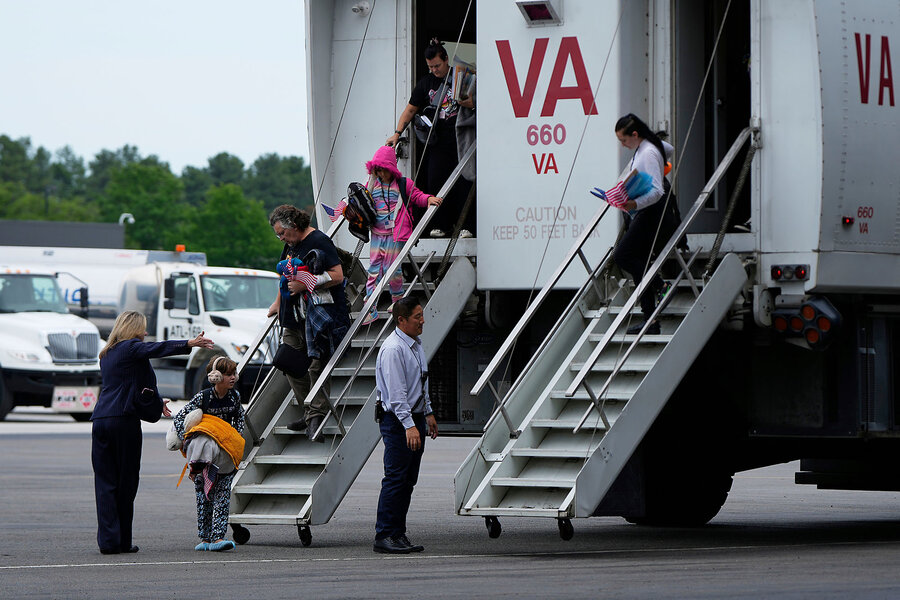
Tulsa, Okla. | Sept. 30, 2026, 5:49 p.m. ET | 6 min read Daan Nel left behind the earthy scent of sekelbos wood. The thought brings him back to the wilds of South Africa, where he used to hunt for impalas with his wife.Now, he hunts for work in Oklahoma. The Afrikaner hadn’t heard of the place until this year, after the United States deemed him a refugee. A former manager in South Africa’s mining industry, he works overnight at a factory that makes pipes.Mr. Nel is “very, very grateful” to President Donald Trump for offering the path to South Africans like him, as immigrating on his own would’ve cost too much. His Tulsa apartment displays a small American flag. Nearly all of the more than 12,900 refugees admitted during fiscal year 2026, which ends Wednesday, came from South Africa. The White House has accused South African leaders of racial discrimination against Afrikaners, which those leaders have dismissed.The Trump administration plans to “primarily” admit that minority group – of largely European descent in majority-Black South Africa – among the 17,500 refugees it can receive over the next 12 months, according to a letter sent to Congress that the Monitor obtained. The State Department doesn’t publish refugee admissions data by race.By contrast, in fiscal year 2024, the Biden administration admitted more than 100,000 refugees from 85 countries. Mr. Nel says he’s open to America widening the welcome again. “You cannot favor the one and not the other,” he says. “Other people’s danger might be more dangerous than ours.”The current plan aligns with a broader White House crackdown on humanitarian paths into the U.S. amid an aggressive deportation push. Refugee groups have sued the government over its policies, while continuing to resettle South Africans across 34 states.Critics accuse the administration of an official preference for white refugees. Lauren Bis, a White House spokesperson, referred questions on exclusion and alleged discrimination to the State Department, a key player in the refugee program. The State Department pointed back to the president.Mr. Trump makes clear the U.S. is “prioritizing resettlement of Afrikaners escaping government-sponsored race-based discrimination,” a spokesperson said in an unsigned email.As they step into a maelstrom of immigration debate, many South Africans – like countless refugees before them – try to lead quiet lives and get on their feet. “I’m back on the ground,” says Mr. Nel. “I need to work my way up.”Objecting to policy, not peopleAs Charissa Petit drives, a dresser and coffee table jostle in the back of her van. She’s on her way to store the furniture donations in a newly arrived Afrikaner’s garage. She’s helped many South African families settle into Oklahoma.More than a couple of decades ago, “I arrived with two suitcases in America, so I know what it’s like,” says Ms. Petit, from South Africa herself, who has also driven refugee women to get their hair cut. “You’re only as strong as your community.”Refugees must have experienced persecution or have a well-founded fear of persecution in the future. Though refugees are authorized to work, expenses like rent can quickly eat up initial funds they receive through nonprofits. As volunteers like Ms. Petit help fill the resource gap, the Trump administration has also extended certain benefits from four to eight months.Historically, many refugees have spent years in camps outside their home countries as they wait for resettlement. Typically, people who haven’t yet fled their country of origin “would have a hard time articulating their refugee-ness,” says one resettlement group representative, who asked not to be named due to political sensitivity around serving South Africans. Evan Vucci/APPresident Donald Trump meets South African President Cyril Ramaphosa in the Oval Office of the White House, May 21, 2025, in Washington. But under Mr. Trump’s order, Afrikaners can go through the application process while still living in South Africa.“Basically, if they fit into the category of this ethnic group, and/or belong to other racial minorities in South Africa, they’re generally eligible to apply,” says the representative. Meanwhile, conditionally approved Congolese, Burmese, Iraqi, and Iranian refugees, for example, have been shut out by Mr. Trump’s policy. Mark Krikorian, executive director of the Center for Immigration Studies, which favors low immigration, doesn’t dispute that many Afrikaner farmers qualify as refugees. But the U.S. should resettle only “those who can’t stay where they are one more minute and who have absolutely no other options,” he says.The president initially suspended refugee admissions on his first day back in office in 2025, citing concerns over resources, assimilation, and security.Claims that the U.S. government didn’t properly vet prior refugees are “ridiculous,” says Jason Marks, who resigned as a supervisory refugee officer from the Department of Homeland Security last year. He says the refugee policy sealed his decision to leave.The U.S. refugee admissions process – including multiple interviews, background checks, and biometrics – involves probably one of the toughest screening standards in the world, says Mr. Marks.Criticism of the Trump administration’s policies doesn’t extend to the refugees themselves, said Krish O’Mara Vignarajah, president of Global Refuge, a resettlement group.“Our core objection isn’t to helping those families,” she said on a press call. “Our objection is to a system that helps only Afrikaners.”Post-apartheid reckoningBack in Tulsa, Martin, a plumber, sits on a donated couch. His refugee family arrived this summer. “The thing that we like here is the safety. The freedom. The cleanliness,” he says.“The kindness,” adds his wife, Charmaine.“But most importantly is the safety,” Martin says.The Afrikaner couple, who asked to have their last name omitted for the security of relatives still applying, are getting used to a quiet neighborhood. For the first time, they say, their teenage daughter took a walk around the block on her own, given the fear of crime back home. Martin used to walk with “two or three knives.” Sarah Matusek/The Christian Science MonitorAt her home in Tulsa, Oklahoma, Vanessa Dunn styles the hair of a South African refugee in her kitchen, Sept. 4, 2026. Virtually all refugees admitted to the United States in fiscal year 2026 came from South Africa. Across South Africa, gun violence is a serious concern, often attributed to criminal groups in urban areas. Recently, at least 38 people were killed in mass shootings in the span of a week.While he hasn’t faced persecution directly, Martin says he sought refugee status “fearing for my kids and my wife in the future.” He recalls learning about the opportunity at a flea market in South Africa, where he met a couple in the refugee program selling their belongings. For his part, Mr. Nel says he was verbally threatened by Black employees at his workplace after attempts to discipline them.“They will tell you, ‘This is not your country anymore – be careful with what you are doing,’” he says. Martin plays clips on social media, including one video showing apparent supporters of a left-wing party whose leader has chanted “Kill the Boer.” A South African appellate court in 2024 ruled that the politician’s use of that anti-apartheid song did not constitute hate speech. (Boer means “farmer” in Afrikaans, but it’s also understood as “Afrikaner.”)Martin feels like the South African media downplay violence against white people. South Africa does not systematically publish violent-crime data by race. While some attacks have targeted white-owned farms, research suggests robbery is the main motive for farm attacks overall. The Monitor has interviewed both Afrikaner and Black farmers who have alleged theft.Beyond perceived threats of violence, some Afrikaners also decry state-sanctioned affirmative action. The South African Constitution considers some discrimination fair, as a remedy for past racial segregation.The South African government has called the extension of U.S. refugee status to Afrikaners “ironic,” given their economic privilege. As of 2023, the average income of white-headed households was five times higher than that of households headed by Black people.“White South Africans are completely outnumbered,” says Charmaine, though she recognizes that Black people suffer violence, too.On the decision to leave, she says, “We just wanted our family to get out of there.”“Jobs first”Whether the U.S. will admit exceptions to South Africans remains unclear. #AfghanEvac, a group supporting Afghans who worked with the U.S. overseas, says two Afghan refugees arrived last week. Those could be the first Afghans – and first non-South African refugees – to enter since 2025. The State Department declined to comment on individual cases.Back in Oklahoma, someone donated a ping-pong table that’s enjoyed in Martin’s garage.They’ll get a pool table, too, he says. And be “the cool parents on the block.” Deepen your worldviewwith Monitor Highlights.Politics with respectGet political stories with respectful analysis.There‘s a world of new ideas in everyBooks newsletter.There‘s more to life, enrich yours withCulture & Learning weekly.Follow humanity‘s discoveries withScience & Nature stories in your inbox.Gain a spiritual perspectivefrom the stories in your inbox.Want to understand the deeper impact of critical events? Learn the Monitor‘s insight.Already a subscriber? Log in to hide ads. His wife pumps the brakes.“We just need to get the jobs first, so we can buy this stuff,” she says. Then, they’ll “let all the refugee kids come and play.” ALREADY A SUBSCRIBER? LoginReal news can be honest, hopeful, credible, constructive.The Christian Science Monitor was founded in 1908 to lift the standard of journalism and uplift humanity. We aim to “speak the truth in love.” Our goal is not to tell you what to think, but to give you the essential knowledge and understanding to come to your own intelligent conclusions. Join us in this mission by subscribing.
Trump's priority refugees, Afrikaners settle into American life
Full Article
Original Source
Read the full article at Csmonitor →KhanList aggregates and links to publicly available news content. We do not host full articles from third-party sources. Always verify important information with original sources.