
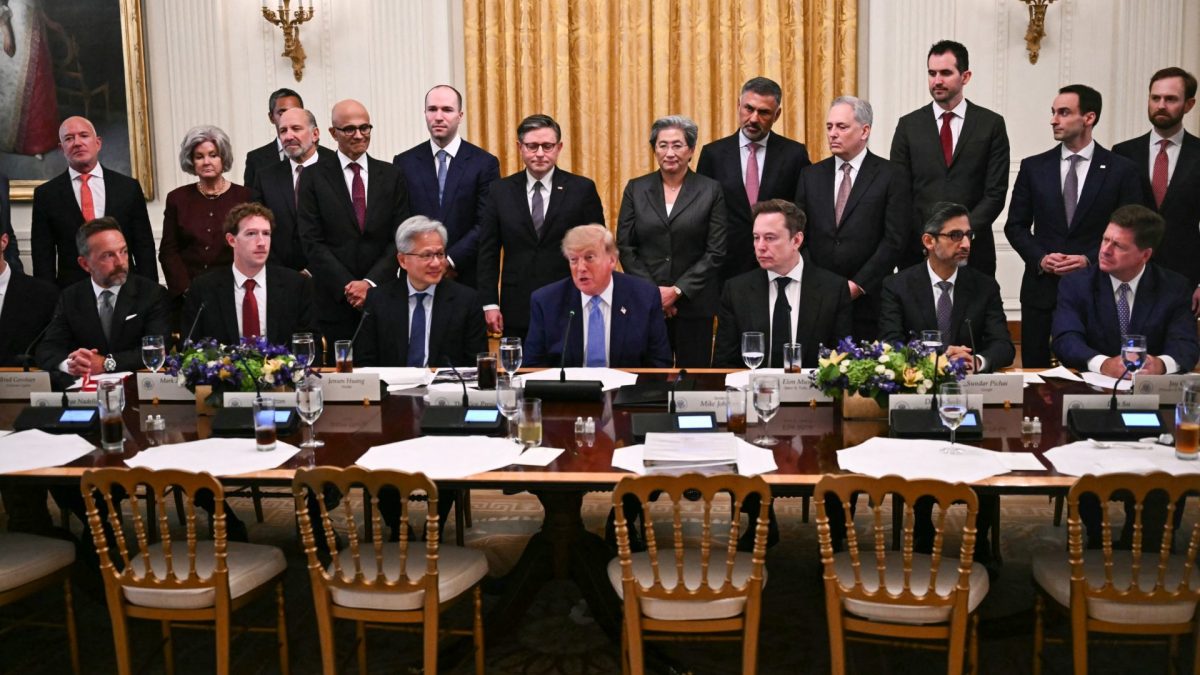
This is Dispatches with Patrick Cockburn, a subscriber-only newsletter from The i Paper. If you’d like to get this direct to your inbox, every single week, you can sign up here. The scandal that led to the fall of Jensen Huang, the co-founder and boss of Nvidia, is superficially a simple tale of sex and allegations of espionage, but at a deeper level it is a symptom of the speed with which the political landscape is changing in America. Until his downfall, Huang appeared to tick all the right boxes for success and power in America. An autocrat at the heart of the AI and data centre revolution, commanding vast influence and wealth, he embodied the zeitgeist – the dominating spirit – of the Trumpian age in America. In a single fortnight, two giant powers that until recently bestrode American and even world politics have been humbled, their invincibility exposed as a sham. One power is President Donald Trump, who led the Republican Party to calamitous defeat on 3 November. The other great power just diminished is Big Tech, which has seen its star performer at the head of Nvidia turned into something close to a political pariah. Put simply, Silicon Valley is not the power it was a week ago. Flamboyant celebrity billionaires like Huang and Elon Musk are out of fashion. AI and data centres are increasingly viewed as dangerous innovations. Exit polls during the midterm elections showed 76 per cent of voters opposing the construction of a data centre in their community, while some 57 per cent saw AI as harmful to society as a whole. In the Republican stronghold of Texas, popular hostility to data centres was crucial to the Democrats’ unprecedented victory.Trump had tried to save Huang whom he saw as a modern-day Henry Ford, doing for AI today what Ford had done for the car industry over a century ago. Their friendship was of recent vintage, but the Nvidia chief did not stint on flattery, saying: “America’s unique advantage is that no [other] country could possibly have its President Trump.” He contributed $25 million to the construction of Trump’s favourite project, the new White House ballroom. Trump, for his part, saw AI as a possible route to reindustrialising America and Huang said that Nvidia might create $500 billion AI infrastructure in the US. Right up to the last moment, Trump was telling Huang to fight for his job, but by then the Nvidia chief was beset by enemies. China hawks inside and outside government were outraged by AI chip sales, directly and indirectly, to China by Nvidia and intelligence agencies had long been quietly antagonistic to Nvidia’s openness to trade with China. Huang advocated selling AI chips to anybody who wanted to buy them, persuading Trump that it was in America’s interest that Beijing should depend on the United States for this essential component since otherwise China would develop its own advanced chips. As with many a Trump initiative, this one had a bizarre money-making element, with the federal government getting 15 per cent and later 25 per cent of sales revenue for certain AI models sold in China. Supporters of Huang have mostly gone to ground, but earlier this week they were arguing that the “Deep State”, in the shape of the intelligence agencies and the foreign policy establishment, had long been looking for a means to bring down Huang – and they found one in his affair with businesswoman Alice Huang (no relation) who was an executive in a company called MegaSpeed in Singapore, importing AI chips from Nvidia worth some $4.6 billion. US intelligence suspected these were being diverted to China, which could not buy them direct because of an export ban. As the scandal broke, the New York Times and other papers revealed that unnamed US intelligence sources believed that Alice Huang was a spy working for Chinese intelligence to influence Jensen Huang. Beijing has denied that this is the case and the US Attorney General Todd Blanche said on Thursday that the justice department is yet to reach a conclusion on whether Alice Huang was a spy. No details about this relationship were given and it seems a little strange that China should wish to influence the Nvidia chief who was already such a powerful influence in their favour in Washington. Alice Huang made no effort to conceal her relationship with Jensen Huang, which again seems peculiar if she was on a mission to obtain the secrets of Nvidia. Nevertheless, the media swiftly identified her as a Chinese Mata Hari, speaking glibly of a “honey trap” directed at Jensen Huang. None of this is likely to do Alice Huang or Jensen Huang much good. Once labelled as a spy or the lover or associate of a spy, it is impossible to escape the taint of treachery. Politicians and public brought up on spy stories in books and films are credulous about what is leaked by intelligence agencies. This same is truer of the media which loves a good spy story, especially if it is spiced up with sex. The crucial question seldom asked in print or on air is why an intelligence agency is leaking some pieces of information? Aside from an innate love for truth and justice on the part of the leakers, what is their motive? Perhaps discrediting Jensen Huang and Nvidia as drivers of a relaxed US policy on high-tech trading with China. Despite his friendship with Trump, Huang was a somewhat isolated figure in Washington, unpopular with the China hawks and foreign policy establishment. This did not much matter when Trump was at peak power over the last two years, but in the wake of midterm elections disastrous for the Republicans and a negative referendum on Trump himself, the President is visibly losing his power to protect his friends and allies. US bureaucracy and institutions long restive under the control of Trump’s weird underlings will leak more freely to reassert their control. Democrats with large majorities in both Houses of Congress will milk the Jensen Huang/Nvidia scandal mercilessly to discredit the administration. But the fall of Jensen Huang and the chastening of Nvidia has an importance beyond the fate of a once powerful man and a huge company that retains immense influence. The power of Big Tech and Silicon Valley as a whole is weakened. Previously they had enjoyed a certain collective personality cult because of their vast wealth and technical prowess, but with their superstar Jensen Huang overthrown, their power is on the ebb. Big government will seek to reestablish its old authority and curb the Big Tech barons as over-mighty subjects who must be cut down to size. Further Thoughts Journalists prefer political victories to be decisive with clear-cut winners and losers because this makes for a simpler and more dramatic story. The Democratic Party triumph in the Congressional midterms on 3 November met this criteria far better than in most elections. For once, the transformational outcome of the poll is not being overstated. President Donald Trump’s aura of invincibility has evaporated overnight, though he still holds executive power and is fighting hard to avoid a self-fulfilling lame duck label. His highly developed political instincts will have told him that it is best to counter-attack briskly after a defeat which explains his appointment of Stephen Miller, whose policies have in the past been described by some as far-right, authoritarian and ethno-nationalist, as his new White House chief of staff. But a thumping historic defeat cannot be reversed whatever Trump’s tactics. The balance of power between him and his multitude of enemies has truly changed to their advantage and they smell blood in the water. Powerful Trump backers like Rupert Murdoch do not bet on losers: Fox News and the New York Post are already edging away from the President. Prior to the midterms any Republican Senator or Congressman not showing slavish obedience to Trump would inevitably be primaried out of politics by the Trump faithful. His iron grip on the Republican Party will be hard to break, even if it is weaker than before. Everybody is pointing to Democrat success in right-wing bastions of the Deep South culminating in winning a Senate seat in Mississippi in the last few days. Democrats had already won in Texas, Georgia and South Carolina and come close in Florida and Louisiana. Divisions that have existed in American politics for 150 years are breaking down. In the 11 states of the Confederacy that seceded from the USA in 1861 and fought the Civil War – the legacy of which still underlies the greatest geographic divide in American politics – Democrats now hold Senate seats in six of them. Once, after the civil rights legislation in the 1960s, it was supposed that the deeply racist states of the South would become more like the North politically and culturally. But in practice over the last half century, the precise opposite happened. Liberal democracy was increasingly challenged in states like Wisconsin, Pennsylvania and Michigan. The midterms saw what looks like this retrograde process abruptly going into reverse – perhaps permanently. Another potential change gets too little mention: after their sweeping gains in the 2010 midterms, the Republicans systematically gerrymandered the national electoral system wherever they were in power to prevent a Democratic resurgence, regardless of the popular vote. This grossly undemocratic ploy worked fairly well until the midterms, but was overwhelmed by the Democratic wave. Another factor makes a successful Trump/Republican counter-attack more difficult. An essential component of Trump’s giant election victories was the Democratic Party’s dismal leadership since President Barack Obama left office in 2017. Hillary Clinton and Kamala Harris were poor-quality politicians pushing a dead-in-the-water establishment agenda. This began to change with Zohran Mamdani’s successful campaign to be Mayor of New York in 2025, running relentlessly on an economic populist platform. In June this year, he told an interviewer with MS NOW: “The party, as a whole, has lost its focus on working people. People want to know, ‘What are you going to do for rent? What are you going to do for housing? What are you going to do for gas? What are you going to do for groceries?’ We have to have answers to that.” Nothing attracts politicians of all stripes so much as a winning election formula which will see them win or retain office. Sincerely or opportunistically, a year later Democrat candidates were aping Mamdani. Beneath the Radar One of the most interesting questions post-midterms will be how far the emboldened Democrats avoid or repeat the multiple mistakes they have made over the past decade in fighting Donald Trump. Because they detested him so much, they concentrated all their fire on him to the exclusion of vote-winning policies. Despite two attempts to impeach Trump in his first term and multiple legal cases against him after he lost office, the Democrats never succeeded in landing a killer punch. On the contrary, they only succeeded in keeping Trump’s name at the top of the news agenda, forcing senior Republicans to rally around him, and giving him the status of a political martyr. Democrats may have learned from past errors, which included being obsessed by the belief that they had been robbed of the presidency in 2016 by the machinations of President Vladimir Putin, a theory still believed by some though there is little evidence the election was stolen. For the true reasons for Democratic defeats, read any account of Hillary’s disastrous campaign. Pursuit of allegations of corruption rather than impeachment of Trump is the better option. “We’re looking at the systemic corruption that has taken place,” the Maryland Democrat and likely chair of the House Judiciary Committee, Jamie Raskin, said in an interview with the Financial Times, “We’ve seen the most breathtaking and outrageous conflicts of interest pervade the Trump administration, beginning at the top.” (The White House denies that the Trump administration has any conflicts of interest. A White House spokesperson said: “As the President has said, he’s willing to work with anyone to continue delivering victories for hardworking Americans. If Democrats choose to pursue sham investigations and radical left policies, they are choosing to work against the American people”.) He warned against being diverted by impeachment proceedings against Trump and instead urged focus on this “avalanche of corruption”. Cockburn’s Picks Estimable charities that once wholly depended on selfless volunteers have a sad tradition of being taken over by over-eager leaders and managers promoting unnecessary centralisation and re-organisation. This is apparently the grim fate threatening The Samaritans, the esteemed charity which since 1953 has provided phone support for people in acute mental distress and at risk of being suicidal. The volunteers manning the local hubs, where they sit together answering phone calls from deeply distressed people, are to be moved to larger buildings often far from where they live or, allegedly, they will operate from their home. The story has not been picked up very much by the media, but there is a lucid account of what is happening to The Samaritans by Justine Smith on The Private Eye Page 94 podcast.
Trump’s power is crumbling – and his billionaire allies are paying the price
Full Article
Original Source
Read the full article at Inews →KhanList aggregates and links to publicly available news content. We do not host full articles from third-party sources. Always verify important information with original sources.