
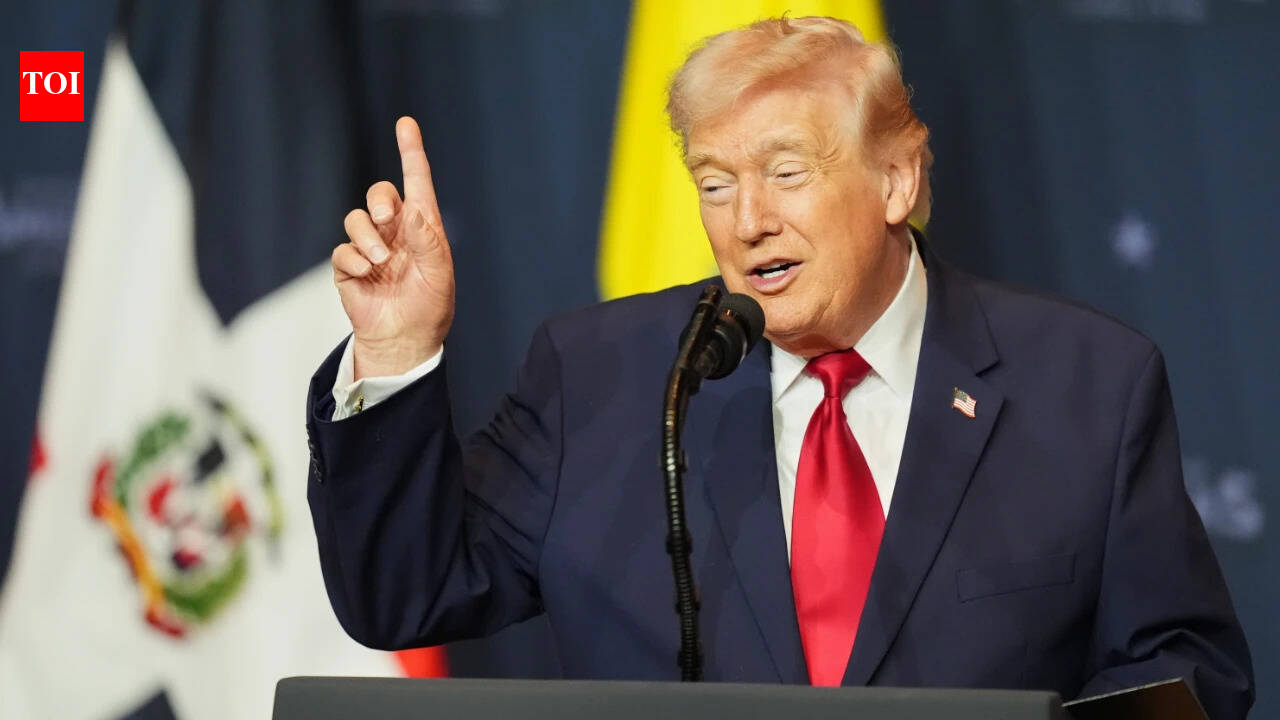
Trump’s endorsements proved powerful in Republican primaries but far less potent in the general election.Donald Trump wanted the 2026 midterms to be a referendum on his presidency and American voters obliged, delivering a verdict that could hardly have been more uncomfortable for him.The president had made himself the central protagonist of the election cycle. He endorsed hundreds of candidates, intervened in Republican primaries, headlined rallies and urged supporters to treat the midterms as an extension of his 2024 mandate. His gave a direct message that a vote for Republicans was a vote for Trump.But when the wider electorate had its say, Democrats captured both chambers of Congress, flipping seven Senate seats and winning a string of House races in traditionally Republican territory.Distancing himself, Trump wrote on Truth Social: "I wasn’t on the Ballot and if I was, we would have won IN A LANDSLIDE!"The midterm results have also exposed an uncomfortable paradox for the US president. Trump has rarely been more successful at getting his preferred candidates through Republican primaries. Yet his endorsement has proved considerably less reliable when those candidates face the general electorate.A look at the numbers tells a story of a politician whose influence within his party has grown, even as his ability to deliver victories beyond it appears to be weakening.The midterm scorecard: 2018, 2022 and 2026According to Ballotpedia's endorsement tracker, Trump endorsed 99 candidates in the 2018 midterms, 276 in 2022 and 351 in 2026. His expanding reach has been accompanied by greater success in Republican primaries, but a less consistent record in general elections.In 2018, his first midterm as president, Trump endorsed 37 candidates in primaries, of whom 95% won. His general-election record was considerably weaker as 56 of the 95 candidates he backed won, giving him a success rate of 59%.Four years later, his primary success rate dipped marginally to 93%, with 224 of 241 endorsees winning their nominations. But his general-election performance improved sharply. Of the 254 candidates he endorsed, 84% won.In 2026, the pattern has shifted again. His primary success rate climbed to 96%, with 302 of 315 candidates winning. But his general-election success rate fell to 70%, according to Ballotpedia's latest tracker.The comparison reveals two distinct trends. Trump's influence over Republican primaries has strengthened considerably since 2018, with his endorsement success rate remaining above 90% in all three cycles. His general-election record, however, has fluctuated sharply, from 59% in 2018 to 84% in 2022, before falling to around 70% in 2026.The numbers suggest that Trump's endorsement has become increasingly influential in deciding who represents the Republican Party, but that influence does not translate as consistently when candidates face the wider electorate.The Senate setbacksThe most consequential defeats came in Senate races, where Democrats flipped seven Republican-held seats to take control of the chamber. Several of the losses involved candidates Trump had backed or helped elevate.Texas: Trump backed Attorney General Ken Paxton over incumbent Senator John Cornyn in the Republican primary. Paxton secured the nomination, but Democrat James Talarico defeated him in the general election. Texas had not elected a Democratic senator since 1988, making the result a major breach in Republican territory.Kansas: Republican Senator Roger Marshall lost to Democrat Adam Hamilton, ending a nearly century-long Republican hold on the Senate seat.North Carolina: Trump's preferred candidate, former Republican National Committee chairman Michael Whatley, lost to former Democratic governor Roy Cooper.South Carolina: Democrat Annie Andrews defeated Trump-backed Darline Graham in a state that had not elected a Democratic senator since 1998.Maine: Democrat Troy Jackson defeated incumbent Republican Senator Susan Collins, ending her three-decade tenure in the chamber.Iowa: Democrat Josh Turek defeated Republican Ashley Hinson in another major setback for a party that had carried the state comfortably in the 2024 presidential election.Ohio: Democrat Sherrod Brown defeated Republican Jon Husted in a special Senate election, flipping another Republican-held seat.These defeats were significant not simply because of the candidates involved, but because of the political geography. Democrats made gains in states that Trump had carried comfortably in 2024, demonstrating how sharply the electoral mood had shifted.Texas offered perhaps the clearest illustration of the risks of Trump's intervention. By backing Paxton against Cornyn, Trump helped determine who carried the Republican banner into November. But winning the party nomination proved no guarantee of winning over the state.It would be impossible to establish that Cornyn would necessarily have won. Yet the result has given Republicans another reason to examine whether loyalty to Trump is becoming a substitute for an electoral appeal.The kingmaker's changing roleThe comparison with 2022 is particularly revealing because Trump was operating from a very different political position.In 2022, he was a former president trying to retain his grip on the Republican Party while Joe Biden occupied the White House. His endorsements often targeted Republicans who had crossed him, particularly those who had rejected his claims about the 2020 election.Georgia offered a prominent example. Governor Brian Kemp and Secretary of State Brad Raffensperger, both of whom had resisted Trump's pressure over the 2020 results, defeated Trump-backed primary challengers.By 2026, Trump was no longer an outsider trying to shape the party from Mar-a-Lago. He was the incumbent president, with considerably greater influence over Republican candidate selection.That change was reflected in the primary numbers. His success rate rose from 93% to 96%, suggesting that his hold over the party's nomination process had strengthened.But being the incumbent also changed the stakes of the general election. Republican candidates were no longer simply campaigning against an unpopular Democratic administration. They were defending Trump's governing record.The president's political brand had become both their biggest asset in Republican primaries and a potential liability in the wider election.The primary victory trapThe results point to a structural problem in Trump's candidate-selection strategy, as a candidate who appeals strongly to Republican primary voters may not necessarily appeal to independents and moderate voters in a general election.Republican primaries are decided by a more ideologically concentrated electorate, in which Trump's endorsement carries considerable weight. General elections involve a broader coalition, including voters who may support Republican policies but have reservations about the president.Texas showed that tension. Trump's backing helped Paxton secure the nomination over Cornyn, but the former attorney general subsequently lost to Talarico.There may be a longer-term organisational problem for Republicans, too. Trump's influence over primaries has increasingly made loyalty to the president an important qualification for political survival within the party.That may be an effective way of enforcing discipline, but it also narrows the party's candidate pool. Republicans who might appeal to independents or moderate voters can find themselves vulnerable to primary challenges, while candidates with stronger ideological credentials emerge to represent the party in competitive states.Democrats overturned the Senate balance, flipping key Republican-held seats and shifting the chamber’s tally.From offence to defenceThere was also a fundamental difference in the political environment of the midterms in 2022 and 2026.In 2022, Trump could campaign against Biden and exploit dissatisfaction with the Democratic administration. In 2026, he was the president, and Republican candidates were effectively defending his record.Inflation, tariffs, the cost of living and the war with Iran became part of the electoral conversation. These were no longer abstract policy debates. They were questions about household budgets, fuel prices and whether voters felt better off under the administration.The AP Voter Poll, based on roughly 100,000 voters, found that around two-thirds blamed Trump's policies for fuelling inflation. About nine in 10 said the cost of living was a crucial or major factor in their vote for Congress. Around six in 10 of these voters backed Democratic candidates in their local House races.The Iran war added another complication. The conflict, launched in February, pushed up energy costs, giving Democrats another line of attack against an administration already struggling to convince voters that their financial situation was improving.The poll also found that around seven in 10 voters believed the economy favoured the wealthy, while about six in 10 felt Trump's priorities were misplaced.The message was difficult for Republicans to escape. Their candidates were not merely fighting individual opponents; they were defending an administration that a sizeable section of the electorate believed was failing to address its everyday concerns.Backlash beyond CongressThe Democratic gains were not confined to Capitol Hill. The party also made significant advances in gubernatorial races, flipping Republican-held governorships in states including Georgia, Iowa, Ohio, Nevada and Texas.The Texas result was particularly striking. Democrat Gina Hinojosa defeated Republican incumbent Greg Abbott, breaking a Republican hold on the governor's office that stretched back decades.In Georgia, Democrat Keisha Lance Bottoms defeated Republican Rick Jackson, while Ohio saw Democrat Amy Acton defeat Republican Vivek Ramaswamy.These victories suggest that the midterm backlash was not simply about individual congressional candidates or a handful of Senate contests. It extended to state-level politics, where Republicans had enjoyed considerable advantages.Democrats also gained ground in state legislatures, further weakening Republican dominance in several traditionally conservative states.For Trump, the implications extend beyond the immediate loss of congressional control. A Democratic majority in both chambers will make it considerably harder for the president to push his legislative agenda through Congress, while Democratic governors and state lawmakers will have greater influence over policy battles ahead of 2028.
Trump's Midas curse: Why his golden picks turned blue in US midterms 2026
Full Article
Original Source
Read the full article at Timesofindia →KhanList aggregates and links to publicly available news content. We do not host full articles from third-party sources. Always verify important information with original sources.