
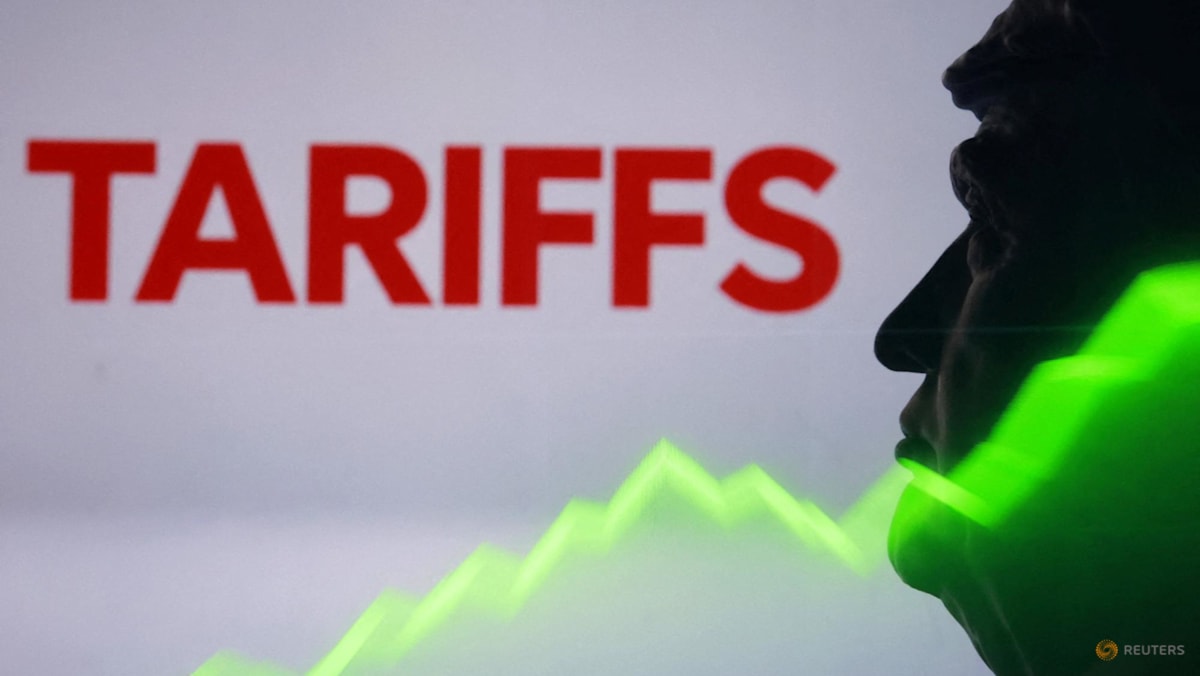
Asia The proposed tariffs on 14 economies, mostly in Asia, come as Washington steps up efforts to counter what it describes as excess industrial capacity and unfair trade practices. A 3D-printed miniature model of US President Donald Trump, the word "Tariffs" and rising stock graph appear in this illustration Nov 25, 2026. (Image: Reuters/Dado Ruvic) New: You can now listen to articles. This audio is generated by an AI tool. United States President Donald Trump's latest tariff offensive is aimed at ramping up pressure on trade partners to strike deals with Washington, as his administration seeks to strengthen its bargaining position with China, say analysts. The US Trade Representative’s (USTR) proposed tariffs on 14 economies – mostly in Asia, along with the European Union and Switzerland – come as Washington steps up efforts to counter what it describes as excess industrial capacity and unfair trade practices. Peter Draper, executive director at the University of Adelaide's Institute for International Trade, said the latest tariffs are designed to push countries to conclude deals with Washington. Speaking to CNA's Asia First on Thursday (Nov 26), he noted that the new tariffs would generally be capped at previously agreed rates for those with a trade pact. “Take the EU for example, its maximum reciprocal tariff is 15 per cent. This tariff is capped at 15 per cent. The higher rate would apply. So, the EU will still pay 15 per cent. For those that already have reciprocal deals, it's pretty much business as usual,” he said. “For those that don't – Vietnam, India, China, Singapore – then there's continued uncertainty ahead. So, that incentivises those countries to conclude reciprocal deals with the US, which is the USTR's intention.” Deborah Elms, head of trade policy at the Hinrich Foundation, agreed that the tariffs could push countries towards negotiations, but said some governments may decide that accepting higher duties is preferable to making concessions to Washington. “We'll see whether that puts the pressure on countries that do not have one of these so-called reciprocal trade deals to get one, or whether they will decide to take the higher tariffs because (they) don't want the onerous conditions that might come with negotiating,” she said. PRESSURE ON ASIAN ECONOMIES Hours after the new tariff announcement, Vietnam said it is working with Washington to complete a trade deal as soon as possible, and that it would cooperate with the US investigation on excessive capacity. Vietnam's growing prominence as a manufacturing alternative to China has put it in Washington's crosshairs. It runs a large trade surplus with the US and faces potential tariffs of up to 35 per cent, which could deal a significant blow to its export industries. “The US is viewing Vietnam as the China replacer, so to speak, so it’s really cracking down on Vietnam,” said Draper. Washington is also concerned about Chinese goods being routed through other economies to reach the American market, and is seeking to pressure its trading partners to curb such practices. “Beijing will be watching extremely carefully how the US tries to get the other 13 trading partners … to crack down on Chinese investment (and) exports from these third countries into the US,” said Elms. China itself faces the prospect of tariffs reaching 40 per cent if its trade truce with Washington expires in January without an extended agreement. Draper said the timing of the new tariff announcement was significant, coming amid ongoing negotiations between the two economic powers over issues such as critical minerals and market access. “China has already paused its export controls on critical minerals for the US. So, there is a deal in the making there,” he said. “This puts extra pressure on China that if it doesn't conclude a satisfactory arrangement with the US, if the trade truce expires, then it would face a much higher tariff.” Despite the growing pressure on China and other Asian economies, Draper believes the China Plus One strategy, in which companies diversify manufacturing beyond China, will remain relevant. “The China Plus One strategy is still very much intact, largely because China faces considerably higher tariffs (and) there is continued uncertainty over what ultimate tariff rates Chinese exporters will face,” he said. “So, if I were an exporter from China, I would be looking to hedge my bets for sure.” For Asian exporters, the impact will depend not only on their own tariff rates, but also on those imposed on their regional competitors. “The crucial issue with many of these tariffs is not what is my tariff rate necessarily, but what is my tariff rate compared to my competitors,” Elms said. She pointed to the Philippines, which is not among the 14 economies targeted by the latest measures, as an example of how differences in tariff treatment could affect exporters' competitiveness. Draper said: “I would be highly incentivised to conclude a deal (with the US), otherwise I'm going to face a much higher tariff rate than my competitors.” WHAT CONSTITUTES EXCESS CAPACITY? The Trump administration has justified the proposed tariffs as a response to excess industrial capacity, but analysts say the distinction between unfair trade practices and legitimate export competitiveness is not always clear. “Excess capacity (for the US) is capacity above whatever market conditions would require,” said Elms. “The problem is … this requires a benchmark. A lot of what the US is claiming is excess capacity is what the rest of the would have called ‘trade’. That's how Asia became so successful over the years … by specialising in one area and then trading with the rest of the world.”Draper said structural excess capacity arises when a government intervenes through measures such as sustained industrial subsidies to give domestic companies an artificial advantage in export markets. He pointed to China's industrial model as an example, where intense domestic competition and falling prices have pushed manufacturers to seek overseas markets. “This is certainly the essence of the Chinese model – they call this problem involution. China is essentially eating itself through sustained price destruction precisely because of excess capacity. So, they have to export – that's the only outlet for their surplus products,” he said. While Trump's proposed tariffs are intended to pressure foreign governments and encourage manufacturers to shift production to the US, American businesses and consumers could ultimately shoulder the higher costs, say analysts.“It's not the exporters that pay these prices. It's actually Americans who pay these prices. So certainly, (this will) drive higher inflation into the US,” said Elms.
Trump's latest tariffs aimed at pressuring Asian trade partners into deals: Analysts
Full Article
Original Source
Read the full article at Channelnewsasia →KhanList aggregates and links to publicly available news content. We do not host full articles from third-party sources. Always verify important information with original sources.