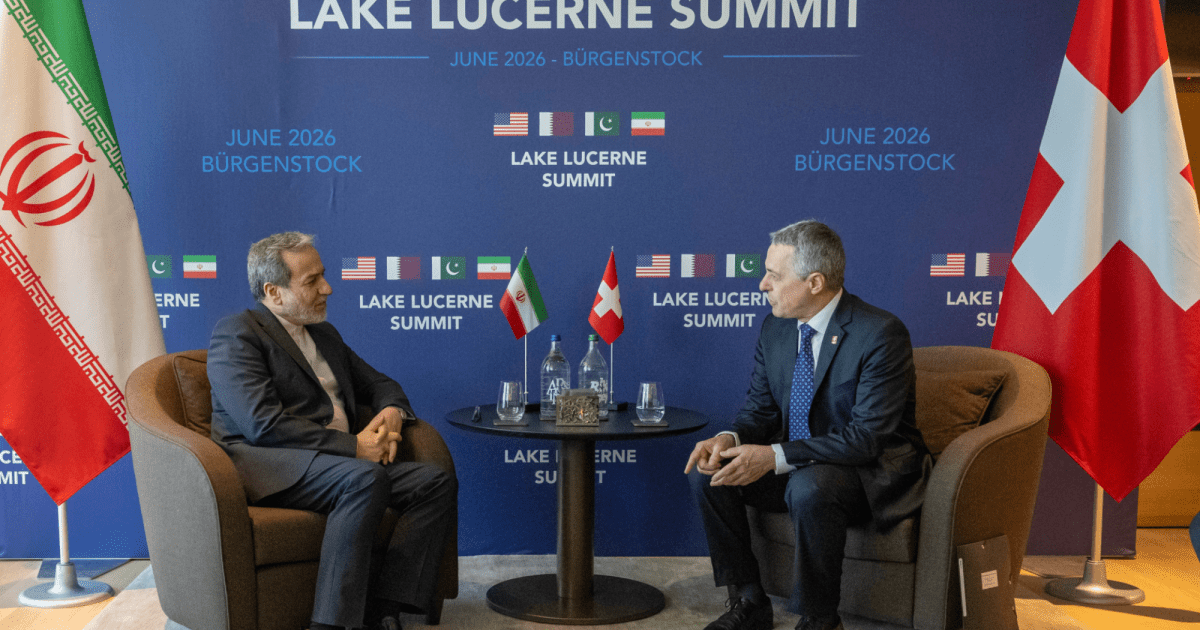
Iran’s Foreign Minister Abbas Araghchi, left, talks with Switzerland's Foreign Minister Ignazio Cassis, right, in Obbuergen, Switzerland, on June 21, 2026, days after the signing of the interim ceasefire deal with the US.Urs Flueeler/Keystone/AP Get your news from a source that’s not owned and controlled by oligarchs. Sign up for the free Mother Jones Daily. On Saturday, a senior Iranian national security official issued a set of demands that the US must meet before a key waterway for oil shipping can be reopened—a statement that further suggests a lasting ceasefire will not be in the cards anytime soon. Mohammad Bagher Zolghadr, the secretary of Iran’s Supreme National Security Council, called for the US to lift its sanctions and naval blockade on Iran, “completely compensate” Iran for war damages, “unconditionally” release frozen Iranian assets, and end all attacks on Iran’s allies in the region. According to multiple media outlets, the US government did not deliver an immediate response to the demands. Many of them resemble those in the interim ceasefire deal signed by the US and Iran in June. Back then, the Trump administration said that it would only lift sanctions completely if the two countries came to an agreement on Iran’s nuclear development, a project that has become central to the country’s struggle for identity and sovereignty amid a long, violent history of foreign interference. While there was an initial ceasefire, it did not last. A couple of days later, Iran’s military closed the Strait of Hormuz, a critical oil transit point, stating the US violated their agreement by allowing Israel to continue bombing Lebanon. Combat resumed and even expanded to Saudi Arabia and the Houthis in Yemen. The prospect that the Strait of Hormuz may reopen arose with the news that Iran and Oman, which share territorial waters in the strait, are close to an agreement on a new transit route through the passageway. But Iran’s stipulations presented to the US indicate that an agreement with Oman means little without US concessions. “The reopening of the Strait of Hormuz is contingent on other conditions, including the United States compensating for its violations of the Islamabad Memorandum,” Abbas Araghchi, Iran’s foreign minister, said on Saturday, according to the New York Times, referring to the June interim deal. So, once again, a needless war has killed thousands of people in Iran and 18 US service members, as well as injuring hundreds more US personnel. The war has also threatened the long-term stability across the region by strikes on civilian infrastructure like water and energy facilities and food storage sites. The only certainty now appears to be that the conflict does not have a clear end in sight.
Trump’s Iran War Is Going Backward
Full Article
Original Source
Read the full article at Motherjones →KhanList aggregates and links to publicly available news content. We do not host full articles from third-party sources. Always verify important information with original sources.