
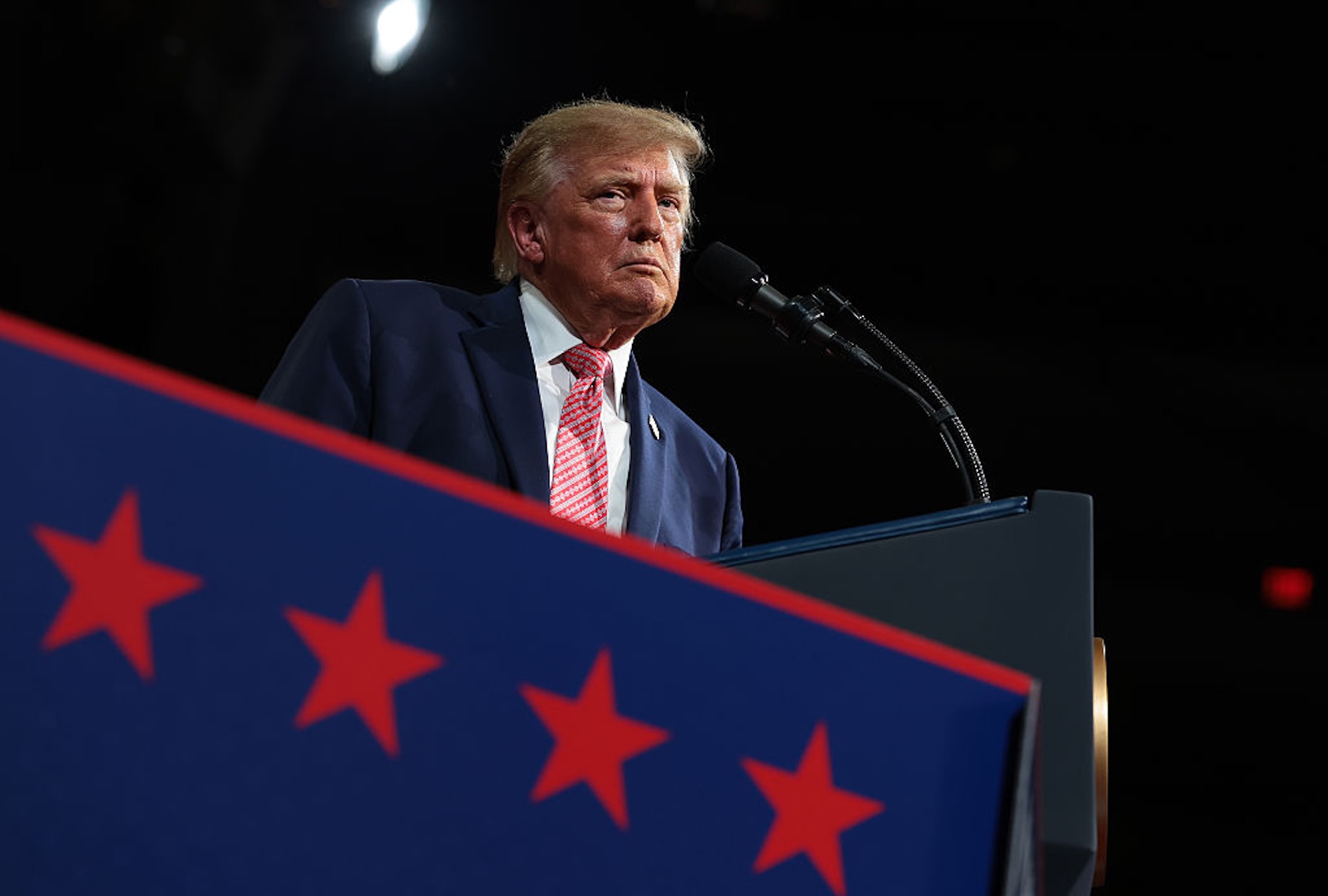
commentary With U.S. and Israeli elections days away, the Iran war may be entering a more dangerous phase Published October 27, 2026 9:00AM (EDT) President Donald Trump speaks during a campaign rally on Oct. 19, 2026 in Park City, Kansas. (Anna Moneymaker/Getty Images) Barely noticed among all the talk in the election campaign about great asses, shithouse countries and commie jihadists running for the Senate was a report from The New York Times warning of “heightened levels of tension and risk” surrounding Israel’s parliamentary elections, slated for today, and America’s Nov. 3 midterms due to the countries’ war with Iran, which has “entered a new phase.” They also offered this bracing observation: “This is how countries can escalate into full-scale war, several diplomats and outside experts noted.” How’s that for a wake-up call? In fairness, Donald Trump has mentioned in passing that he plans to “finish the job” after the midterm elections, with CNN reporting that the president “appears to be leaning toward major action.” On Oct. 15, the outlet revealed that the U.S. is considering using the “mother of all bombs” on Iranian energy infrastructure and nuclear facilities. (They admit that such a strike would be “performative,” since it would not actually accomplish anything, but would supposedly allow Trump to declare victory.) If anyone had the idea that a midterm election campaign would be the place where serious people of goodwill debate the major issues of the day, they were mistaken. For the most part, the war with Iran has hardly come up, and to the extent that it has, it’s been in the context of high gas prices. If anyone had the idea that a midterm election campaign would be the place where serious people of goodwill debate the major issues of the day, they were mistaken. For the most part, the war with Iran has hardly come up, and to the extent that it has, it’s been in the context of high gas prices, not the possibility of the conflict turning into a major conflagration from which the United States will not be able to walk away after putting on a fireworks show. We may be at a turning point, and nobody’s paying attention. The U.S. has received credible intelligence, according to the Times report, that Iran has “advanced” plans to attack Americans at home and abroad. According to Reuters, the State Department has ordered non-emergency government employees and their family members to leave U.S. diplomatic missions in Saudi Arabia and has reduced staff in Lebanon, the United Arab Emirates, Qatar and Jordan. NBC News revealed that “the U.S. military has been quietly scaling back its troop presence at bases across the Middle East as well.” It certainly sounds as if something is afoot, which the Times characterized in fairly alarming terms: The fact that Prime Minister Benjamin Netanyahu of Israel and President Trump are facing critical elections that could dramatically affect the balance of power in their countries feeds into the complex set of calculations that all sides are making. Even if he is defeated on Tuesday, Mr. Netanyahu could decide to launch one last strike that he may believe his successor would hesitate to execute. Similarly, Mr. Trump, who knows how unpopular the war is even among his strongest supporters, may want to show that at least when it comes to his powers as commander in chief, his authority is undiminished. Trump has claimed dozens of times that we have already won the war. This is not out of character; his habit is to prematurely declare victory in everything, apparently assuming that the force of his declaration makes it a reality. In the lead-up to the U.S. and Israel’s Feb. 28 attacks on Iran, Trump was apparently so pumped up by his historic political comeback and success at cruel mass deportation, murder on the high seas and the conquest of Venezuela, an oil-rich country, that he assumed he could succeed at what every former president knew was a fool’s errand: take over Iran, seize its oil and dominate the world’s oil supply. And, as Haberman and Swan reported in their book “Regime Change,” Trump had been convinced by whom he called a presidential historian (actually a caddie for Gary Player) that he was “the most powerful man who’s ever existed on the planet by far” — more powerful than Mao, Alexander the Great, Stalin, Hitler, all of them. What Trump has succeeded in doing is making Iran a global power, capable of re-ordering the world through control of one of the most important waterways on the planet. In the process, he has exposed the U.S. as a second-rate military power, at least compared to the country’s previous reputation, by insisting on fighting an unnecessary war of choice without a strategy while being low on munitions and proving that it lacks the capability of fighting on more than one front. Having let down our Middle Eastern partners who assumed that by allowing bases in their countries they could count on America to defend them — not to mention the administration’s destructive tariffs and abandonment of Ukraine — the world knows that the U.S. is unreliable, and they are looking elsewhere for alliances and economic partnerships. All this brings to mind historian Barbara Tuchman’s “The March of Folly.” Published in 1984, the book examines tragic wars of choice that needn’t have been fought but, because of hubris and ignorance, were waged anyway, despite being against the best interests of the countries that started them. As Tuchman put it: To qualify as folly for this inquiry, the policy adopted must meet three criteria: it must have been perceived as counter-productive in its own time, not merely by hindsight . . . Secondly a feasible alternative course of action must have been available . . . third . . . the policy in question should be that of a group, not an individual leader. The war with Iran ticks all those boxes. Want more sharp takes on politics? Sign up for our free newsletter, Standing Room Only, written by Amanda Marcotte, now also a weekly show on YouTube or wherever you get your podcasts. Among the conflicts Tuchman chronicled in the book are the errors of the Catholic Church that led to the Reformation, as well as King George III’s epic misunderstanding of the dynamics driving the colonists (and England’s other enemies) to rebel against the British Crown. She also turned her keen historical eye to the big kahuna of her era, Vietnam, in which the U.S. squandered its power and moral authority on a war that began as an ideological experiment, escalated for political reasons, and ended in failure and embarrassment only 51 years ago. You’d think that lesson would still be fresh enough that we wouldn’t indulge in such a folly again. But, of course, we have. While Afghanistan had at least the fig leaf of justification after 9/11, Iraq and now Iran have both demonstrated that the U.S. has learned nothing from its own recent history. Eight months in, Trump’s misadventure in the Islamic Republic has proven even more irrational than the others. As with all the follies, Trump indulged his fantasies, failed to understand the adversary and ended up working against his country’s own interests. A delusional, psychologically unfit president started a war based on shifting rationales, finally landing on the idea that Iran was pursuing a nuclear weapon. This was the same country that had been complying with an agreement not to pursue a nuclear weapon, but which this president tore up simply because it had been negotiated by the man he succeeded in office. We don’t yet know whether these latest threats will lead to an escalation by either party. But either way, the deed is done. The world has been fundamentally changed by Trump’s daft decision to start this war, and there is no going back. That’s how all these follies end, and it’s very rarely a happy ending for the countries that started it. Related Topics ------------------------------------------ Related Articles
Trump’s Iran war could escalate. Is anyone paying attention?
Full Article
Original Source
Read the full article at Salon →KhanList aggregates and links to publicly available news content. We do not host full articles from third-party sources. Always verify important information with original sources.