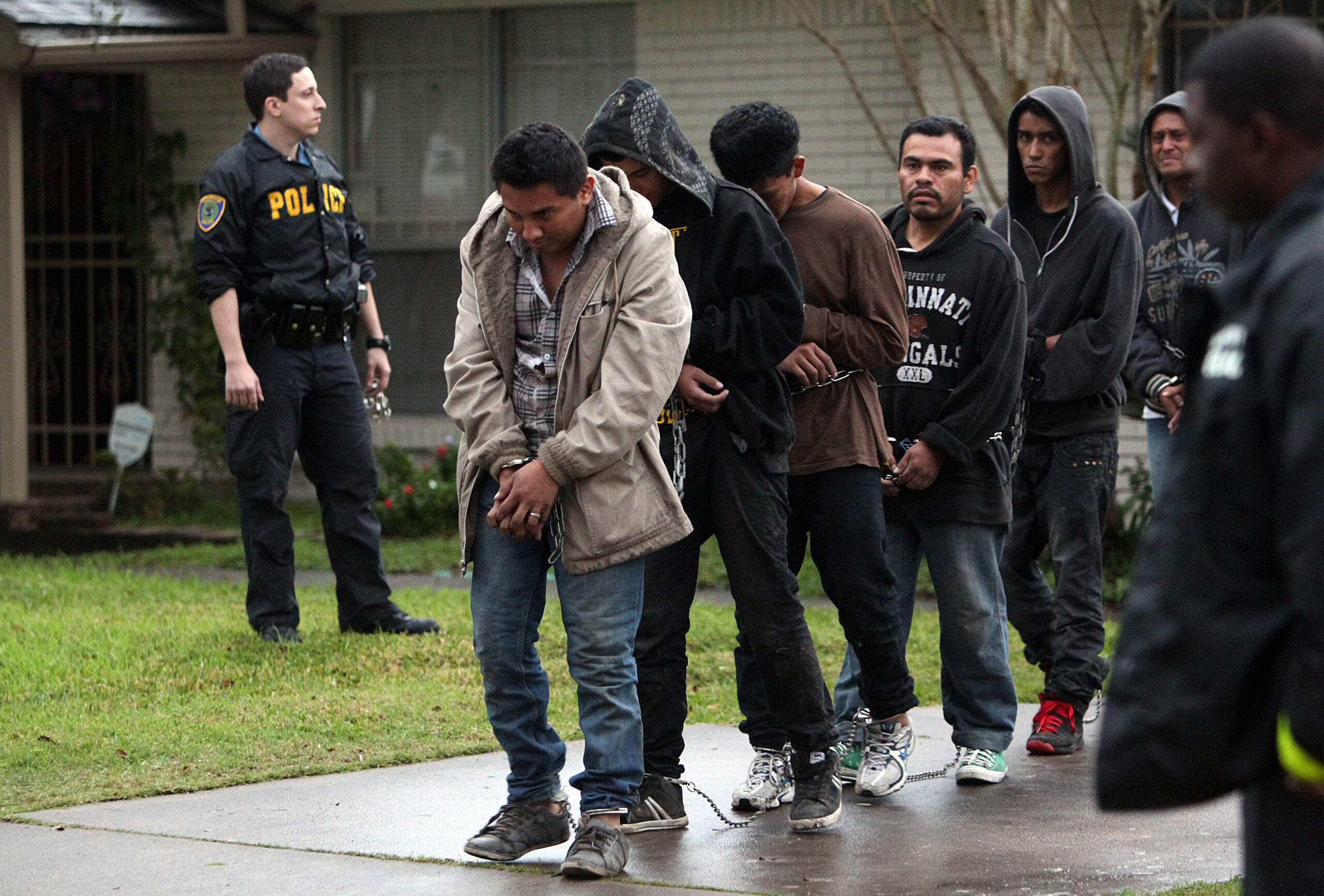
Politics The administration has made real progress in enforcing the law and reforming institutions, but some people are never happy. Photo by Mayra Beltran/Houston Chronicle via Getty Images The street fights with ICE seem to have ended for now. So have many of the televised SWAT-style immigration arrests. Did the resistance win? Have the changes made by the second Donald Trump administration helped curb illegal immigration, or has much of this just been for show? A careful look at the sum of the evidence at this point shows the measurable effects are increasingly difficult to dispute, whatever the political debate may be. No one knows how many illegal immigrants (a catch-all term here for false asylees, visa overstays, border sneaks, the general undocumented, and the like) are in the United States, but various studies suggest it is a large number, maybe 18.6 million people, close to 6 percent of the entire population of the United States. For many years, we had no mechanisms to reliably count them, and in many instances the government did not really want to know. For example, despite issuing as many as 11 million visas a year, the State Department has avoided conducting any comprehensive analysis of how many people overstay or misuse their visas for use as feedback to guide future decisions, claiming in a bureaucratic tussle that the task belongs to the Department of Homeland Security and isn’t any of their business. So any measurement of Trump’s attempts to lower illegal immigration begin with current, not historical, numbers. The U.S. Border Patrol recorded about 237,000 migrant “encounters” at the southern border in FY 2025, down from more than 1.5 million in FY 2024 and more than 2 million annually during the Biden peak years of 2022–2023. ICE reached a milestone this year of more than 10,000 foreign gang members arrested, many at the border. There are now more Border Patrol agents than any other time in the Patrol’s 102-year history. At the same time, Trump did away with the CBP One app, which allowed would-be asylum seekers to begin the process by smart phone app even before they reached U.S. soil. Trump also restricted asylum processing and toughened standards against widespread fraud, even seeking to punish an American immigration attorney who (allegedly) filed false asylum applications, a rare federal action. Trump expanded expedited deportations and removals, reinstated tougher ICE deterrence policies and arrests, and made changes to the State Department visa-issuing system abroad to include new and higher fees and bond deposits. He also reduced the number of posts issuing visas at all in fraud-plagued Africa and stopped immigrant and non-immigrant visa issuance entirely in countries that do not cooperate with the U.S. on deportations and fraud prevention. ICE arrests rose from a long-term average of roughly 350 per day to as many as 1,300 per day, increasing more than three times compared with the final year of the Biden administration. Monthly deportations from within the United States had increased by roughly 4.6 times by the ninth month of Trump’s second term. The use of third countries to accept deportees when their home country refuses to do so has increased significantly, with a new office at the State Department set up just to handle the details. Efforts to encourage self-deportation have yielded almost 90,000 voluntary departures, according to one estimate. ICE detention populations increased substantially, reaching nearly 70,000 detainees at one point, compared with roughly 39,000 when Trump returned to office. Congress also approved tens of billions of dollars for immigration enforcement and detention operations through 2029. Trump toughened up the civics test immigrants must pass in order to become citizens. The Justice Department launched legal challenges in states which allow illegal alien college students to pay the tuition rate reserved for legal in-state residents. Trump disincentivized working illegally in the United States while at the same time cutting into money-laundering by Mexican and other drug cartels with a 1 percent remittance fee on the often untaxed money sent by aliens in the U.S. to their home country. The administration’s changes were reinforced by two recent Supreme Court victories which allow Trump to regain substantial authority managing the border. In Mullin v. Al Otro Lado, the Court ruled an undocumented person must be physically present in the United States to make an asylum claim. Asylum-seekers who are stopped on the other side of the border (i.e., in Mexico, not actually admitted to America) are not “present” in the United States. If treated as inside the country, as under Biden, these individuals would be allowed to enter the U.S. and remain for years, often with work permits, while their asylum claims were pending. Many asylum seekers simply disappeared into the United States as permanent illegals rather than face refusal and deportation. The U.S. Government Accountability Office found the immigration court system does not systematically track hearing attendance anyway, making it impossible to produce a real “no-show rate.” The Supreme Court also gave DHS a powerful new tool in Mullin v. Doe, upholding the right of the administration to remove temporary protection status (TPS) from more than 356,000 Syrians and Haitians now in the U.S. Congress created TPS in 1990 to allow temporary legal status and work authorization to nationals of countries experiencing armed conflict, natural disasters, or other transient conditions that make safe return impossible. With TPS, Congress intended the emphasis to be on “temporary.” The alien would not be expected to return home in the immediate aftermath of an earthquake, but was expected to return home as soon as possible. TPS as created by Congress never provided a path to permanent residency or citizenship. Yet hundreds of thousands of aliens stayed in the U.S. indefinitely under TPS, often vying for other immigration statuses like asylum when available. Many Haitians affected by the new Supreme Court ruling have been in the U.S. on “temporary” status since 2010, many Syrians since 2012. What was once intended as a temporary humanitarian gesture had been hacked into a de facto permanent immigration status. The new Court ruling allows TPS to return to its original function. Trump is also seeking to end TPS for 13 out of 17 countries that held the designation when Joe Biden left office, covering some 1.3 million people in total. One TPS designation, for Somalis, has been in place for 35 years. Subscribe Today Get daily emails in your inbox At the same time, Trump’s deportations, arrests, and detentions do continue to face significant legal and political constraints. This shows how deeply entrenched illegal immigration is in our society, and how easily it can be made into an emotional and political football. The article you are reading now, with its statistics about ICE enforcement growing, might be seen by The Atlantic as a call to arms against fascism. But at The American Conservative, many of the same government actions are likely to get a nod of approval. Progressives are driven by the immigration myth that, because their great-great-grandpa immigrated to the U.S. from Warsaw or Palermo, America is obligated forever to allow near-unfettered immigration. Others believe it is the right of any person living under less-than-ideal circumstances anywhere in the world to “have a better life” in the U.S., ignoring that every other nation instead tries to vigorously control its borders and interior with metered immigration. Finally, so much of the opposition to the administration’s immigration changes is simplistic Trump-hatred. Reasonable Trader Joe’s–type suburban people are willing to suck tear gas and engage in street fights with armed federal law enforcement over points of immigration law they had not heard of a year ago. One resistor was just sentenced to 100 years in jail for trying to murder an officer in an armed assault on an ICE facility. The mayor of New York, unaware apparently of the importance of the rule of law in America, has vowed to resist a recent Supreme Court decision because he feels it is anti-immigrant. These people’s apparent willingness to risk death or imprisonment over the fate of illegal aliens they do not even know is irrational. What they see as authoritarianism is simply the enforcement, for the first time, of laws on the books for decades. They don’t see immigration enforcement as something that might possibly help America, only through some schadenfreud-inflected calculus that makes it seem Trump is losing a battle against them. This way of thinking blocks any sensible discussion of immigration, one that ultimately could result in reforms to the law. Policies that might once have been debated on their merits are now interpreted almost exclusively through the lens of “resistance.” It is all America’s loss, as chaos replaces democracy in the streets.
Trump’s Immigration Success—And Its Discontents
Full Article
Original Source
Read the full article at Theamericanconservative →KhanList aggregates and links to publicly available news content. We do not host full articles from third-party sources. Always verify important information with original sources.