
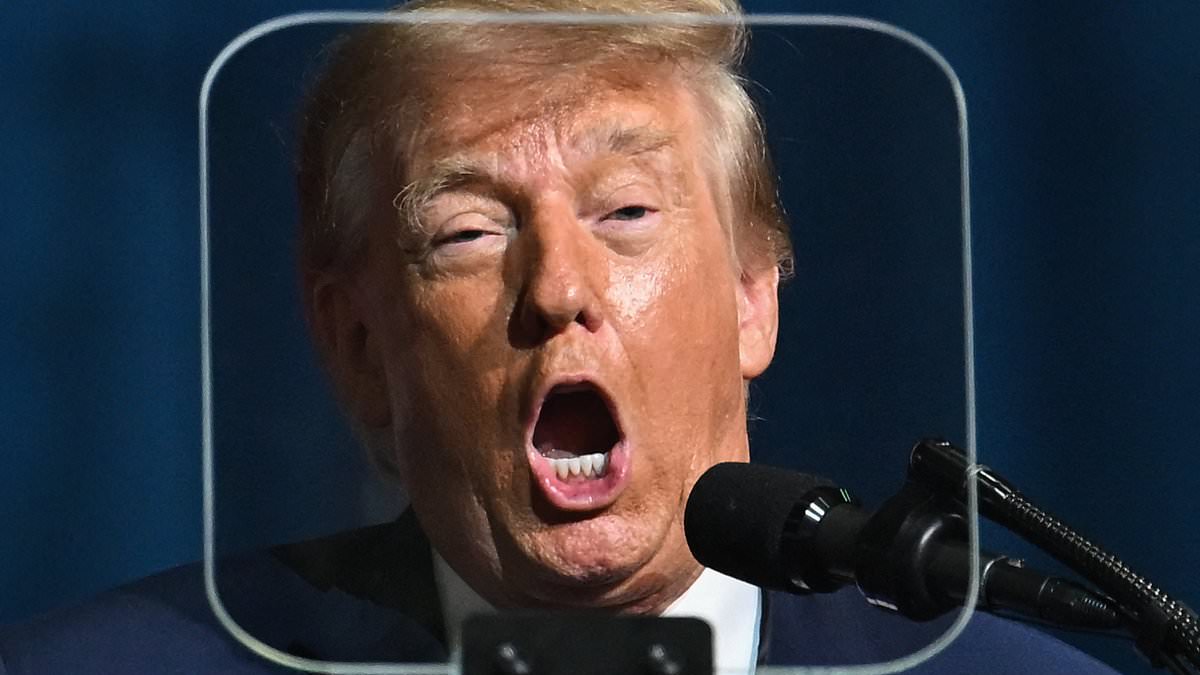
For Donald Trump, it will be his final test at the ballot box – and a referendum on the first half of his second term.By the end of Tuesday, over 100 million people will have voted in House and Senate races across the country, determining whether Democrats can capture control of both chambers.Predictions have included that Republicans will be swamped by a 'blue wave,' even a 'blue tsunami' – but other experts have been more sanguine, suggesting the polls could be wrong. It's happened before.Across the country, in conversations with voters, the Daily Mail has found the cost of living, gas and diesel prices, and disillusion with the Iran war to be the major issues, cutting across party lines.Much of the frustration is aimed at President Trump, whose approval rating recently sunk to a record low of 36 percent in an average of polls, with disapproval topping 60 percent.The President embarked on a frenzied last month of campaigning, holding 25 rallies in vulnerable states during October to get the GOP vote out.However, some believe the gains may be offset by his presence and rhetoric putting off independents, what one expert called a 'red undertow.'Some Republican candidates walked a political tightrope, embracing parts of Trump's agenda while distancing themselves from him on the Iran war. President Trump launched himself into two dozen rallies in October but will it save Republicans? Should Democrats take the House and Senate it will lead to Trump spending his final two years in office blocked from getting much of his agenda through, and engulfed by congressional corruption investigations into himself and his family.Held in the middle of each four-year presidential administration, the midterms see all 435 seats in the House, and 35 of the 100 Senate seats up for grabs. Three dozen governorships are also being decided.Currently, Republicans hold a majority of 218-214 in the House. There are two vacancies and one independent who caucuses with Republicans.That means Democrats need only to flip three red seats to take control and all reputable experts have them as overwhelming favorites to do so. It is mainly a question of how high they can push their majority in order to give Hakeem Jeffries, who would become Speaker, more capacity to rein in the democratic socialist wing of his own party.Prediction market Kalshi has put the Democrats at about 93 percent odds of winning the House and at 71 percent of taking the Senate, as of Friday.With the House almost certainly going Democrat, all eyes are on the Senate, where Republicans hold a majority of 53-47.A 50-50 result after November 3 would mean Republicans keeping control, with Vice President JD Vance holding a casting vote. Republicans would retain control of the committees Democrats hope to use to investigate Trump. President Trump campaigned for Ashley Hinson, the Republican Senate candidate in IowaFor victory, Democrats must make a net gain of four seats, taking them to 51.Of the 35 seats being fought, Republicans currently hold 22, and Democrats 13.The simplest way for Democrats to win is to hold the vulnerable state of Michigan, and then take four of North Carolina, Ohio, Alaska, Iowa, Maine, Texas, Kansas and South CarolinaIf Republicans were to take Michigan it would be an enormous setback for Democrats and it has become a focus of the battle in the final days.The seat is open as Democratic senator Gary Peters did not seek reelection.Abdul El-Sayed, 42, the Democratic nominee, who would be America's first Muslim senator, has proved to be a lightning rod for Republicans.President Trump has attacked him perhaps more than any other candidate, calling him a 'jihadist,' while Mike Rogers, 63, the Republican candidate, has tried to tie him to the Muslim Brotherhood.El-Sayed, a former public health official, has disavowed the group and denied any connection with it. He has also faced a backlash over links to the controversial Twitch streamer Hasan Piker. Michigan Democrat senatorial candidate Abdul El-Sayed has been a focus for Republicans as Democrats try to hang on to MichiganThe race had been rated a toss-up by the influential Cook Report, which assesses that no state is giving Democrats as much 'heartburn' as Michigan.However, late Monday, the site changed its rating to 'Lean D' as part of a prediction that saw the Democrats gaining 3-6 Senate seats. Meanwhile, Democrats are highly confident of taking North Carolina. Former governor Roy Cooper holds an eight-point lead in polls over former Republican party chair, and Trump ally, Michael Whatley. Republican-aligned groups have pulled advertising money from the state to direct elsewhere.Should North Carolina go blue, Democrats would need three more wins from states currently rated 'toss-ups' by the Cook Report – Ohio, Maine, Iowa, Texas and Kansas, which hasn't elected a Democratic senator since 1932. South Carolina, which hasn't done so since 1998, is also in the mix.While voters' concerns about the economy are universal, each state has its own issues and candidate dynamics affecting their race.In Texas, which has threatened to go blue before, Democrat James Talarico, 37, a seminarian, has made his Christian faith at the center of his campaign.But some on the religious right have accused him of deceiving voters and attacked him over previous comments about Jesus being 'non-binary' and there being 'six genders.'Trump has laid into him as 'Talafreako,' falsely accusing him of being a vegan, and tried to boost the Republican candidate Ken Paxton, who has been beset by marital and corruption scandals. Texas Democrat James Talarico could turn Texas blue but President Trump has dubbed him 'Talafreako'In Alaska, Democrat Mary Peltola is ahead in polls against sitting Republican Dan Sullivan. But the race has been roiled in the final week as the Justice Department escalates a criminal investigation into whether Democrats recruited a separate candidate in an effort to confuse voters.Sullivan appears on ballots as 'Dan S. Sullivan' alongside the labels of 'Republican' and "Incumbent," but a previously unheralded challenger is listed as 'Daniel J. Sullivan Jr,' without any party affiliation indicated,In Maine, Democrats were on the backfoot in July when their nominee Graham Platner dropped out after a sexual assault allegation, which he has denied.However, his replacement Troy Jackson, a former logger, now has a three-point lead in an average of polls over Republican Susan Collins, who is seeking her sixth term. A supporter of Democratic candidate for US Senate James Talarico holds up a sign at a rally in Dallas, Texas Voters wait in line to cast their ballot at a polling station in Austin, TexasIn Ohio, Jon Husted was appointed to take over the Senate seat of JD Vance when he became Vice President but is now losing in polls to former Democratic governor Sherrod Brown.The race has been one of the country's most expensive this cycle with Brown raising over $68 million by mid-October, to Husted's $20 million. Hundreds of millions of dollars more has poured in from outside groups.Husted, a former college football player, received unusual praise from Trump about his physique. The President told a rally: ‘His a** is like a pile of muscle.'Ohio's gubernatorial race has also received significant attention as Trump ally Vivek Ramaswamy runs against Democrat Amy Acton, a physician.Ramaswamy ran the most controversial advert in the entire midterm cycle, featuring Acton's estranged mother calling her a 'liar' and insinuating she has mental health issues.The mother, Donna Arthur, lost custody of her children after her husband, the children's stepfather, was indicted for raping Acton.Amid uproar, Trump backed Ramaswamy, saying the advert was like 'hitting pay dirt.' President Trump decided not to go to Kansas and Iowa at the weekend and to hold 'tele-rallies' instead A billboard critical of President Donald Trump in Toledo, OhioIn Iowa, Republican Ashley Hinson, a former broadcast journalist and staunch Trump ally, distanced herself in the final days of campaigning, declaring she would be a 'thorn' in the President's side if he was not good for Iowa. She is in a tied race with Democratic candidate Josh Turek, a double gold-medal winning Paralympic basketball player.One of the Senate seats most unexpectedly in play is Kansas, where Trump won in a landslide in three presidential elections.Like Texas, Democrats are running a candidate whose faith is at the forefront of his campaign. Adam Hamilton is the pastor of the state's biggest megachurch and has accused sitting Republican Roger Marshall, a doctor, of suing his patients and living out of state.In the bitter campaign, Marshall has hit Hamilton over a historic church abuse scandal and run an advert accusing him of 'protecting a pedophile.'In Kansas, the overwhelming issue is soaring diesel prices, caused by the Iran war, as farmers struggle during harvest time.Meanwhile, Democrat's last-minute hopes are rising in deep red South Carolina, which Trump won by 18 points in 2024.A poll shortly before Election Day put Darline Graham, the sister of the late Republican senator Lindsey Graham, in a tie with Annie Andrews, a Democratic pediatrician and gun control advocate.Trump made two visits to South Carolina in eight days in a rescue mission, branding the Democrat 'Tranny Annie' over her previous comments about transgenderism, and painting her as a 'radical lunatic' who would 'take your guns.' Democrat Dr Annie Andrews, a pediatrician, is running Republican Darline Graham close in a Senate race in South CarolinaGoing into the final days, Democratic Senate candidates were ahead in an average of polls by 3.6 points in Alaska, three points in Ohio, 2.5 points in Texas, and 2.4 points in Maine.However, the polling guru Nate Silver concluded that all were just a 'normal-sized polling error away from flipping' to Republicans.Averages of polls measuring the generic ballot, voters' preference for which party should control the House, show Democrats about eight points ahead.That margin would mean a gain of 24 seats in the House and a 239-196 majority, according to a model produced by Alan Abramowitz, Professor Emeritus of Political Science at Emory University.It would also mean Democrats gaining of six seats in the Senate, resulting in a 53-47 majority in the upper chamber.Given its margin of error, the model showed a two-thirds probability of Democrats gaining between 15 and 33 seats in the House, and between three and nine Senate seats.There was a one-in-six chance of Democrats gaining three or fewer seats in the Senate, leaving Republicans in control.Professor Abramowitz concluded there is a 'realistic chance that Democrats could fall short of the 51 seats they need to control the Senate.' After months of campaigning over 100 million ballots are expected to be castTraditionally, in midterm elections, the party in power receives a slap down from voters.In 2006, a so-called 'blue wave' saw Democrats pick up 31 seats in the House, ushering in the first era of Nancy Pelosi as Speaker.Four years later, President Barack Obama called his party's defeat a 'shellacking' as they lost over 60 House seats.In 2018, when Trump's Republicans were in control, the GOP lost 40 House seats.However, amid all the suggestions of a Democratic surge, it is worth noting that in Trump's first term, Republicans somewhat bucked the historical trend by increasing their Senate majority by two.His poll numbers are lower this time though. A recent poll put his net approval rating for how he has handled the economy at minus 33, and for inflation, it is at a rock-bottom minus 48.Republicans have spent big to stave off losses.Elon Musk alone has spent about $366 million to support Republican candidates, according to campaign finance records. The SpaceX boss, who voted early in Texas, said: 'The Democrats intend to cement one-party rule forever and make “democracy” meaningless.'Overall, a record $3.8 billion had been spent on political advertisements by both parties and outside groups by October 12, with more pouring in for the final stretch.Top spending came in the US Senate races in Texas, Ohio and Michigan, according to AdImpact, which tracks the numbers. Sign up HERE to our DC Insider newsletter for your guide on all the latest from the midterms campaign trail and what's rattling the White House
Trump's final midterm reckoning: 100 million Americans deliver their verdict as his approval hits rock bottom and Democrats dream of a 'blue tsunami' in his nightmare scenario
Full Article
Original Source
Read the full article at Dailymail →KhanList aggregates and links to publicly available news content. We do not host full articles from third-party sources. Always verify important information with original sources.