
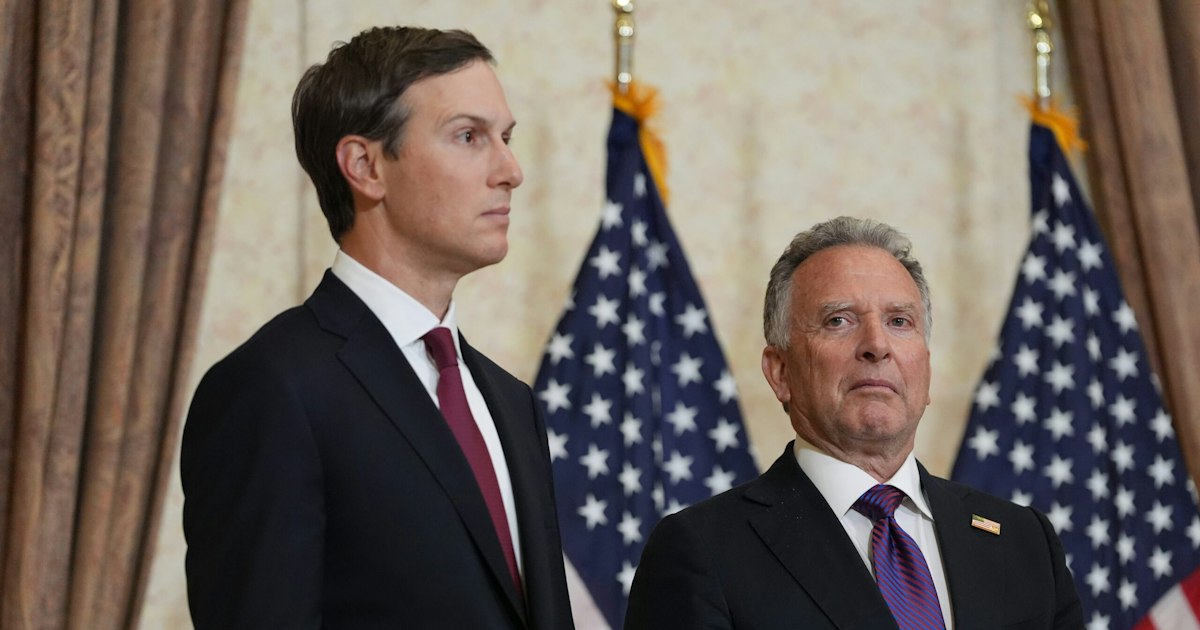
Ukraine But the Europeans should lead the process of changing it. (Photo by Jacquelyn Martin - Pool/Getty Images) After an eight-month pause, trilateral talks aimed at ending the Russia–Ukraine War resumed in Abu Dhabi last week, this time with an updated focus: Europe’s security architecture. In the lead up to the meeting, President Donald Trump’s envoy and son-in-law, Jared Kushner, described the goal: “to develop practical arrangements that address the security concerns of all sides, reduce the risk of future conflict, and create a more stable and predictable security environment.” European leaders immediately and loudly objected to this new direction, with some calling it a clear concession to the Kremlin. But this reaction is misplaced. Any discussion over how to end the war must address the shape of Europe’s security order for the simple reason that it is the flaws, shortcomings, and inconsistencies of the existing system that led to the outbreak of the conflict in the first place. Washington should not, however, underestimate the challenges involved in updating Europe’s security arrangements. A lasting solution will require not just European buy-in, but European leadership and the development of rules capable of managing what will be a contested and adversarial relationship between Russia and its neighbors for many years to come. Opponents of this broader focus have put forward a litany of reasons why the question of security architecture should be excluded from negotiations, at least at this stage. For some, the complaint is one of sequencing. They argue the discussions about modifying Europe’s security system can only begin once the fighting in Ukraine stops. History, however, suggests that this is unrealistic. Negotiations to end long-running bitter conflicts almost always occur as fighting continues on the battlefield. Talks to end the Korean War, for instance, started in 1951, about a year after the war began, but no deal was reached until 1953, after over 150 rounds of negotiations. For other critics, the concern is not one of timing, but the simple fact that Europe’s security architecture is on the table at all. Europe already has a security architecture, they argue, and it is based around the EU and NATO. If it needs updating (and some believe it does not), it is no business of Moscow’s. After all, they assert, Russia has repeatedly violated its commitments and shouldn’t get a say in Europe’s security in any case. There are several problems with this position, however. First, the , signed in 1990 to govern post–Cold War relations between Russia and the rest of Europe, is 36 years old and badly out of date, built to manage a Europe that looked very different than what exists today. Since then, the Soviet Union dissolved, NATO expanded to include 32 members, the European Economic Community became the European Union, and that organization took in new members. Yugoslavia broke into independent states after a series of brutal civil wars in which NATO interfered. Wars have been fought in Georgia and Ukraine, and most arms control treaties between the U.S., NATO, and Russia have expired. The balance of economic and military power on the continent has shifted. That a system set up for a fundamentally different Europe is not up to the task of managing today’s security relationships should not be controversial. Second, to define Europe’s security architecture as sufficiently robust because it has NATO and the EU is a strange distortion. If true, then Europe’s security order excludes the dozen or so European countries that are not members of either organization (for instance, both Russia and Ukraine) but incorporates Canada and the United States which lie an ocean away. Surely Russia deserves more of a say in Europe’s security architecture, of which it must be a part, than does the United States. And finally, it is not only Moscow that has shown an interest in revising the security architecture established in Europe at the end of the Cold War. The United States and both NATO and the EU have made their own changes to the rules and shape of Europe’s security order since 1990, often violating the spirit of agreements signed at the time. Their most recent updates occurred less than five years ago, when Finland and Sweden joined NATO. Although NATO’s eastward expansion is not technically prohibited by past agreements, the encroachment of its forces and military infrastructure toward the Russian border has clearly violated the Paris Charter’s commitment to “indivisible security” by making new NATO members more secure at Russia’s expense. From Moscow’s perspective, then, a request to revisit Europe’s security architecture is justified on at least two grounds: first, that this security order has been altered numerous times over the past four decades, sometimes by Russia but more often by NATO and EU members; and second, that Russia too is a member of Europe and deserves a say in the “European security order.” It is not a concession to Russia, but to reality, to acknowledge that shortcomings of Europe’s post-Cold War security architecture, including disagreements about who is included and who is not, are among the most important causes of the war in Ukraine. Russia’s primary objection has been the gradual development of a European security system that encompasses its neighbors while leaving Russia itself on the outside. This does not justify Russia’s use of force, but it does suggest that any lasting resolution to the conflict in Ukraine will require steps toward an updated security arrangement that formally incorporates the changes that have occurred over the past three decades, clarifies questions of membership, and addresses the grievances of Russia and its European neighbors in an enduring way. The U.S. is therefore right to bring this issue into ongoing trilateral talks now. Addressing the so-called “root causes” of the conflict is indeed a Russian demand, but it is also in Ukraine’s and Europe’s interests if the aim is a stable peace that guards against the recurrence of war. The question, then, is not whether Europe’s security order should be incorporated into ongoing talks but rather how to address this issue, given its complexity. So far, the U.S. approach has been ineffective. By seeming ready to work with Moscow over the heads of the Europeans, U.S. negotiators have exacerbated Europe’s perception of insecurity without achieving any real progress. It is clear that Washington cannot “deliver Europe” as some in Russia might have hoped when Trump returned to the White House in 2025. A better strategy would be to have Europe lead the renegotiation of its security architecture directly, with the U.S. acting not as mediator, but as supporting player. The Trump administration has already indicated that it expects Europe to manage its own conventional deterrence and take on more responsibility for its own defense. Since they are the ones who will have to implement any new security system and carry its burdens increasingly without U.S. involvement, it should also be up to Europe’s leaders to define how that future system will be organized and how it will incorporate Russia. To this point, much of Europe has not been ready to talk seriously with Russia about the continent’s security order. This is changing due to Europe’s fear that it will be left out of discussions likely to affect its future and its understanding that the price of a seat at the table in ongoing negotiations over the Russia–Ukraine War is a willingness to engage with Moscow. However, Europe’s readiness to talk is just a first step. A dialogue to devise a new European security architecture will not be quick or easy and it is unrealistic to think that it will be complete soon. The EU and Russia have both put forward maximalist proposals and negotiating from these to a mutually acceptable outcome will be challenging. Europe’s updated security order is likely to take shape over many years, made up not of a single grand bargain but instead a set of smaller agreements signed over time as trust between parties grows. This does not mean that the end of the current war must wait until this process is complete. Instead, talks to deal with Ukraine-specific issues and those related to Europe’s security architecture can occur in parallel, with the goal of achieving some baseline set of principles as part of a war settlement and deferring remaining issues to a later point. Subscribe Today Get daily emails in your inbox A near-term agreement might include a temporary freeze on new deployments of long-range missiles by all parties and new military construction close to the shared NATO–Russia border. It should also include efforts to manage areas of highest risk, including the Baltic region and Kaliningrad, the Black Sea, and the hybrid domain. An initial arrangement might clearly define redlines, mandate deescalatory steps by both sides, and include joint commitments to avoid certain types of activities or provocations. A return of all parties to the Open Skies treaty might be a medium-term goal. Finally, the establishment of a new crisis communication channel could prevent miscalculation. If the goal is to end the war in Ukraine, the European security architecture cannot be a taboo subject, nor can the discussion be managed primarily by the United States. It must be a European-led effort. Europe’s growing willingness to engage in a serious discussion is a positive sign that the Trump administration should encourage but not micromanage. Europe’s first challenge will be developing a group of interlocutors capable of representing diverse interests but also ready to put aside ideology in favor of pragmatism. It is not clear the recently proposed team—which would include officials from vocally anti-Russia governments and from the EU–can achieve a diplomatic breakthrough, but it is a starting point. The process of building a new European security architecture will undoubtedly suffer from setbacks. But that this process seems to have started in earnest is cause for hope.
Trump’s Envoys Are Right: Europe’s Security Order Must Change
Full Article
Original Source
Read the full article at Theamericanconservative →KhanList aggregates and links to publicly available news content. We do not host full articles from third-party sources. Always verify important information with original sources.