
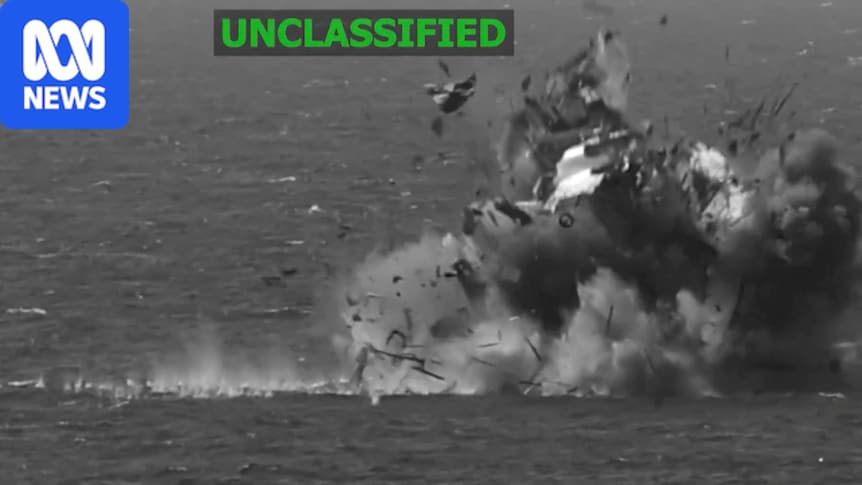
The Trump administration's lethal strikes on alleged "narco-trafficking" vessels at sea could be considered crimes against humanity that violate international, maritime and humanitarian law, according to a United Nations report.Since September last year, the United States military has launched air strikes on at least 68 vessels in the Pacific Ocean and Caribbean Sea, killing at least 223 people.Donald Trump says the operation, known as "Southern Spear" is necessary because the US is in an armed conflict with Latin American drug gangs transporting deadly drugs to America.At least 223 people have been killed in lethal US military strikes on at least 68 vessels in the Pacific Ocean and Caribbean Sea since September, 2025. (Reuters: Supplied/US Southern Command)The US president has also defended it as "self-defence" against groups such as the Venezuelan Tren de Aragua and Cartel de los Soles gangs, designated as Foreign Terrorist Organisations (FTOs).The strikes began amid an escalation in tensions that culminated in the "capture" of former Venezuelan President Nicolás Maduro by US forces in a covert night-time military operation.In a briefing note prepared for the UN Human Rights Council, Special Rapporteur Ben Saul said there is no legal justification supporting Mr Trump's perspective."Such attacks amount to serial extrajudicial killings in violation of the right to life," the report, published on Monday, said."[They are] unjustified in national or personal self-defence or under international humanitarian law, the international law of the sea, narcotics suppression conventions, or international counter-terrorism law."What did the UN report find?Mr Saul's report assessed the strikes' legality across nine areas, including the right to use self-defence, the authority to target individuals in an armed conflict, and whether the use of force was reasonable and proportionate to the risk of an alleged threat.The assessment found:There was no right to use the strikes as a means of self-defence because the organisations alleged to be chartering the vessels "have not mounted any 'armed attack' on the US;The strikes breached international self-defence law because there was no proof Venezuela sent the alleged trafficking groups as "armed proxies";The strikes were not a "last resort" or "necessary or proportionate" because the US ignored alternate responses such as an interception or boarding of the vessels;The US faced no military hostilities posed by the boats, meaning "the United States [was] attacking non-military vessels and individuals in peacetime";There was no evidence people aboard the vessels posed "any imminent threat to United States military personnel".In recent months, the US Southern Command has also targeted vessels it claims are refuelling stations for other drug trafficking boats. (Reuters: Supplied/US Southern Command)Mr Saul also said he found "reasonable grounds" that the strikes constituted a crime against humanity as part of "a widespread or systematic attack directed against any civilian population".Neither Mr Trump, members of his cabinet or White House officials have publicly responded to the report.Have the strikes been effective?Have the strikes impacted drug flow? Not according to the UN report.Mr Saul found there was "growing evidence" showing the military operation had not reduced the volume of illicit and dangerous drugs entering the US.He said the US Drug Enforcement Agency reported this year the strikes had not led to a decrease in the overall price or supply of cocaine into the country, and that border seizures had "remained constant"."Further, much cocaine in the region is reportedly moved on container ships (not small boats), most of which are never inspected at ports and then cross United States' land borders," the report said."The military attacks have focused on cocaine and not addressed the primary cause of drug overdose deaths in the United States — fentanyl and opioids — which are largely not transported by sea from Venezuela."The report also said the strikes to date had cost the US government an estimated $US4.7 billion ($6.6 billion).Trump plans to ramp up strikes elsewhereDespite the report's findings, Mr Trump has previously suggested the US could look to strike other parts of Latin America, including Mexico, Colombia and Cuba.US Secretary of State Marco Rubio this month toured countries in the region to discuss issues such as drug trafficking and illegal migration.After discussions in Colombia, newly-elected President Abelardo De La Espriella announced a plan to grow cooperation with the US, which has already seen American forces contribute to Colombian strikes and raids against drug cartels in the country.A military helicopter the US claimed took part in joint strikes against drug cartels in Ecuador in March. (Reuters: Supplied/US Southern Command)On September 9, Mr Rubio confirmed he would seek $US45 million ($63.2 million) in funding for Ecuador to crack down on drug trafficking, and the US and Ecuadorian militaries have launched joint strikes on vessels off the country's shores.Mr Saul's report found those strikes also included a "total extermination" strike in the Amazonian village of San Martin on the Colombian border that potentially involved "enforced disappearance, torture and forced displacement" of targeted individuals.Some refuelling vessels in the eastern Pacific have also been targeted in air strikes after US military personnel cleared them of people aboard. (Reuters: Supplied/US Southern Command)The international negotiations form part of the Trump administration's newly-created "Shield of the Americas" coalition, which includes the US and 19 Latin American nations, aimed at eliminating drug cartels.Earlier this month, newly-elected Peruvian President Keiko Fujimori said her country would also join the coalition.Report condemns Maduro 'capture'In the dark of the night on January 3 in the Venezuelan capital Caracas, explosions filled the air and low-flying aircraft could be seen throughout the city's skyline.The operation to capture Mr Maduro involved up to 150 aircraft launching strikes on key targets, supported by naval vessels off the coast and US Army Delta Force special forces soldiers on the ground, the UN report said.At least 75 people were killed in what Mr Saul described as plainly more than law enforcement."It constituted a prohibited use of force … giving Venezuela a right of self-defence, given its gravity; and an act of aggression under customary law."Such transboundary abductions constitute arbitrary detention."The Trump administration has accused Mr Maduro and his wife Cilia Flores of facilitating drug trafficking and firearms offences harmful to the US, which they both deny.Mr Maduro and his wife's trial in the US will begin on June 1, 2027.ABC/Reuters
Trump's 'drug boat' strikes may be crimes against humanity, UN says
Full Article
Original Source
Read the full article at Abc →KhanList aggregates and links to publicly available news content. We do not host full articles from third-party sources. Always verify important information with original sources.