
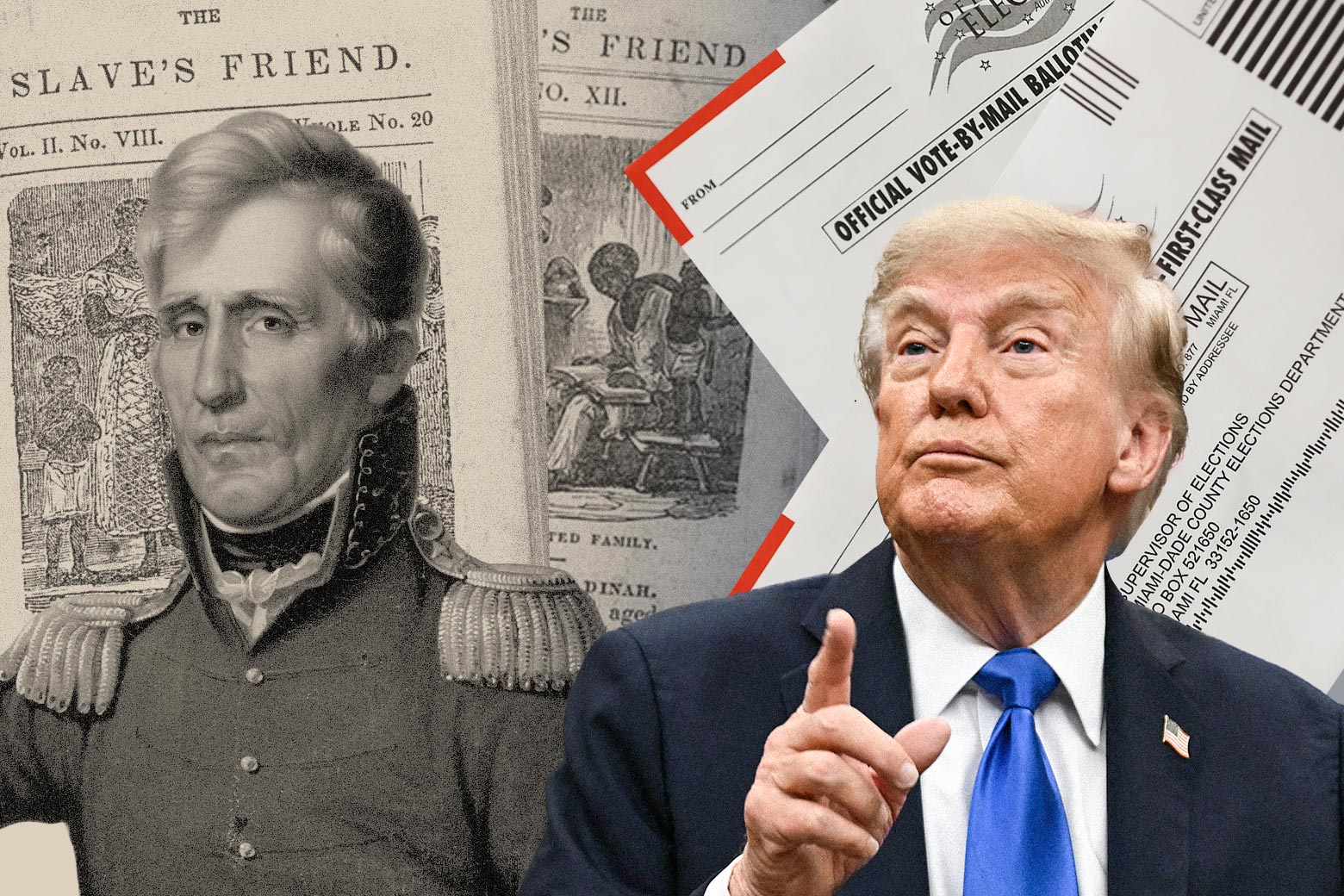
Jurisprudence His favorite president. Photo illustration by Slate. Photos by Rembrandt Peale/Wikipedia, Rare Books and Special Collections Division Library of Congress, Joe Raedle/Getty Images, and Brendan Smialowski/ AFP via Getty Images. Sign up for Executive Dysfunction, a weekly newsletter that highlights one under-the-radar story about how Trump is changing the law—or how the law is pushing back—and keeps you posted on the latest from Slate’s Jurisprudence team. President Donald Trump’s executive order directing the post office to suppress mail voting has often been called “unprecedented.” That is not quite right. An earlier president—in fact, one of Trump’s role models—also empowered the Postal Service to squelch political opposition. It was one of the most disreputable episodes in U.S. history, and Trump has attempted to revive it with a modern twist. In the summer of 1835, the American Anti-Slavery Society began mailing a pamphlet titled Human Rights, along with other literature, to thousands of civic and religious leaders in Southern states, hoping to convince readers of the immorality of slavery. Things did not go as planned. That July, a shipment that included Human Rights, the Emancipator, and a children’s magazine called the Slave’s Friend arrived in Charleston, South Carolina. The local postmaster, a Jacksonian Democrat named Alfred Huger, was unnerved by what he considered inflammatory content and sequestered the abolitionist material, rather than comply with his legal obligation to deliver the mail. That evening, a mob of so-called lynch men broke into the warehouse and removed the mailbags, which they soon consigned to a great bonfire that attracted thousands of cheering spectators. Huger wrote for instructions to Postmaster General Amos Kendall, as well as New York Postmaster Samuel Gouverneur, from whose office the offending literature had been shipped. Gouverneur agreed to refuse acceptance of abolitionist shipments pending a ruling from Kendall. Kendall had been a key backer of Democrat Andrew Jackson in the 1828 election, having defected from Henry Clay’s Whigs. His reward was appointment to Jackson’s “Kitchen Cabinet,” in which he was widely considered one of the president’s most loyal advisers. After his reelection in 1832, Jackson nominated Kendall to be postmaster general. The appointment was controversial, as Jackson’s opponents feared the consequences of putting such a partisan figure in charge of the nation’s communications. Nonetheless, Kendall was confirmed. He did not let Jackson down. Kendall’s reply to the Charleston postmaster was careful but unmistakable. Acknowledging that he lacked statutory authority to ban material from the mail, he nonetheless ruled against delivery of the abolitionist periodicals. “By no act, or direction of mine, official or private, could I be induced to aid, knowingly, in giving circulation to papers of this description, directly or indirectly,” he explained. Jackson, a slaveholder and the brutal enforcer of Indian removal, enthusiastically agreed that the “wicked plan of exciting the negroes to insurrection and to massacre” had to be stopped. He instructed Southern postmasters to record and publicize the names of even individual subscribers to abolitionist newspapers to encourage intimidation by their neighbors and perhaps even compel them to leave the South. In his message to Congress that year, Jackson recommended legislation to prohibit, “under severe penalties, the circulation in the Southern States, through the mail, of incendiary publications intended to instigate the slaves to insurrection,” which of course meant any abolitionist pamphlets or newspapers. Jackson’s proposal died in the Senate, but that did not end postal censorship of abolitionist periodicals. Many Southern states passed their own laws and resolutions mandating rejection of abolitionist material, on the spurious claim that it tended “to excite the slaves of the southern states to insurrection and revolt.” Southern postmasters thus continued to withhold antislavery periodicals, with the tacit approval of Jackson protégé Kendall. The local suppression of abolitionist mail persisted throughout the antebellum era during the administrations of Jackson’s eight successors, none of whom enforced the federal statute prohibiting detention of the mail. In 1857, for example, Attorney General Caleb Cushing, appointed by President James Buchanan, opined that Mississippi law superseded the federal postal statute because of the state’s right, under the Constitution, to protect itself “against ‘domestic violence’ and to make provisions to ‘suppress insurrection.’ ” Consequently, the postmaster in Yazoo City, Mississippi, could not be required to deliver printed matter that tended “to produce disaffection, disorder and rebellion among the colored population of the state.” Both Jackson’s and Trump’s efforts to manipulate the mail have rested on fabricated premises. In Jackson’s case, it was the racist myth that enslaved people were content with their condition and would remain passive unless instigated by Northern abolitionists. In Trump’s case, it is the myth that mail ballots—the same method Trump uses to vote—are a form of election rigging. Or, as he put it with characteristic mendacity and capitalization, “ELECTIONS CAN NEVER BE HONEST WITH MAIL IN BALLOTS.” The slavocrats’ abuse of the Postal Service ended only with the Civil War. The Supreme Court has the power to terminate Trump’s voter-suppression scheme much sooner. We shall see. Donald Trump History Jurisprudence Voting Voting Rights U.S. Postal Service 2026 Midterms
Trump’s Attack on the Postal Service Echoes Another President’s Shameful Plot
Full Article
Original Source
Read the full article at Slate →KhanList aggregates and links to publicly available news content. We do not host full articles from third-party sources. Always verify important information with original sources.