
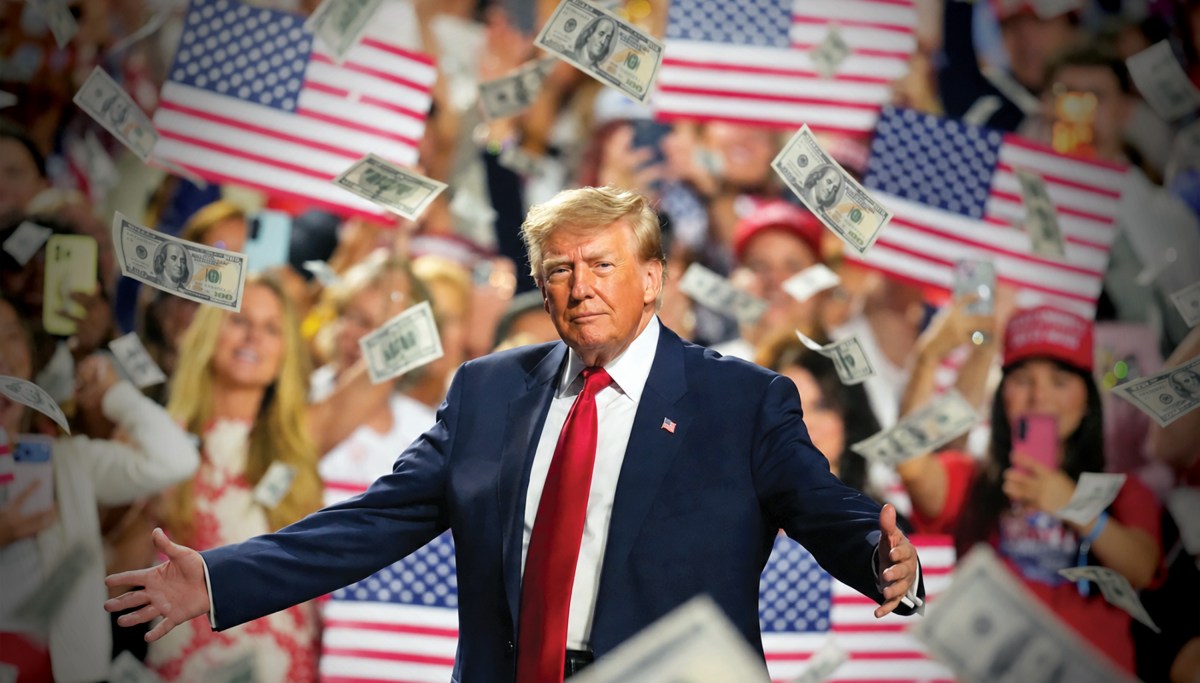
President Donald Trump’s promise to give people $5,000 if Republicans win in November brings with it an array of logistical and political challenges.Trump said at the GOP midterm convention that if Republicans hold on to the House and the Senate, the federal government would send a $5,000 check to every adult citizen. He said during the Dallas event that the check would be a “dividend” for the “tremendous economic success” of the United States. Trump stipulated, though, that the money would have to be spent in the U.S. TRUMP’S PROMISED $5,000 ‘DIVIDEND’ CHECKS: WHAT TO KNOWBut the declaration in Texas presents major challenges. Treasury Secretary Scott Bessent suggested it might be possible to issue the money without authorization from Congress, although experts view this as unlikely.During testimony on Capitol Hill, Rep. Emanuel Cleaver (D-MO) pressed Bessent on whether he believes Trump can actually make $5,000 payments without Congress’s consent. Bessent added he would consult with House Speaker Mike Johnson (R-LA).(Washington Examiner illustration; Julio Cortez/AP) “We are currently examining that at Treasury,” Bessent said, “and when the Republicans win in November, if we need to, I look forward to working with Speaker Johnson on it.”Bessent added a bit later, “If it becomes clear that we need congressional authority, I will meet with Speaker Johnson.”Ryan Young, a senior economist at the Competitive Enterprise Institute, emphasized to the Washington Examiner that Congress has the power of the purse, not the White House. So, any $5,000 payments would have to be approved by lawmakers and not just by Trump.It’s a constitutional rule that has challenged prior presidents, including Trump’s immediate predecessor, Joe Biden, a Democrat.“In the Biden administration, when he tried to spend about $430 billion on student loans, the courts were pretty decisive in stepping in and saying, ‘You can’t do that. You have to go through Congress,’” Young said.“Anything on that scale, you’ve got to go through Congress,” Young added. “And anything that they would get through without Congress, surely that would be subject to a lawsuit on major questions grounds, at the very least.”Capitol Hill concerns Going through Congress to get the $5,000 payments enacted would take an enormous amount of political capital. That is because the national debt just hit $40 trillion while inflation is already rising. The optics of adding to that at a time when bond yields are up and interest rates are high would be damaging to the economy — something lawmakers don’t want to have tied to them.Veronique de Rugy, a senior research fellow at the Mercatus Center at George Mason University, told the Washington Examiner that there is “zero” chance that Congress would pass legislation to pay out $5,000 to adults.“Where are they going to get the money? There’s no dividend — dividend, the language of the administration talking about dividends — implies that this is like a payoff from some investments, but that’s not the case,” she said.The dividend check would cost the Treasury somewhere in the ballpark of $1.3 trillion if every adult in the U.S. received the $5,000 payment as Trump indicated. Or, to put it another way, it would well eclipse the $870 billion the War Department spent on military programs last fiscal year. Still, there are ways to massage that number down. One obvious way would be to put sharp income caps on the benefit so that the number of payments and thus the cost to the government would be dramatically reduced.“Means testing is probably the biggest one,” Young said, although he emphasized that the cost will still be high no matter what.Mark Hamrick, chief economic analyst for the Hamrick Brief, said that it is “impossible” for such payments not to add to the deficit.“They’ve talked about achieving all these benchmarks that haven’t been achieved, including 3% growth, and the way things are moving right now, that appears to be very unlikely,” Hamrick told the Washington Examiner. “So, it’s either sort of thinking that’s born of an alternative universe, or pie in the sky, or some combination thereof.”Still, Bessent indicated on Capitol Hill that there might be a way to do it without adding to debt and deficits.“I believe that there are ways to do it without increasing the debt or deficit,” Bessent said.When asked specifically how that could be done, the treasury secretary responded that it is “in process right now” and that he is not ready to discuss it.“But at Treasury, we’ve been working on it for quite a while,” Bessent added.There are also concerns about inflation that make the payments an even trickier lift for the Trump administration and Congress.Many supply-siders blame Biden and Democrats, as well as Trump and Republicans to an extent, for pumping the economy full of stimulus spending during the COVID-19 pandemic. The effort juiced demand and, in turn, created the inflation monster that the Federal Reserve is still grappling to vanquish.Experts said that sending out more than $1 trillion in checks, without offsetting tax hikes or spending cuts, would add to inflationary pressures. “What we’re going to see is either No. 1, the federal government borrowing more dollars, or having the Federal Reserve print the dollars to buy more government debt to make this possible,” said Joel Griffith, a senior fellow at Advancing American Freedom, a group founded by former Vice President Mike Pence. “Either one of those scenarios causes a higher cost of living.”Hamrick said that some of the inflationary pressure might be lessened if households saved the payments rather than immediately going out and spending them. But he said the evidence is clear that most of it would likely be spent pretty quickly.BESSENT SAYS TREASURY IS ‘EXAMINING’ ABILITY TO CUT $5,000 CHECKS WITHOUT CONGRESSThere are also broader structural economic concerns at play, which would make it difficult for Congress to pass such payments. For instance, Social Security and Medicare are heading to must-act deadlines in the coming years.“They shouldn’t be handing out checks,” de Rugy said. “They should be reforming entitlement spending. In 2032, the trust fund for Social Security is going to dry up, and that means, by law, spending is going to have to be cut by 22% across the board.”Zach Halaschak (@zhalaschak) is the economics reporter for the Washington Examiner.
Trump’s $5,000 check promise faces major obstacles
Full Article
Original Source
Read the full article at Washingtonexaminer →KhanList aggregates and links to publicly available news content. We do not host full articles from third-party sources. Always verify important information with original sources.