
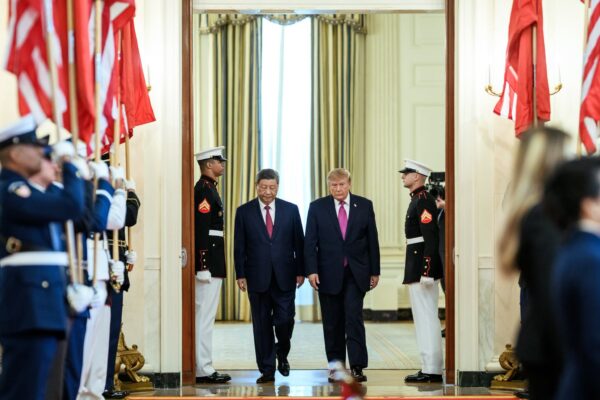
When Chinese President Xi Jinping held a summit with U.S. President Donald Trump on September 24, Trump made sure Xi knew how he felt. The U.S. leader expressed no fewer than three times in the first minute of their joint remarks that it was his “honor” – or even “great honor” – to host Xi. The “honor,” apparently was all Trump’s. Xi made no similar expression of feeling “honored” to be hosted by the U.S. president, simply saying he was “glad” to be in Washington. That set the tone for a meeting that was long on symbolism but short on substance. Trump was eager to impress; Xi was all business. Trump was reportedly keen to match the lavish hosting he received during his visit to Beijing in May. As Xi pointed out at the state dinner in Washington, it’s “unprecedented” for the Chinese and American presidents to exchange state visits in such a short period of time. “Today, President Trump and I had sincere and in-depth exchanges and reached common understanding on many issues,” Xi said. “This has added new substance to the constructive China-U.S. relationship of strategic stability, and provided new strategic guidance for China-U.S. relations.” “The constructive China-U.S. relationship of strategic stability” is Beijing’s new mantra for the relationship – and the first that China has successfully gotten Washington to buy into. The basic gist is that China and the United States will continue to compete – something Beijing has finally admitted is happening, after years of studiously denying any rivalry – but keep their competition “within bounds.” Other than agreeing, in principle, not to let their competition spill into conflict, though, it wasn’t immediately clear what “common understandings” were reached at the summit. No major breakthroughs were expected, and that turned out to be accurate. The biggest deliverable was an agreement – actually reached before the summit, during China-U.S. economic talks on September 20 – to extend their trade truce through January 10. The original deal, reached at the first Trump-Xi summit in Busan, South Korea in October 2025, saw the U.S. lower tariffs on Chinese goods, while Chinese agreed to pause enforcement of export controls on certain critical minerals. The deal was only good for a year initially, and was set to expire in November. Many experts had predicted an extension was in the offing – if that hadn’t been the case, it was suggested that there wouldn’t have been much reason for Trump and Xi to meet at all. But the short length of the extension – just two extra months – was a bit of a surprise. Bessent mentioned that China needed to make good on its promises, suggesting that the deal could be extended again if Washington is satisfied with what it sees. Or it could be eventually scrapped. China, meanwhile, hasn’t confirmed even that limited extension. The official readout from the Chinese Foreign Ministry said a “new joint arrangement” had been reached in economic and trade discussions, but did not elaborate on what that deal was. To recap: the biggest practical impact of the Trump-Xi summit was a possible agreement to slightly extend a pause – not a cancellation – on the worst of the trade war. Oh, and two more pandas for the Atlanta Zoo. That about sums up the fruits of the fragile truce currently in place between China and the United States. If the outcome on trade was a mixed bag, other areas were even murkier. There was much focus on artificial intelligence (AI) prior to the summit, especially as U.S. AI companies themselves have begun raising safety concerns. There had been suggestions that the U.S. and China could unveil an “AI safety mechanism” that would see both sides notify the other of concerning incidents. Trump, however, has consistently rejected any calls for additional oversight of AI – precisely because he wants the United States to go full speed ahead in the race against China. In a Truth Social post, prior to the summit, Trump stated that AI (which he has started referring to as “super intelligence”) “will be a big topic of discussion, but I want to leave it exactly where it is. That is China’s position also.” Xi, however, was more cautious on AI, referencing the need to “jointly prevented the misuse and abuse of AI,” and emphasizing that “AI must be kept under human control.” But, like Trump, his primary concern was the AI race and preventing the U.S. from “guarding against” China’s AI development through export controls and other restrictions. As James Wang noted in a recent analysis for The Diplomat, Beijing is well aware of Washington’s tendency to frame restrictions on Chinese technology as safety measures. As expected, Xi also brought up Taiwan. He explicitly asked “the U.S. side” to “adhere to the correct position of opposing ‘Taiwan independence.’” Much reporting ahead of the summit held that Xi was hoping to get Trump to explicitly say that the U.S. “opposes Taiwan independence.” The usual phrasing is that the U.S. “does not support Taiwan independence.” For China, an outright expression of opposition would be a key win – especially because Beijing purposefully conflates Taiwan’s ruling party and president with “Taiwan independence forces.” Beijing is also hoping to extend the current “pause” on U.S. arms sales to Taiwan to a de facto moratorium – something it’s tried to do in the past, but without success. Whenever a U.S. administration signals openness to scaling back arms sales to please China, Beijing ups the pressure. Rupert Hammond-Chambers, president of the U.S.-Taiwan Business Council, called the current period the “fourth Taiwan arms sale freeze,” following “two under former President George W. Bush from 2005-2007 and 2007-2008, and one under former President Barack Obama from 2011-2015.” In all these cases, Hammond-Chambers argued, the “freeze” did nothing more than embolden Beijing. “The Trump Administration has let the fox in the henhouse. Telegraphing sensitivity to the Chinese position on Taiwan this past spring, Trump has empowered China to affect his decisions [on arms sales],” Hammond-Chambers wrote in a media release. There’s been no movement on the arms sale, which has been on hold since before the May summit. As with the Trump-Xi summit in May, this time there was another brief reference to an exchange of views “on major international and regional issues including the situation in the Middle East, the Ukraine crisis and the Korean Peninsula.” There was, however, no suggestion of any agreement or alignment on those issues – unlike after the May summit, when Trump got Xi to say that China opposes Iran’s development of nuclear weapons and supports “the free flow of energy” through the Strait of Hormuz. If the actual substance showed little sign of convergence, you’d never know it from the optics. Trump lauded his “truly great friendship” with Xi and showed special deference to the Chinese president, including personally meeting him on the tarmac upon Xi’s arrival in the United States. Trump and First Lady Melania Trump also arranged an opulent welcome ceremony, featuring musical performances and drills by 479 military personnel and ending with a flyover by a B-2 stealth bomber and four F-22 fighter jets. After the summit proper came the state dinner attended by a who’s who list of top American businesspeople: OpenAI’s Sam Altman, Nvidia’s Jensen Huang, Apple’s Tim Cook, Amazon’s Jeff Bezos, Meta’s Mark Zuckerberg, Google’s Sundar Pichai, and Elon Musk of Tesla, X, and SpaceX. Notably, though, Xi did not bring his own entourage of business leaders – a marked contrast with Trump’s visit to Beijing, when he included top CEOs in his delegation. Speaking to the New York Times, Emily Kilcrease of the Center for a New American Security called the absence of Chinese business leaders “a rather depressing marks of how bad the relationship has gotten.” Overall, the summit left the impression of a stable, positive relationship, but there was little to back up that sentiment. Trump claimed that he and Xi had “made tremendous strides on the issues facing our two countries” – including the “unbelievably successful” Board of Trade, which hasn’t actually even launched yet – but as always, there were no specifics. Xi’s positive comments, meanwhile, were mostly forward-looking. “[T]hrough candid, in-depth, and continued dialogue, our two countries can understand each other better, seek common ground while shelving differences, and build up mutual trust,” he said – an aspiration, not an accomplishment. Xi also emphasize the parallels between the “great rejuvenation of the Chinese nation” and Trump’s “make America great again” slogan, which he argued can “be mutually reinforcing.” Xi continued: “Our competition should be a healthy one and should be kept within bounds. It should be a race of catching up with one another, not a wrestle in which one either wins or loses.” It was a somewhat odd way of trying to cast competition as “win-win.” I don’t know what races Xi has been watching, but generally those have a winner as well – and multiple losers. Given the shallow nature of the current era of good feelings in China-U.S. relations, it’s telling that the trade truce was extended only until January 10 – just long enough to keep relations steady through the APEC summit (to be held in Shenzhen, China from November 18-19) and the G20 summit (Miami, the United States, December 14-15). Assuming Trump and Xi attend both events, that could set up two additional summits, for a total of four in 2026 alone. After that, all bets are off.
Trump-Xi Summit: Heavy of Vibes, Light on Substance
Full Article
Original Source
Read the full article at Thediplomat →KhanList aggregates and links to publicly available news content. We do not host full articles from third-party sources. Always verify important information with original sources.