
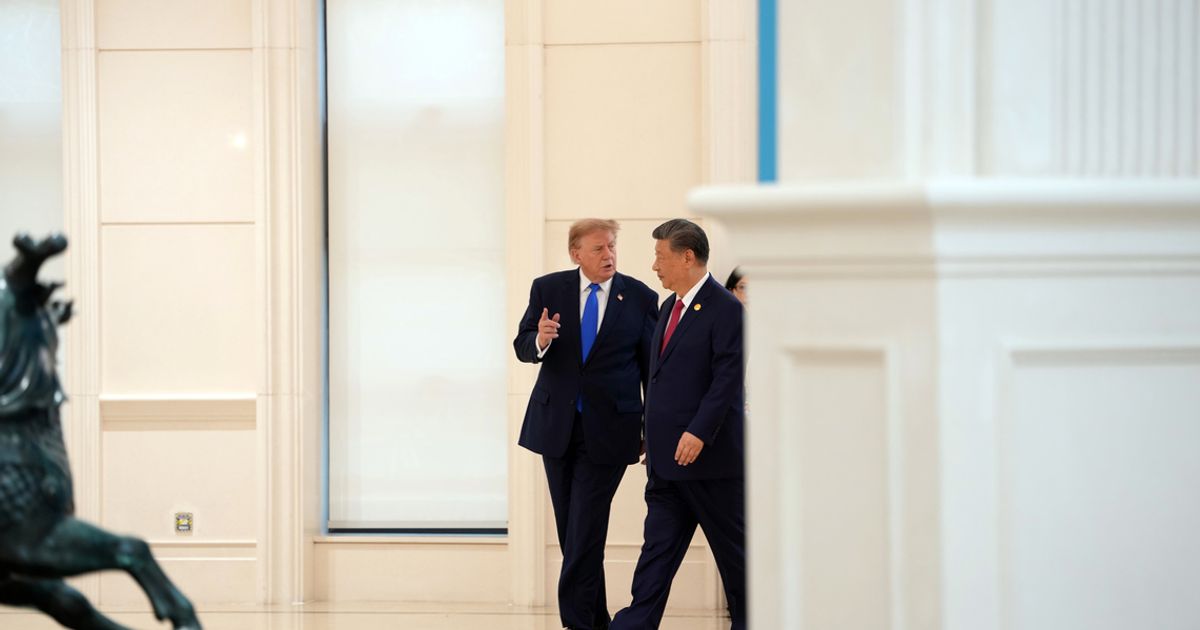
SHENZHEN – From hand holding to a brief hug, US President Donald Trump and Chinese President Xi Jinping displayed close rapport as they met for the third time this year, while seeking to sustain fragile rapprochement despite disagreements over trade and technology.Their hour-long meeting, held on Nov 19 on the sidelines of the Asia-Pacific Economic Cooperation (APEC) summit in Shenzhen, came against a backdrop of fresh friction over US restrictions on advanced AI chips and the abrupt resignation of Nvidia chief executive Jensen Huang over a scandal with an alleged Chinese spy.Despite the tensions, both leaders struck an upbeat tone about the direction of bilateral relations, with Xi emphasising the need to build on recent progress and manage differences, while Trump said: “As long as you and I are in charge... we’re never going to have a problem.”In his opening remarks, Xi said the two leaders had jointly explored “the right way for China and the US, as two major countries, to get along”, and relations have remained generally stable.“The efforts you have made are there for all to see and will go down in history,” he said, noting that building a constructive China-US relationship of strategic stability is an unprecedented, pioneering undertaking.He added that he remains committed to working with Trump to steer the course of China-US relations.Trump was similarly upbeat in his opening remarks, hailing his “very special relationship” with “my friend” Xi and expressing optimism that their latest meeting would produce results.Trump spoke of their mutual interest in “ensuring that energy flows through the Strait of Hormuz” and that “Iran cannot have a nuclear weapon”.He highlighted progress in bilateral trade, saying that a Board of Trade established following their May summit had brought “greater balance to a very lopsided relationship” between the two countries.Trump also said that he would ask Xi to “do more for our farmers”, citing China’s “insatiable appetite”.George Chen, partner and chair of digital practice at Washington-based consultancy The Asia Group, told The Straits Times that agricultural trade was relatively straightforward to advance compared with contentious issues such as AI and semiconductor export controls.“Both sides may want to pick something relatively easy to start to show more results. That can also build more mutual trust,” said Chen, who was in Shenzhen for the APEC CEO summit.Such a deal could also carry domestic political benefits for Trump following the Republican Party’s midterm elections losses, particularly in the agricultural states, he added.Chinese Commerce Ministry said on Nov 19 that officials from both countries held the inaugural Board of Trade meeting via video conference on Nov 13, with plans for the agricultural working group established under the board to hold its first meeting soon.The Shenzhen summit came after Trump-Xi meetings in Beijing in May and Washington in September. They are expected to meet again at the Group of 20 (G20) summit in Miami in December.The previous meetings produced agreements to establish bilateral trade and investment mechanisms, including a US$30 billion (S$38.7 billion) tariff reduction framework, and to improve communication on AI-related risks and extend a trade truce until Jan 10, 2027.Close rapportIn Shenzhen, the two leaders displayed warm rapport, with some of their interactions drawing media attention.After a group photo on the morning of Nov 19, Trump extended his left hand to Xi as he stepped on an escalator, appearing to invite the Chinese leader to stand beside him, according to a video that went viral online. Xi was seen reaching out to lightly hold Trump’s wrist and stepped up to stand beside him.Xi also made the rare gesture of welcoming Trump at the airport, reciprocating the latter’s reception of him in Washington in September. It was the first time Xi did so for any foreign leader since he took power in 2012.The two leaders shared a brief hug at the foot of the aircraft stairs, while their countries’ national anthems were played, honours that showed the importance Beijing placed on the visit, despite it not being a formal state visit.Another video clip of Trump pulling back the window curtain to view the night sky while travelling in his presidential limo, known as The Beast, on Nov 18 trended on Chinese social media. Some Chinese netizens saw it as a sign of how safe Trump feels when he is in China.For Xi, the meeting was an opportunity to demonstrate that Beijing could sustain engagement with Washington while hosting a major regional economic gathering.China has sought to use its role as APEC host to promote its vision of regional economic integration and free trade, contrasting with what it often describes as rising protectionism and unilateralism.AI rivalryHowever, the diplomatic warmth on display came amid fresh friction over Washington’s tightening restrictions on China’s access to advanced technology.On Nov 16, the Trump administration announced fresh restrictions aimed at preventing Chinese companies from accessing advanced American AI chips through overseas data centres.The measures seek to close a potential loophole in existing US export controls, which restrict direct sales of advanced AI chips to China over national security concerns that the technology could strengthen Beijing’s military and AI capabilities.Beijing opposed the latest curbs, warning on Nov 17 that it would take countermeasures if Washington pressed ahead with them.In the readout of the meeting, Beijing called for greater coordination to manage AI safety risks and ensure the technology remains under human control, without addressing US chip export restrictions or the broader technological rivalry.Since the second Trump-Xi summit in Washington, the two sides have agreed in principle to explore an incident-notification mechanism that would allow them to share information about serious AI-related risks and incidents, although the scope and operation of such an arrangement remain unclear.Zhu Feng, director of the Institute of International Studies at Nanjing University, told ST that the absence of detailed discussion of AI competition or US chip restrictions was not surprising, given Beijing’s emphasis on the broader direction of bilateral ties.He said Xi had offered a “highly positive” assessment of China-US ties, particularly the role played by Trump in strengthening communication, managing differences and stabilising ties.The warm exchanges between the two leaders reflected efforts to prevent domestic political pressures from undermining the relationship, said Zhu.“Strategic competition between China and the US cannot be easily changed, so we must prevent bilateral relations from being held hostage by domestic politics,” he said.Nevertheless, he cautioned that the relationship faced fresh uncertainties, including the fallout from Huang’s scandal and the possibility of renewed anti-China sentiment in Washington.Sun Chenghao, a senior fellow at Tsinghua University’s Center for International Security and Strategy in Beijing, told ST that a key measure of success would be whether the agreements reached at the leaders’ previous meetings could be translated into working arrangements.“Ultimately, frequent summits become valuable when they build enough institutional capacity to reduce the need for presidential intervention in every dispute,” said Sun.
Trump, Xi signal closeness in Shenzhen even as trade, tech disputes linger
Full Article
Original Source
Read the full article at Straitstimes →KhanList aggregates and links to publicly available news content. We do not host full articles from third-party sources. Always verify important information with original sources.