
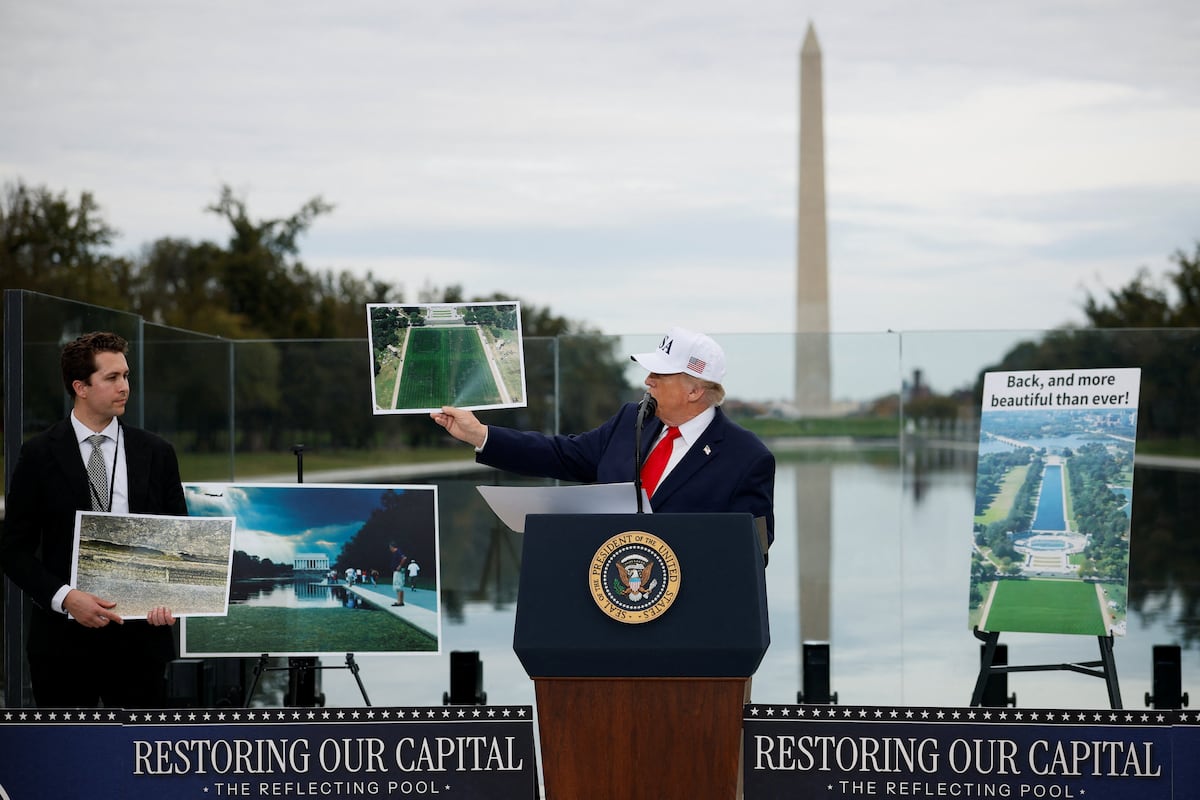
It was yet another eye-popping moment in Donald Trump’s second term. On Monday, the U.S. president chose the monument to one of his most illustrious predecessors, Abraham Lincoln, to send his final message from Washington as part of his extravagant midterm election campaign. Focusing almost exclusively on the repairs to the pond at the foot of the seated statue of the 16th president, it turned out to be a bizarre way to set the stage for the midterms — which are being held this Tuesday and are looking grim for his party.It does not seem that the supposed success of the renovation of that reflective pool — a success that reality has disproved time and again — is what most concerns the millions of Americans called to the ballot box on the eve of this major election. Polls indicate that it is not the “leaks in the pool,” the “vandalism” it has supposedly suffered since its renovation, or the alleged “soft dark blue” color of its water that is troubling voters when the president’s approval rating is at an all-time low, inflation is making life difficult for households, the war in Iran has sent gas prices soaring, and the administration’s immigration agenda has helped create a climate of fear in cities across the country.But Trump does not care about any of that. With a weary tone and wearing a white cap bearing the initials USA, the president used an array of enlarged photographs to demonstrate the success of his renovation, with the Washington Monument — another landmark of the National Mall — visible in the background. The Lincoln Memorial is a place steeped in history; it is where Martin Luther King told the world he had a dream and where the Million Man March took place. But over the past year it has become a tribute to the current president’s megalomania and to how far he will take his obsessions. Watching him deploy his unmistakable patter, full of lies, exaggerations, and attacks on predecessors Barack Obama and Joe Biden, brought to mind less the milestones of the civil rights struggle than the group of mixed martial arts fighters who used these same steps in early July to hold a press conference before the fight at the White House that Trump’s administration staged to celebrate the 250th anniversary of the Declaration of Independence. But, above all, it resurrected the controversy over the repair of the reflecting pool, undertaken six months ago and quickly embroiled in scandal. Any other president would have avoided that association with failure hours before polling places open. But Trump is not any other president: he is someone who is proud of installing “totally new pipes” and of the details of the sealing and painting work. A long-standing problemThe controversy over that shoddy repair dominated springtime in Washington in a tug-of-war driven by Trump’s construction background and his fixation on leaving his mark on the capital. The pool’s problems date back to its inauguration over a century ago, and Trump promised he would fix the issue by giving the water a bright blue color — only to see the pool tinged the same green it always had been shortly after it reopened. Monday’s campaign event capped a frenzied tour of rallies: 28 in the past month across nine Republican states. Choosing Washington — and not a competitive district — to close the tour, regardless of staging it at that pool, had already added the event to the list of baffling decisions Trump has made during a campaign centered on his repeated plea to voters to act as if he were on the ballot. If voters take him at his word, the risk is high for Republican candidates, with 435 House seats and 35 Senate seats in play. Despite what caution would have advised, and far from stepping aside, Trump decided to place himself at the center of a midterm campaign in which the party in power is flirting with a dubious record: losing both chambers of Congress. There are only six precedents for such a sweep. The first was in 1894, with Grover Cleveland in the White House — the only president before Trump to serve two nonconsecutive terms. The others came in 1918, at the end of World War I; in 1946, after World War II; in 1954, following Korea; in 1994, after the end of the Cold War; and in 2006, when Americans’ patience with the war in Iraq had run thin. On the campaign’s final day, Trump seemed less concerned with those precedents than with proving he was right in his attempt to cement his legacy as the city’s chief architect and main promoter of the neoclassical (especially Corinthian) style, rather than as the leader of the world’s major power. “The pool is looking really good,” he insisted once more toward the end of a 35-minute speech in which he also repeated xenophobic insults against Abdul El-Sayed — who is seeking to become Michigan’s representative as the Capitol’s first Muslim senator — and touted his administration’s alleged achievements in fighting crime and closing the border with Mexico. This Tuesday, if Trump and his allies accept the results, the president is set to learn how far the dissonance runs between his obsessions and the day-to-day concerns of an electorate going to the polls to deliver a verdict on his term. Sign up for our weekly newsletter to get more English-language news coverage from EL PAÍS USA Edition
Trump wraps up midterms campaign with bizarre defense of Lincoln Memorial pool renovation
Full Article
Original Source
Read the full article at English →KhanList aggregates and links to publicly available news content. We do not host full articles from third-party sources. Always verify important information with original sources.