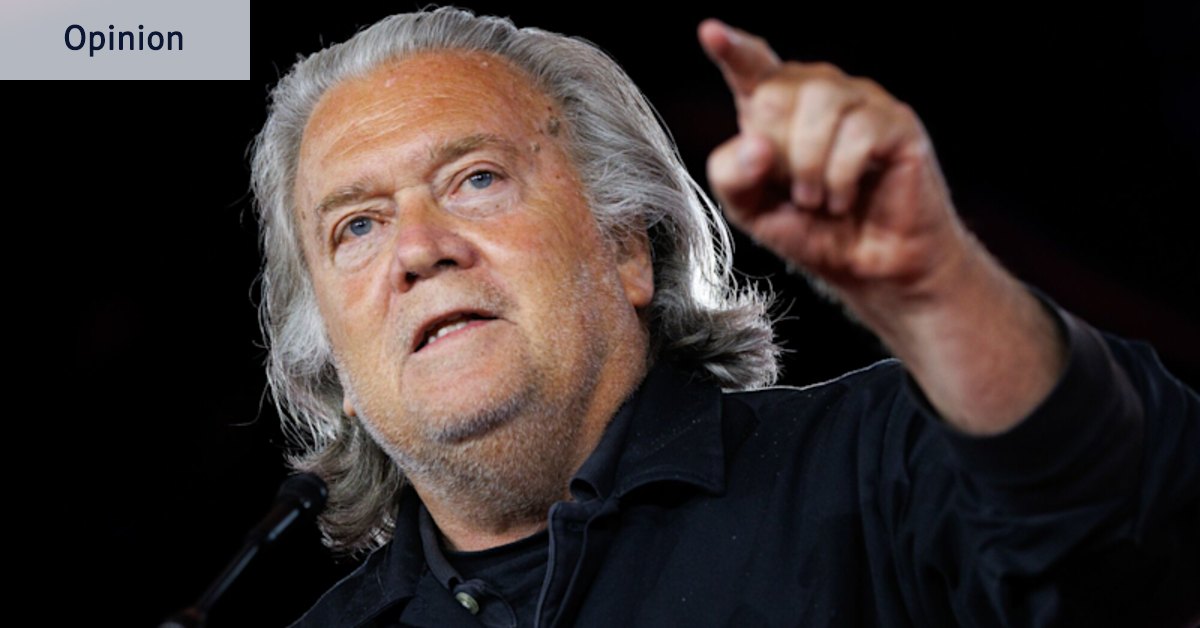
OpinionPolitical and international editorJuly 25, 2026 — 5:00amSteve Bannon, the barnstorming godfather of the MAGA movement, follows Australian affairs more closely than almost any other American politico.He has some surprising praise for Anthony Albanese and some awkward advice for Pauline Hanson. But his confident prediction of America’s near future is shocking.Illustration by Simon Letch Donald Trump’s campaign strategist for his 2016 election win says: “I believe we will have a national emergency declared by late August,” ahead of the Congressional midterm elections due on November 3. “You will have enough evidence by mid-August to show that we have a massive problem” of election fraud, he tells me in an interview. Trump’s televised address to the nation on Thursday last week was the beginning of the process, he says.The president declassified documents, which he claimed show “shocking vulnerabilities in our election infrastructure” revealed by the 2020 election.These had been hidden, even from him, by a “deep state” conspiracy of US intelligence services, he posited.Trump demanded that the Congress pass a bill called the Safeguard American Voter Eligibility, or SAVE, Act. The bill stipulates that all voters produce a passport or birth certificate to be eligible to vote. Democrats denounce it as an effort at mass disenfranchisement. The Brennan Centre for Justice at New York University estimates that it could block 21 million Americans from the ballot box.Under the US Constitution, it’s the states, not the federal government, that run elections. The SAVE Act would force state governments to hand voter roll information to Washington.Trump sent his Homeland Security Secretary, Markwayne Mullin, out the following morning to issue a threat to state officials: they could face prison time unless they followed the administration’s orders to remove non-citizens from rolls.After running Trump’s 2016 campaign, Steve Bannon served briefly in his White House.APBut Bannon tells me that he doesn’t think there’s time to pass the bill. “There will be more Thursdays. You have to lay the predicate first.” The administration would find more evidence of fraud, he predicted. “They will find more things.“We cannot have another stolen election,” he said, a reference to Trump’s fiction that Joe Biden won by fraud in 2020. Almost one in three Americans believes him.“We are facing a national security emergency, and we will need real teeth to deal with it,” Bannon says. “You put ICE agents around polling booths to stop illegal immigrants from voting or any playing with voting machines. Maybe the National Guard; we need to clean up mail-in ballots.” Trump wants them outlawed, even though 29 per cent of Americans used mail-in ballots to vote in 2024.Could Bannon’s vision actually materialise? “Yes,” says a Democrat strategist, Steve Elmendorf, who’s advised many of the most prominent leaders of his party over many years.“It’s believable, but Bannon says a lot that is ‘out there’.” Nevertheless, the Democrats are taking the scenario seriously. “The Dems are aware of all the crazy and are making contingencies,” Elmendorf tells me.Trump would be accused of an authoritarian grab for power. The documents he released last week did not stand up to scrutiny as proof that fraud influenced election outcomes.The Republicans control both houses of Congress. Bannon had hoped against history that the Republicans could hold both chambers in November “if we maintain a maniacal focus” on the “the basics of the economy, including getting the budget deficit under control, not this massive deficit that’s pushing up interest rates”. The US annual budget deficit last year was 5.7 per cent of GDP. For comparison, Australia’s was 1 per cent.Like many MAGA leaders, Bannon is frustrated with Trump’s war on Iran: “Because of the war, we’ve taken our eye off these issues. The longer the war goes on, the worse it gets … If we lose the House [of Representatives], the White House becomes Fort Apache,” a 1948 western which has become a byword for a state of siege against impossible odds. The House would assail Trump with subpoenas and impeachment motions for the rest of his term, says Bannon, realistically enough.After running Trump’s 2016 campaign, Bannon served briefly in his White House and since 2019 broadcasts the daily War Room podcast, rated highly for both its number of listeners and for its volume of misinformation. He still speaks with the president.“Iran keeps sucking us into the Middle East,” Bannon complains. “Obama told Trump, a couple of days after we won in 2016, that he’d tried to pivot to Asia but all he’d managed to do was to redeploy one Marine brigade to Darwin. Central Command [responsible for the Middle East] has such a powerful gravitational force that it doesn’t allow us to focus on the Chinese Communist Party threat.”Unlike Anthony Albanese: “What your prime minister has done is nothing short of brilliant,” says Bannon in one of his less likely political appreciations.“I’m not a fan of much of his economic or social policy, but, strategically, I don’t think there’s a government in the world that understands as well as this man. Your government has focused on sea lanes, on military alliances and diplomatic alliances in the South Pacific, showing the Pacific Islands people the importance of Australia and showing that Australia is there for them, will support them … I think you have taken the lead, and we are playing a little bit of catch-up.”On the US commitment to AUKUS, Bannon says that “nothing is a certainty, but this is the closest you can get to one. Australia is a central linchpin, if not the central linchpin in the Pacific”.“If we had lost Australia in World War II, we would not have won the war against Japan for another decade or longer, and China is many times more powerful than Japan in the 1940s,” says the former US Navy officer.He accuses the Biden administration of allowing US Pacific priority to “atrophy”, yet concedes that Trump is distracted by his Iran war.One of Bannon’s co-hosts of War Room is Trump’s ambassador-designate to Canberra, former congressman David Brat. “He had all types of opportunities to work in the administration and when the State Department offered him Australia, he came to me and said, ‘What do you think?’ I said it’s one of the most important strategic posts in the world. The US heartland is the Pacific, World War II proved that.” Bannon said he’d helped “find” Brat for the Republicans, and Brat went on to become the first person in US history to unseat a House majority leader in a primary.“David was a forerunner of populist nationalism, he has access to the highest levels of power and he has a big presence in MAGA media – he’ll be the perfect man for the job” in Canberra, once he’s confirmed by the US Senate.Pauline Hanson is an unabashed Trump fan. The feeling is mutual. Bannon says that “we watch Pauline Hanson closely. She’s smart, she’s more nationalist than Trump was at the beginning, she’s always talking about putting Australia first”.Except when, as Liberal Party shadow minister Andrew Hastie puts it, she’s putting “MAGA first, Australia second”.Bannon’s advice to her? “The hardest thing is to make sure you’re getting quality people. You have to be able to leverage your message. It has to be relentless.”Well, that’s awkward. Hanson never has managed to recruit and hold quality members and candidates. Criminals, Nazis, nut jobs. As she told my colleague Paul Sakkal last month, “I’m being infiltrated by these extremists, so it’s all the time happening with One Nation.”One Nation’s Senator Malcolm Roberts illustrates Bannon’s point about the difficulty of consistent messaging while burdened by confused candidates. Roberts is an anti-vaxxing conspiracy theorist who claims that people dying of COVID in makeshift morgues were “staged” and “bullshit” and contradicts his leader by calling AUKUS “absurd”.The new federal MP for Farrer, David Farley, is an exception. So is Barnaby Joyce, making some obvious allowances for idiosyncrasies.Bannon doesn’t say so outright, but he’s evidently stumped by a couple of recent Hanson comments. Right-wing populists are supposed to attack elites and pick on minorities, such as Muslims or Asians. But Hanson called Australian workers “lazy” during her outing at the National Press Club. Bannon stresses that “there was never any criticism of workers” in Trump’s campaigns; on the contrary, he posed as the champion of workers against the villainous globalisation. “I would not say Australian workers are lazy,” Bannon adds for emphasis. More awkwardness.Similarly, Hanson talks about revisiting the issue of abortion access. Bannon says that abortion was “not in Trump’s wheelhouse” in 2016. The Trump campaign deliberately chose Mike Pence as the running mate so that he could appeal to the right-wing evangelical and conservative Christian voters without having to involve the leader. Awkwardness again.Could Hanson be more radical than Trump? Or is she just less calculating?Bannon speaks of a “new politics” of a radical right and a radical left. When Zohran Mamdani was elected mayor of New York over a year ago, the self-identified socialist was dismissed as a strictly local phenomenon without wider appeal. But, as the news site Politico points out, Bannon immediately saw it as the harbinger of a radical new anti-establishment left at the national level, “flashing red lights” for moderate Democrats.Bannon has been vindicated. He calls them “Marxist jihadists” and says “they have the momentum in the Democratic Party”. Candidates endorsed by Mamdani and Bernie Sanders now are defeating moderates in primaries well beyond New York.In the new politics, Bannon says, “there’s no middle ground – there’s the right wing and the left wing. The right wing will win, or the left wing will win, and that’s it.” Radical positions – mass deportations on the right or free rent on the left – are essential to motivating people to get out to vote, he says.In America, this might be the secret to success. But what about a country with mandatory voting? Where elections are decided not at the extremes but at the centre? In such a country, radical positions are not the fast track to success but the gangplank to failure.US politics is more radical, but the Australian electoral system produces outcomes that are more conservative in the literal sense, risk-averse. Driving fast can be a thrill, but, ultimately, you’ll only survive if you remember which side of the road you’re supposed to be driving on.Peter Hartcher is political editor and international editor. He writes his world column on Tuesdays.Get a note directly from our foreign correspondents on what’s making headlines around the world. Sign up for our weekly What in the World newsletter.From our partners
Trump will declare a ‘national emergency’ before midterms: Bannon
Full Article
Original Source
Read the full article at Smh →KhanList aggregates and links to publicly available news content. We do not host full articles from third-party sources. Always verify important information with original sources.