
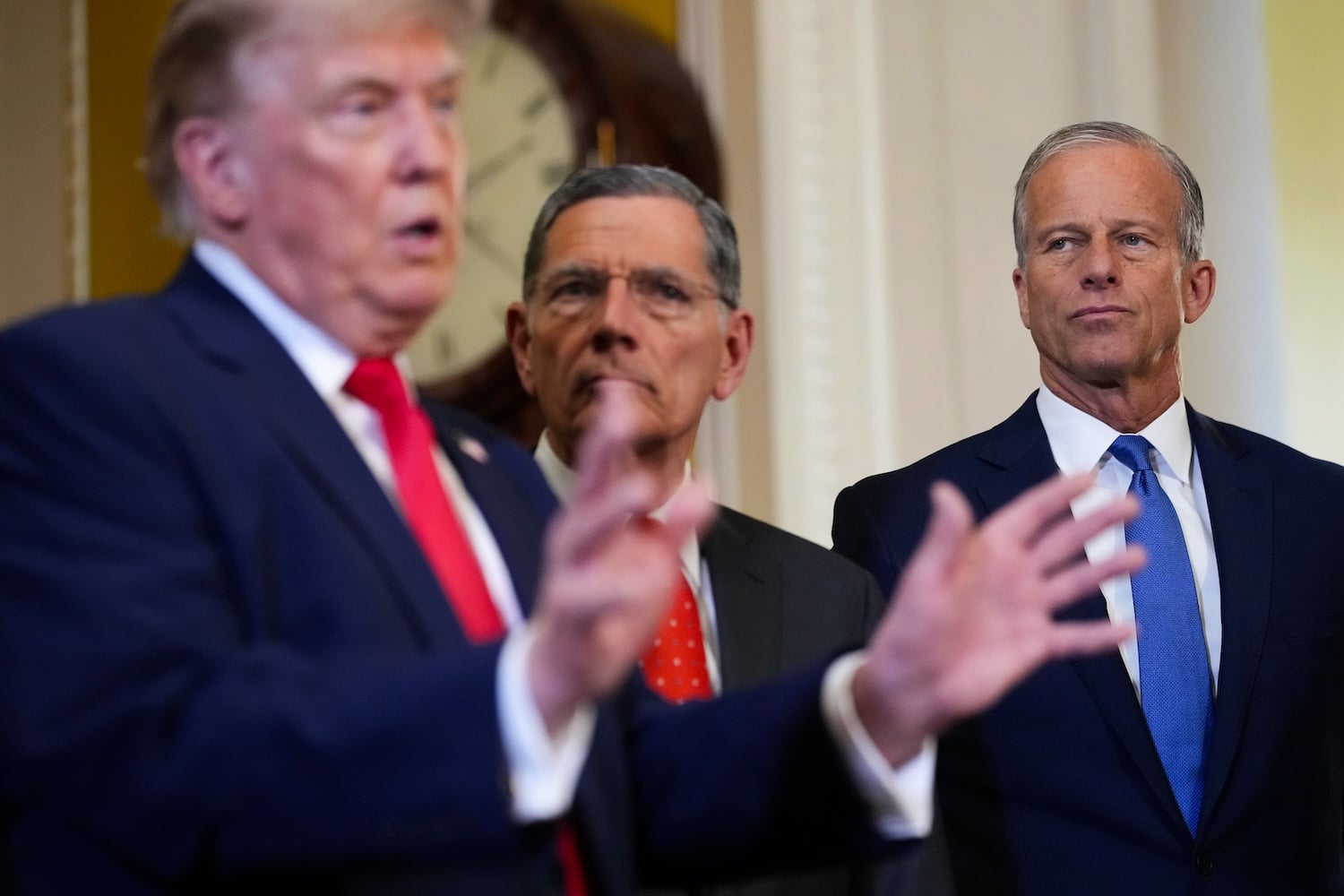
Government interference in the world’s largest oil-producing state would be counterproductive. Trump is seen from the chest upward, slightly out of focus in the foreground and gesturing with both hand as he speaks. The other two men stand behind him, in focus, with serious expressions as they listen. All three men wear suits and ties. U.S. President Donald Trump speaks to the media beside Republican Sens. John Barrasso and John Thune in Washington on June 24. Andrew Harnik/Getty Images September 23, 2026, 11:49 AM U.S. President Donald Trump has cribbed many things from former President Richard Nixon, among them tariffs; price controls; and now, apparently, government interference in energy markets. Soaring energy bills are a concern for any sitting president (see the early 1970s or the mid-2020s), and energy prices are skyrocketing. Gasoline in the United States now averages $4.47 a gallon, but more to the point, diesel is now $6.52 a gallon on average, up from $3.69 from one year ago. That is absolutely hammering truckers and farmers. U.S. President Donald Trump has cribbed many things from former President Richard Nixon, among them tariffs; price controls; and now, apparently, government interference in energy markets. Soaring energy bills are a concern for any sitting president (see the early 1970s or the mid-2020s), and energy prices are skyrocketing. Gasoline in the United States now averages $4.47 a gallon, but more to the point, diesel is now $6.52 a gallon on average, up from $3.69 from one year ago. That is absolutely hammering truckers and farmers. That is why there is now a stampede on Capitol Hill, seconded by Trump, to curb U.S. exports of diesel fuel, in the hope that the invisible hand, if made visible, will somehow make the market work better. It’s an idea that is both misguided and alarming. In New York City on Wednesday, Trump’s energy secretary said a diesel export ban would not work and would lead to higher prices as refiners cut back output. It’s easy to see why Trump, who keeps blaming Ukraine and its strikes on Russian energy targets for the higher prices, might be tempted by an export ban. The United States does produce a lot of refined petroleum products, and it exports a lot as well. But any ban on U.S. exports would be a bad idea. Any short-term price relief—and there would be on the Gulf Coast, where most U.S. refineries are located—would be offset by higher prices elsewhere, mostly on the other coasts but also everywhere else in the world. And once the closure hits the export outlet, which makes up about 12 percent of the output of the United States’ refineries, which are running flat out, those refiners will throttle back. Currently, refiners are enjoying a historically large “crack spread,” the difference between the price of crude and the price of actually useful refined products. If the idea is to incentivize production of gasoline and diesel to make those fuels cheaper, then this is the wrong way to go about it. “The U.S. Gulf Coast would get a temporary pump price dip, at the cost of likely higher coastal prices [elsewhere] and eventually, higher prices for everyone as investment gets scared away,” said Bob McNally, the founder of Rapidan Energy Group and a former White House energy advisor. A decade ago, the United States didn’t even export oil or oil products. That was because of the government interference in the 1970s that sought to manage energy markets and ended up making them worse. Today, the picture is different, in large part because the United States became the largest producer of oil and natural gas in history over that same time frame due to the fracking revolution. But only a portion of what the United States exports is diesel; a good part is crude; a large chunk is propane; some is gasoline and aviation fuel; and the rest, about 1.4 million barrels a day, is diesel. The United States consumes more than 20 million barrels of oil per day. There is another problem with the proposed export ban, which has to do with the kind of oil that the United States produces (light and sweet) and the kind of oil that its massive refinery complex is built to handle (heavier and sour). Restricting exports would force refiners into bidding wars for the heavy stuff, or into trying to make do with suboptimal goods. Either way, it’s a bad outcome. It’s true that the Russian war on Ukraine, and Kyiv’s reprisals in the form of long-range strikes on Russian refineries and other oil facilities, have not eased a global energy market that is having a bad year. But the bigger problem remains the partial closure of two of the world’s biggest energy chokepoints—the Strait of Hormuz and Bab el-Mandeb—which are a consequence of the war against Iran that Trump began in February and from which he has yet to find an exit. The associated damage in the region, including to refineries, was exacerbated by waves of Chinese restrictions on refined exports. An American ban won’t help that, but it will make it all worse. “Russia is hurting, but the Middle East is worse, and China shut down,” said Sergey Vakulenko, a former Russian energy executive at the Carnegie Russia Eurasia Center. “What the world is short of is refining capacity.” Economics United States Russia Iran Ukraine Keith Johnson is a staff writer at Foreign Policy covering geoeconomics and energy. Bluesky: @kfj-fp.bsky.social X: @KFJ_FP Read More A large ship is seen on the water at sunset. Don’t Blame Ukraine for High Gas Prices Kyiv’s energy war on Russia may hurt on the margins, but the real culprit is Trump’s war on Iran. Cattle are herded in a stable in Hamilton, Texas. Trump Picks the Wrong Beef Before Midterms The president’s plan to tame soaring beef prices has alienated a key constituency. U.S. President Donald Trump speaks during the 81st session of the United Nations General Assembly. Trump Threatens to ‘Annihilate’ Iran in U.N. Speech Such warnings—on the U.N. stage, no less—could be considered war crimes. OTHER SUBSCRIPTION OPTIONS Stories Readers Liked Go to slide 1 Go to slide 2 Go to slide 3 Go to slide 4 Go to slide 5 Go to slide 6 Go to slide 7 Go to slide 8 Go to slide 9 Go to slide 10 A statue of a seated, bearded man with a bare torso and draped cloth around his waist, holding a scroll in one hand, positioned in front of a row of large classical columns. An illustration of Donald Trump in a blue suit and long red tie gesturing with open hands in front of a grid patterned background with jagged red, blue, and black line graphs diving downward. Five people sit in folding chairs pushed up against a wall, all of them on their phones and several looking board. Text on the wall behind them says "AI for Real" with images of robotic arms and household appliances printed around it. An illustration depicting a man submerged up to his nose in water. The wavy water is divided horizontally into three color bands that mimic a flag: white foam at the very top peaks, a deep blue middle section filled with bubbles, and a red lower section covering his neck and suit jacket. His blue eyes look upward with a wide, strained expression. As the Tide Turns Against Putin, Beware the Drowning Man By Peter Frankopan Negotiators from the United States, Canada, and five European countries converse after finishing the draft of the North Atlantic Treaty in Washington on March 18, 1949. Trans-Atlanticism Isn’t Dead—It’s Being Renegotiated By Alexandra de Hoop Scheffer A woman crosses a road in front of a mural depicting Russian President Vladimir Putin in Kashira, Russia, southeast of Moscow, on Oct. 16, 2017. The Western Myth of Russian Greatness By Christian Caryl An illustration of a vintage-style map featuring North America and parts of Europe and Africa. Overlaid on the map are 3D red brick walls shaped exactly like the borders of the contiguous United States and Alaska, casting long shadows to the right. America, the Once Global Nation By Odd Arne Westad A creative illustration against a pale yellow background showing a garden planter containing a dense green hedge. Five human arms emerge from the hedge, with four of the hands holding small flags of China, Russia, the United States, and the European Union, while the fifth hand holds the flag of India. An illustration showing a pair of hands tightly wringing out an American flag. Water droplets shaped like missiles squeeze out of the twisted fabric and fall toward a puddle shaped like the map of Iran on a red background. An aerial photo shows Doha in the booming petrostate of Qatar.
Trump Wants to Ban Diesel Exports. It Won’t Help.
Full Article
Original Source
Read the full article at Foreignpolicy →KhanList aggregates and links to publicly available news content. We do not host full articles from third-party sources. Always verify important information with original sources.