
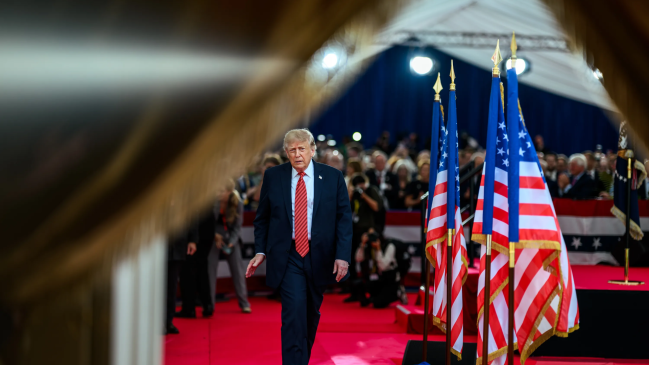
President Donald Trump says he plans to create an “AI Force” and appoint a new AI czar, putting the federal government behind an aggressive push to expand AI while rejecting calls for the industry to slow down. The announcement comes as concerns over AI safety, data center power consumption and the risks posed by increasingly capable models are becoming harder for Washington and Silicon Valley to ignore. Trump announced the plans Saturday, comparing the proposed AI Force to the Space Force created during his first administration. Details about its structure, responsibilities or whether it would be a civilian or military organization are yet to be provided. Trump also said he would appoint a new AI czar, although he did not identify the person who would take on the role. However, the move is a clear indication that the Trump administration wants the US to maintain its momentum as competition with China intensifies. Exisiting systems to deal with potential risks Trump has dismissed concerns that increasingly capable AI systems could eventually pose an existential threat, describing such fears as a “hoax” and arguing that existing criminal and civil justice systems can be used to deal with harmful applications. “We will not in any way hinder or stifle the Growth of this incredible Industry. Rather, we will cherish it, help it, and watch over it, as it grows! However, we will also be looking for BAD, and we can do that, very easily, with our already existing Criminal and Civil Justice System,” Trump wrote in a Truth Social post. He compared AI to previous technological transformations such as the Industrial Revolution and the internet. Trump also noted that the technology could eventually have an economic impact equivalent to as much as 25% of US GDP, while emphasizing the importance of maintaining the country’s position in the competition with China. Former White House AI and crypto czar David Sacks, whose post as a special government employee ended in March 2026, argued that concerns about AI threatening humanity are overstated while acknowledging that some caution is necessary, CBS News reported. AI boom becomes an energy problem The debate is not only about what AI systems might eventually be capable of, as the infrastructure required to build and operate them is already placing pressure on electricity systems. AI data centers require large amounts of electricity for computing and cooling, and their expansion is creating new challenges for grids, utilities and local communities. The International Energy Agency estimates that global data center electricity consumption will roughly double from 485 TWh in 2025 to around 950 TWh by 2030. Electricity use by AI-focused data centers is expected to grow even faster, potentially tripling during the same period. The US is expected to account for a particularly large share of that growth. The IEA projects that data centers could account for almost half of the increase in US electricity demand through 2030. Trump has previously acknowledged the political implications of that expansion, pushing a “ratepayer protection pledge” aimed at having major tech companies cover the electricity costs associated with their data center expansion rather than shifting those costs onto households. The White House has also planned discussions with companies including Amazon, Google, Meta, Microsoft, xAI, Oracle and OpenAI over voluntary commitments to secure or generate electricity for their data centers, potentially through dedicated power agreements or on-site generation.Get the latest in engineering, tech, space & science - delivered daily to your inbox.Bojan Stojkovski is a freelance journalist based in Skopje, North Macedonia, covering foreign policy and technology for more than a decade. His work has appeared in Foreign Policy, ZDNet, and Nature.
Trump wants ‘AI Force’ to keep US AI race moving, push ahead with modern tech despite concerns
Full Article
Original Source
Read the full article at Interestingengineering →KhanList aggregates and links to publicly available news content. We do not host full articles from third-party sources. Always verify important information with original sources.