
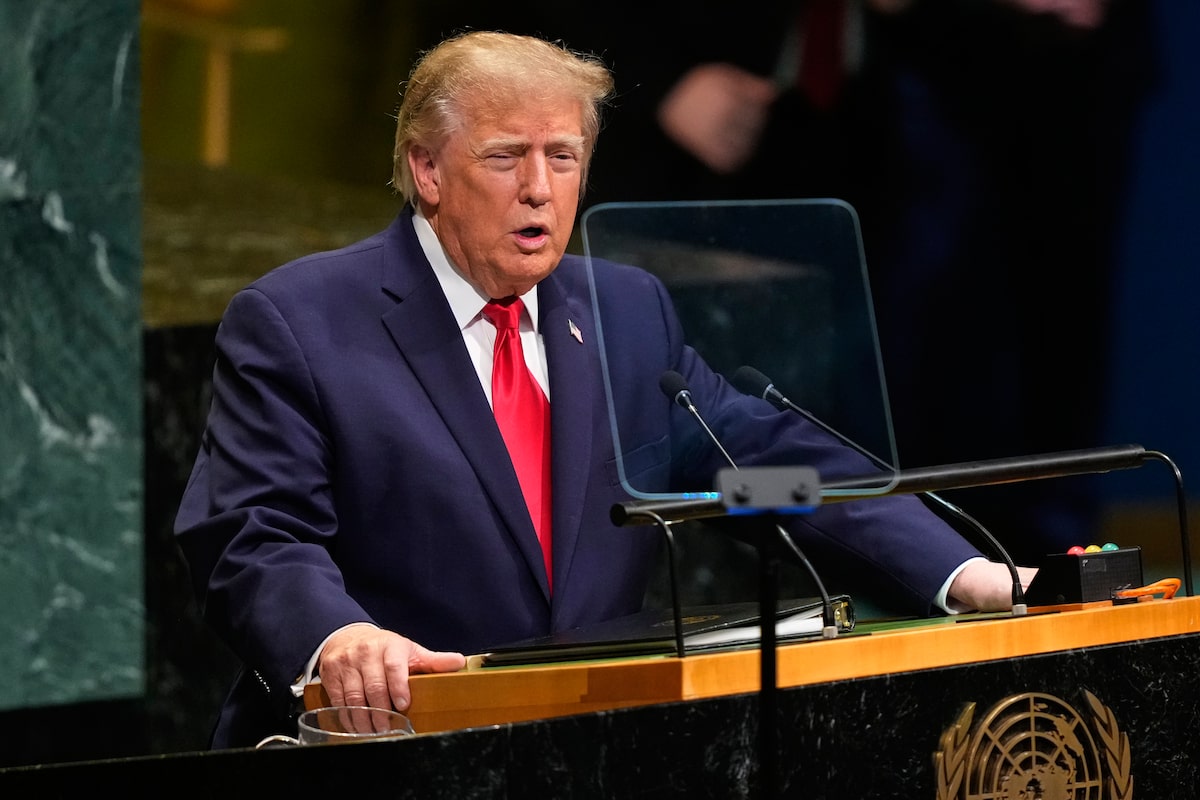
Open this photo in gallery:U.S. President Donald Trump speaks during the 81st session of the United Nations General Assembly at United Nations headquarters on Tuesday.Yuki Iwamura/The Associated PressThe appearance of the American President before world leaders at the United Nations is one of the set-piece rituals of every autumn. John F. Kennedy used the forum to urge further “peaceful co-operation” with the Soviet Union after the 1963 treaty banning nuclear tests in Earth’s atmosphere, under water and in space. In 1990, George H.W. Bush expanded on his vision of the bright promise of a “new world order.” George W. Bush reacted to the terrorist attacks of 2001 by speaking of a “world uniting for a long struggle” and of terrorists’ crimes “so terrible they offend humanity itself.”These speeches shook the world. Donald Trump provided an equally significant UN moment Tuesday by threatening to “annihilate” Iran and plunge it “into hell with no chance of survival” if the country’s theocratic leaders don’t make a deal to end the war with the U.S. and Israel.World leaders gather for annual UN meeting to discuss wars, AI and climate shocksMr. Trump’s speech before the world body followed the pattern established by his previous remarks. Last year he said Europe’s “immigration and suicidal energy ideas will be the death of” the continent’s most powerful countries. The President took his critique a step further this year, his upbraiding of specific countries more bellicose, his boasts more fulsome, his threats more belligerent.He drew applause for his vow that Iran would never have a nuclear weapon, though he cast his approach as a choice between two options.“I have a big decision to make,” he said. “Will a deal be made with Iran that lets them rebuild and create a far greater country than it ever was before − maybe one of the greatest in the Middle East or even the world? Or do I annihilate the Islamic Republic and do it quickly, never giving them a chance to kill and destroy people and countries again?”U.S. President Donald Trump used his UN General Assembly speech Sept. 22 to argue that the war with Iran prevented Tehran from obtaining a nuclear weapon and warn that he could 'annihilate the Islamic Republic' if no deal is reached to end the conflict.ReutersBut amid these comments was an unusual, even astonishing Trump concession: the acknowledgement that an agreement with Iran would not occur until “right after the election.”This comment − made in what was clearly a prepared address and not in the kind of informal, extemporaneous asides that are often a feature of his remarks − was at odds with repeated Trump claims that an accord was imminent. It also may have had the perverse effect, at least from the White House point of view, of propping up the high gasoline and diesel fuel prices that have every appearance of damaging the prospects of Republican candidates in the midterm congressional elections, now six weeks away.Respected voter surveys show Americans’ impatience with inflation and fuel prices and suggest the possibility, if not the likelihood, of a wave of Democratic support that could propel the party to take control of the House of Representatives and perhaps the Senate as well.Mr. Trump followed that predication with a vow that he would not be swayed by political considerations in his approach to Iran. “I gave absolutely no credence and will not give credence to the election when it comes to Iran,” he said. “It doesn’t even enter my mind.”Open this photo in gallery:Iran Foreign Minister Abbas Araghchi arrives at the United Nations General Assembly on Tuesday.Alexi J. Rosenfeld/Getty ImagesHe went on to warn Iran not to delay negotiations in the hope the elections would constitute a repudiation of him or his policies. “What they don’t realize is that I’m not running,” he said, as if Tehran does not follow U.S. politics. A month ago, in an Aug. 21 rally on behalf of the Senate primary runoff campaign of Darline Graham, the sister of the late senator Lindsey Graham, the President said, “So what I really want you to do is pretend, please, that I’m on the ballot. … I am on the ballot. We’re all on the ballot. Our country’s on the ballot.” He repeated that theme earlier this month at the Republican mini-convention in Dallas. Much of the President’s speech was a reprise of comments that have become regular features of his domestic rallies, including a recitation of his accomplishments, his view that the United States is “leading in virtually everything” and his conviction that he has presided over a new “golden age of America.” The Trump administration clearly planned these remarks − their tone not generally part of national leaders’s addresses at the opening of the UN session − to carry the triumphal message onto a world stage.Guterres calls for ‘a world built on interdependence’ in final address to UN General Assembly“The annual UN speech is an opportunity for a president to address the world community with his vision for a path forward,” said Mary Kate Cary, a speechwriter for George H.W. Bush, in an interview.These speeches are usually drafted with contributions of themes from White House officials, the State Department and the National Security Council, with lengthy debates about language and emphasis before a final product is produced.In his remarks Tuesday, Mr. Trump called Mexico the “epicentre” of drug cartels and declared that Cuba is an “absolutely failed state,” adding, “It will fall.” Delegates from Cuba and Iran left the room after the President’s remarks.The Trump address came shortly after the release of a CNN poll that showed that just 29 per cent of American adults approve of his handling of foreign affairs, a drop of 10 percentage points since the beginning of the year and a new low in the network’s survey, conducted during both Trump presidential terms. The poll showed that his handling of Iran has the approval of 26 per cent of Americans, down seven percentage points since the conflict began in late February.
Trump uses UN address to threaten and deride foes and allies alike, as usual
Full Article
Original Source
Read the full article at Theglobeandmail →KhanList aggregates and links to publicly available news content. We do not host full articles from third-party sources. Always verify important information with original sources.