
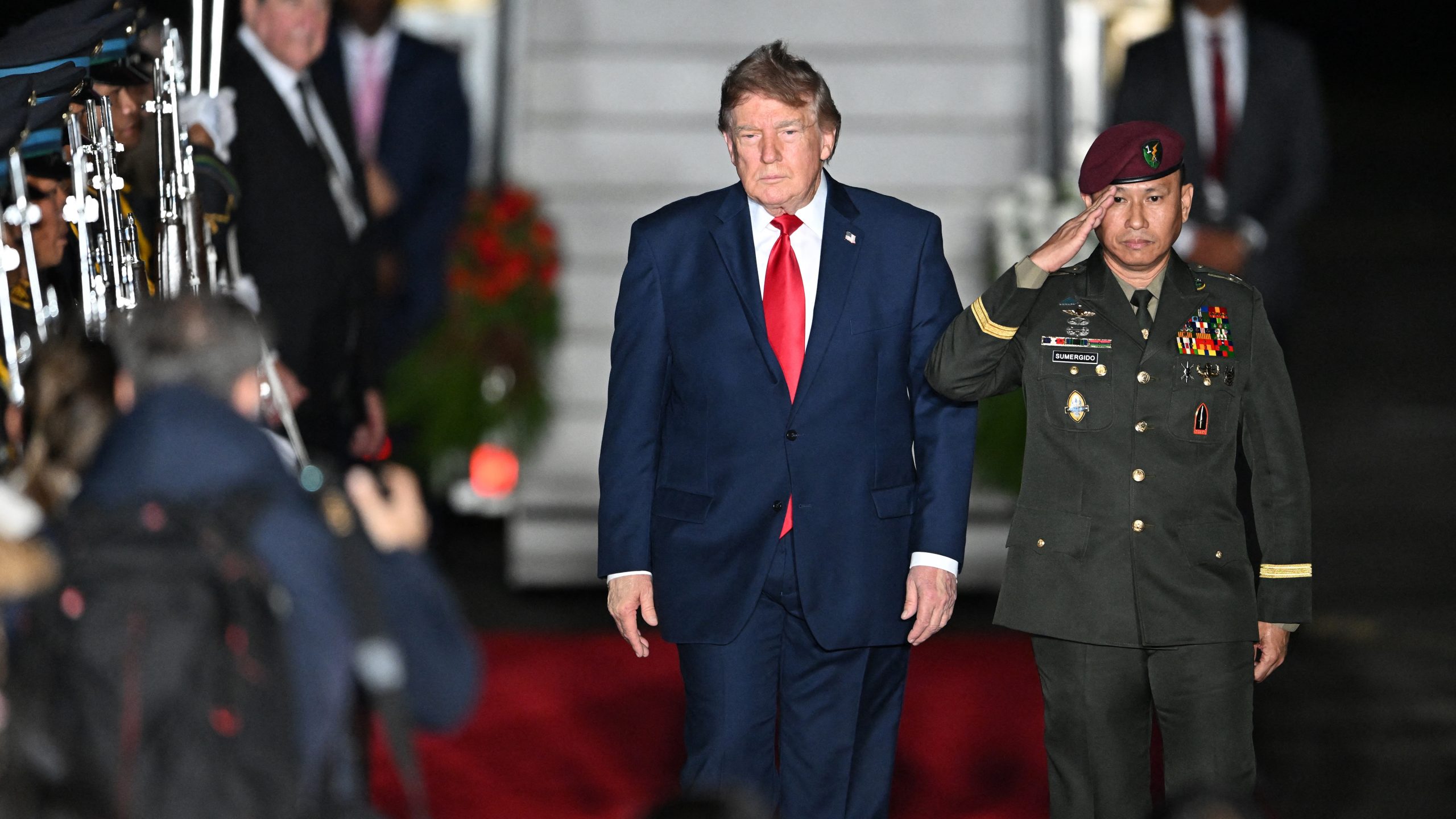
US President Donald Trump (C) arrives at Ninoy Aquino International Airport to attend the 49th Association of Southeast Asian Nations (ASEAN) Summit in Manila on November 17, 2026. Photo: JAM STA ROSA / POOL When US President Donald Trump touched down in Manila on Tuesday afternoon (November 17), arriving only after the Association of Southeast Asian Nations had already concluded its formal plenary and handed its rotating chair to Singapore, early international coverage largely framed the compressed 24 hour visit as a diplomatic slight. Yet, behind the abbreviated schedule, Trump used his brief layover in the Philippine capital not for multilateral consensus building but to rapidly harvest bilateral and plurilateral deliverables before flying to Shenzhen on Wednesday for the Asia Pacific Economic Cooperation summit and Thursday’s anticipated talks with Chinese President Xi Jingpin and Russian President Vladimir Putin.Weakened at home by Republican midterm losses and constrained by domestic hawks from offering Beijing major semiconductor concessions in Shenzhen, Trump leveraged Manila a staging ground to project regional momentum, extracting asymmetric trade and security commitments from Southeast Asian capitals even as Washington tightened technology controls on their economies. Asymmetric trade and security wins Within hours of landing, Trump presided over a signing ceremony lasting less than 10 minutes with Thai Prime Minister Anutin Charnvirakul. Under the joint trade statement. Bangkok agreed to eliminate tariffs on US exports; to dismantle non-tariff barriers, across sectors ranging from vehicles and pharmaceuticals to ethanol and poultry; and to purchase an estimated US$2.6 billion in additional American goods.While Trump hailed the pact as a bilateral victory, the terms underscore a stark asymmetry. Rather than securing reciprocal duty free access to the American market, Thailand’s concessions are aimed primarily at shielding its exports from steeper punitive US tariffs above its 19 percent baseline rate.Moreover, Thai officials stressed that the Manila signing marks progress in negotiations rather than a legally binding trade treaty. The full agreement remains subject to domestic legal procedures, including parliamentary consideration and public consultation, leaving its implementation and politically sensitive provisions unresolved.Trump paired the trade announcement with a revived leaders’ meeting of the Quad, comprising the United States, Japan, India, and Australia, on the sidelines of the ASEAN gathering. The four leaders announced plans for joint maritime patrol aircraft exercises in the Indo Pacific alongside a Quad artificial intelligence accelerator, signaling security alignment on China’s doorstep just 48 hours before Trump faces Xi.Before departing for China, Trump is also scheduled to meet Philippine President Ferdinand Marcos Jr. at Malacañang Palace to advance Pax Silica, a US-led initiative to build critical mineral, semiconductor and AI supply chains less dependent on China. The initiative’s ambitions, however, have encountered resistance in the Philippines, where protests over its implications for land, communities and environmental protection have exposed the domestic political costs of Washington’s supply-chain ambitions. The stick behind the carrot For Southeast Asian governments, Trump’s rapid haul in Manila highlights a deepening contradiction in regional diplomacy. Just days earlier, ASEAN leaders had touted the signing of the bloc’s Digital Economy Framework Agreement as a milestone for regional integration and economic neutrality.Yet on Monday, barely 24 hours before Air Force One landed in Manila, the US Commerce Department’s Bureau of Industry and Security issued an interim final rule restricting remote cloud access to advanced American computing capabilities through overseas data centers.The measures target remote computing arrangements that could allow companies in China and other restricted jurisdictions to access advanced US technology through third-country infrastructure. They also introduce new licensing requirements for advanced semiconductor exports to Indonesia, Malaysia, Singapore, Thailand and Brazil, potentially complicating the ambitions of Southeast Asian data-centre hubsThe distinction matters. Washington is not simply restricting technology exports to China; it is extending its compliance requirements into the regional infrastructure through which advanced computing power can be accessed. For ASEAN economies seeking to attract investment in data centres and AI services, the implications extend well beyond the immediate semiconductor trade. The timing is particularly consequential. While Southeast Asian governments accommodate American demands on trade and strategic supply chains, they must also contend with the prospect that US export controls could constrain their own digital development. What to watch as Shenzhen unfolds As Southeast Asian leaders board flights from Manila to Shenzhen on Wednesday, one immediate dynamic is certain to define the summit sidelines: Beijing’s counter-courtship of ASEAN economies squeezed by Washington’s asymmetric terms.While global headlines will fixate on the unprecedented three way meeting among Xi, Trump, and Putin on Thursday, Chinese officials are already using the Shenzhen gathering to position China as the indispensable anchor of open regional trade and unrationed digital infrastructure.Xi is expected to press Southeast Asian counterparts to deepen commercial integration under the upgraded China ASEAN Free Trade Area 3.0 protocol, while promoting Chinese technology firms as alternative providers of cloud platforms, AI models and domestic hardware.Coing at the same time is Beijing’s promotion of its Shanghai-based World Artificial Intelligence Cooperation Organization as an inclusive governance alternative to Pax Silica, giving developing economies diplomatic and commercial options as US technology restrictions tighten. Southeast Asian capitals have largely accommodated Trump’s transactional demands in Manila, offering visible deference as an insurance policy against harsher bilateral tariffs and a deterioration in security relations.However, by handing Washington visible commitments on trade, critical minerals and maritime cooperation on the eve of APEC, ASEAN states have made their balancing act more difficult. Beijing will have pointed questions about the credibility of regional neutrality, particularly when American security and supply-chain initiatives increasingly intersect with restrictions on the region’s economic and technological choices.Caught between American compliance mandates and Chinese commercial inducements, Southeast Asia’s digital and industrial sectors will remain squarely in the crossfire long after Air Force One departs. Albert Cleisthenes Wong is an independent writer and analyst covering geopolitics, technology policy, and digital infrastructure.
Trump turns brief Manila stop into pre-Shenzhen leverage haul
Full Article
Original Source
Read the full article at Asiatimes →KhanList aggregates and links to publicly available news content. We do not host full articles from third-party sources. Always verify important information with original sources.