
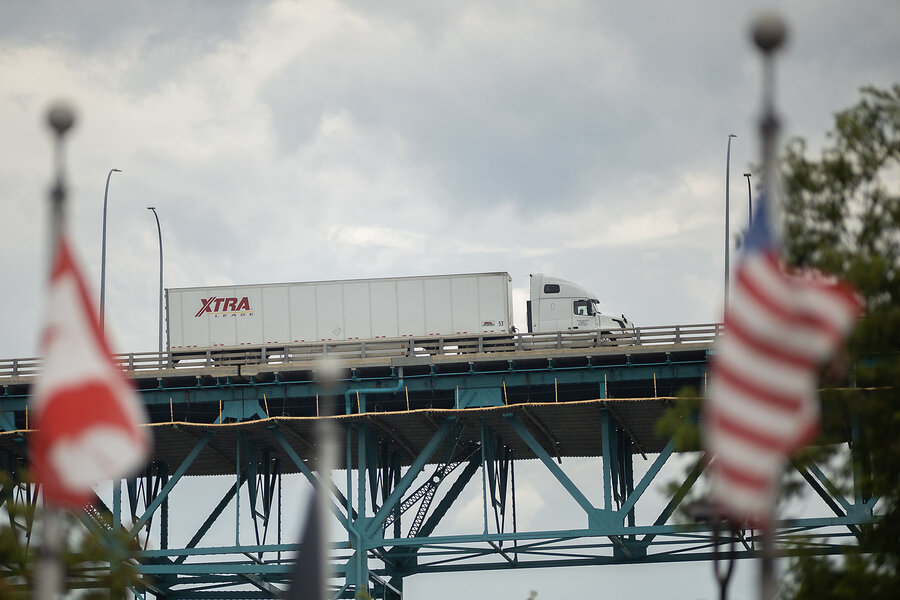
America has long used its economic heft to get its way in international affairs. But never quite like this.In a single day, the Trump administration threatened additional tariffs on Canada, America’s second-largest trading partner, after trade talks failed, and then unveiled a new round of sanctions on Iran.The Iran sanctions illustrate the continuity of this administration’s policies with those of previous administrations. For decades, U.S. presidents have increasingly turned to using America’s considerable economic levers against foes, despite limited success. The Canada tariffs represent President Donald Trump’s new wrinkle to U.S. economic policy, broadly threatening most nations, even longtime allies, to win concessions from them. Why We Wrote This The president’s newest tariffs and sanctions, which test the legal limits of his executive power, are expected to raise prices for U.S. consumers ahead of key midterm elections. Whether tariffs prove more successful than sanctions in bending nations to U.S. demands will be tested – legally, internationally, and at America’s ballot box – in the coming months. Tariffs – at least in the U.S. courts – have so far proved a mixed bag, with several judges ordering refunds or forcing work-arounds. Ditto internationally. China had the economic size and control over key resources to force the Trump administration to back off from its most severe tariff threats against it.America’s allies, by contrast, and as is often the case, gave in to American pressure. Now, one of those key allies – Canada – says it will try its hand at resisting U.S. coercion.On Friday, Canadian Prime Minister Mark Carney pulled out of talks with the United States, saying the Trump administration was making “unfair and uneconomic” last-minute demands that impinged on Canada’s sovereignty. That prompted the Trump administration to impose new 50% tariffs on $20 billion worth of Canadian imports into the United States, a modest economic blow, but one that will nevertheless hit some industries hard, such as wine and hockey sticks. Those affected goods account for about 5% of trade between the two countries. Patrick Doyle/The Canadian Press/AP Prime Minister Mark Carney speaks about Canada's response to new U.S. tariffs, accompanied by Canada-U.S. Trade Minister Dominic LeBlanc and Chief Trade Negotiator Janice Charette, during a news conference on Parliament Hill in Ottawa, Ontario, Aug. 22, 2026. In a follow-up social media post Monday, Mr. Trump raised the stakes, threatening that the U.S. would also double tariffs on all cars, trucks, and related parts from Canada to 50%. “Build in the U.S. and there are ZERO TARIFFS,” he wrote. “Canada will be treated like a State no longer!”Not one known to back down easily, Mr. Carney says Canada will retaliate “dollar for dollar” with tariffs of its own on goods imported into the United States. Starting Sept. 8, he said, Canada plans to impose retaliatory tariffs on U.S. steel products, dairy products, and agricultural equipment. In so doing, Mr. Carney is taking a big risk. Canada’s much smaller economy depends far more on the U.S. than the other way around (see Canada story).The risks for President Trump lie elsewhere. In February, the U.S. Supreme Court struck down most of his nation-specific duties. Mr. Trump is now trying to rebuild his tariff wall by relying on a rarely used provision of the 1930 Smoot-Hawley Tariff Act, known as Section 338. The lack of legal precedent makes it likely that the Canadian tariffs will be challenged in court, trade experts say.Mr. Trump began imposing targeted tariffs on China and specific products in his first term, which he has greatly expanded to broadly hit most nations in his second.Can tariffs help?The irony is that the president is relying on a Depression-era act long believed to have prolonged that economic calamity. At best, it did America’s economy no favors, economic historians say. Tariffs in the long term tend to slow economic growth and innovation. They also engender less trust among nations.Still, the U.S. tariffs may be beneficial if they allow rival nations to compete economically rather than through war, concludes Columbia political scientist Jeffry Frieden in a June article for the International Monetary Fund. “But they have costs and involve trade-offs. ... The last thing national leaders want when they pursue what they regard as key geopolitical policies is domestic political backlash.”That backlash has already begun to build. Polls suggest the tariffs have become unpopular as consumers blame them for the rising cost of goods. A Financial Times survey earlier this month found 56% of registered voters disapproved of the president’s trade and tariff policies compared with only 30% who approved.With narrow majorities in both houses of Congress, the president risks losing his legislative grip in the midterm elections in November. The sanctions against Canada are hitting hardest in states – Michigan, Ohio, and Alaska – with upcoming U.S. Senate races central to the fight for control of Congress.“Beware autocratic regimes”Also on Monday, Treasury Secretary Scott Bessent announced provisions for an “economic D-Day” on Iran. “I am announcing the MOST CRUSHING ECONOMIC OPERATION EVER TAKEN AGAINST ANY COUNTRY!” President Trump threatened in a Truth Social post last week. In enacting sanctions, the administration is pulling a well-worn economic lever of U.S. policy.The latest sanctions expand existing restrictions to new sectors, such as digital assets, gold, and aviation. They also expand sanctions to cover third parties that do business with Iran (see Iran story). The track record for this economic tool, however, is not promising.Since World War II, sanctions have worked only about a third of the time, according to research from the Peterson Institute for International Economics, and that success has usually involved partial – rather than total – victory. One of the study’s key recommendations: “Beware autocratic regimes. Bullying bullies with sanctions is generally an ineffective strategy.”Still, the sanctions-setting trend has been accelerating, not only in the U.S. but worldwide.“Every U.S. president in the twenty-first century has imposed sanctions at roughly twice the rate of his predecessor, and in recent years this trend has gone global. Between 2019 and 2024, the number of trade restrictions enacted worldwide more than tripled,” concluded Edward Fishman, senior fellow and director of the Maurice R. Greenberg Center for Geoeconomics at the Council on Foreign Relations, in a May CFR article.Will Tehran respond to sanctions?Iran is an old hand at weathering such economic maneuvers. Nearly a half-century of U.S. sanctions have punished the Iranian economy, isolated it from the West, and made it difficult even for its allies to buy Iranian oil. Last year alone, Iran accounted for nearly half of all new sanctions imposed by the U.S. Department of the Treasury’s Office of Foreign Assets Control, according to an analysis by Gibson Dunn, an international law firm founded in Los Angeles.But the regime in Tehran remains in power, even after the U.S. and Israeli airstrikes in February killed its supreme leader, Ayatollah Ali Khamenei.Even before the latest sanctions were announced Monday, the Iranian currency fell to a new low: 2 million rials to one U.S. dollar. And inflation has surged, with prices of some foods doubling or tripling. The United Arab Emirates has restricted trade and financial engagement with Iran. Secretary Bessent said Monday that any entity that helps the Iranian regime launder money would lose access to the U.S. financial system, which is necessary to clear most international trade.But those measures against third parties won’t take effect right away, Mr. Bessent added. So, for now, it remains unknown whether the new sanctions will prove more effective than previous rounds.
Trump tests the limits of economic leverage against foe – and friend
Full Article
Original Source
Read the full article at Csmonitor →KhanList aggregates and links to publicly available news content. We do not host full articles from third-party sources. Always verify important information with original sources.