
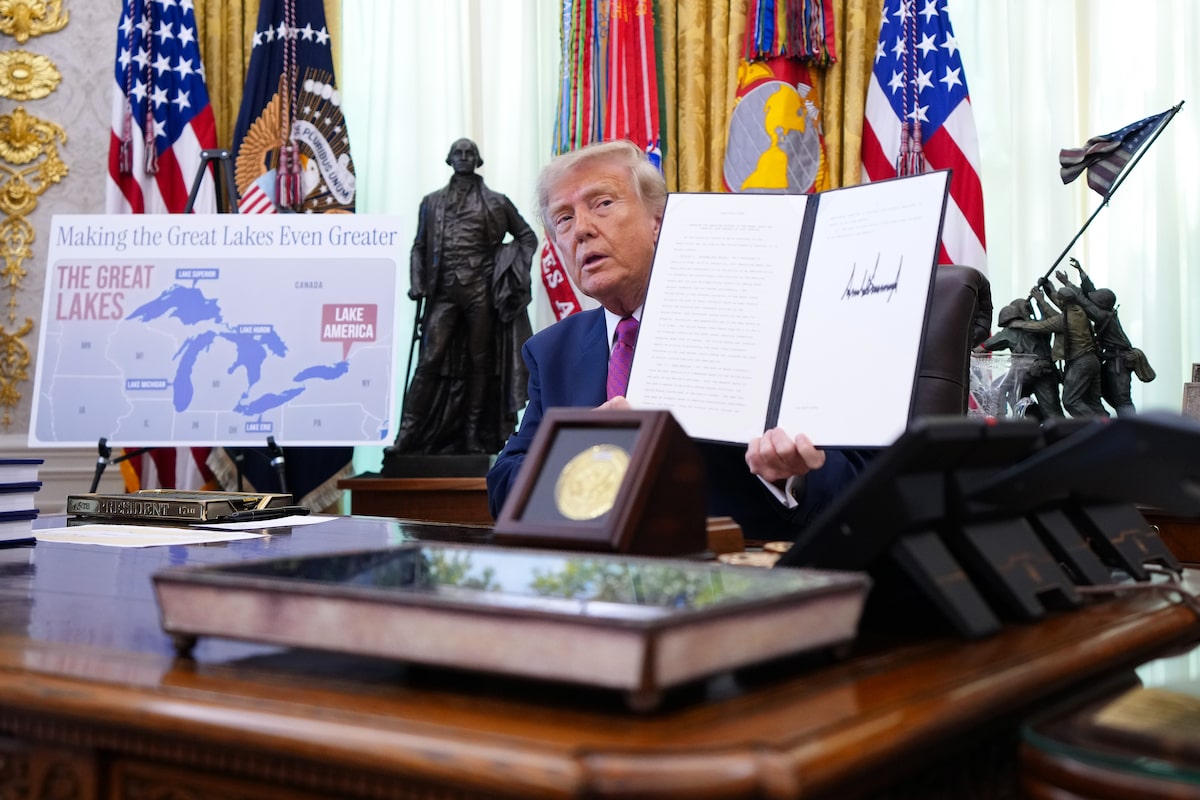
Open this photo in gallery:A map naming Lake Ontario as 'Lake America' is displayed as U.S. President Donald Trump signs an executive order during an event in the Oval Office of the White House on Thursday in Washington, D.C.Andrew Harnik/Getty ImagesU.S. President Donald Trump signed an order that he said immediately changes the name of Lake Ontario to Lake America, just hours after Canada’s minister responsible for trade talks between the two countries suggested a deal may still be possible.Mr. Trump signed a document in the White House Thursday afternoon.“This is official, effective immediately,” he said.He then repeated some of his past grievances, including claims that Canada’s auto policies are unfair and that Canada does not spend enough on its military.“Canada has been ripping us off for a long time on trade,” he said.Prime Minister Mark Carney responded with a post on X.“The name Lake Ontario comes from the Wendat word Ontari’io, which, appropriately, means ‘the lake is beautiful, the lake is big.’ The name is more than 400 years old, predating both the Confederation of Canada and the Declaration of Independence of the United States of America. We know that America is changing. Their trading relationships, their foreign policies, their national monuments, their hydronyms. Canadians also know that naming reality means calling it Lake Ontario – then, now and always.”To First Nations that named Lake Ontario, Trump’s threat doesn’t hold waterManitoba Premier Wab Kinew dismissed the President’s announcement.“You know when a rock band is really over the hill, and you see them in a casino playing some song from like 50 years ago? I think that’s the part of Donald Trump’s presidency we’re at now,” he told reporters in Winnipeg. “It’s not his best work.”Mr. Trump has previously declared that the U.S. renamed the Gulf of Mexico.“We changed it, and now it’s very routinely called the Gulf of America. So, if you think about it, we have a gulf and we have a lake. Now all we need is an ocean. So maybe we’ll have to change the name of the Atlantic and/or the Pacific,” he said.Earlier in the day, Dominic LeBlanc, the federal minister in charge of Canada-U.S. trade, issued a statement that suggested Canada was open to further talks after receiving “clarifications” from his U.S. counterpart.“Canada welcomes that the U.S. is now withdrawing its positions on discoverability and labelling and is confirming that measures to promote French language and Canadian culture will not be subject to future U.S. trade actions,” Mr. LeBlanc said Thursday in a post on X. “We look forward to further constructive U.S. clarifications on their other positions, which would create the possibility of a mutually beneficial trade agreement that respects Canadian sovereignty.”The Canadian minister was reacting to comments made by U.S. Trade Representative Jamieson Greer in a Wednesday interview with CBC News. In the interview, which he conducted in both English and French, Mr. Greer rejected the Canadian version of events as to how French-language issues were discussed during the trade negotiations.Open this photo in gallery:Dominic LeBlanc, Canada's minister in charge of U.S.-Canada trade, leaves the Office of the United States Trade Representative in Washington, DC, on Aug. 21.AMID FARAHI/AFP/Getty ImagesHe said that while the American side did raise concerns about Canadian policies urging online streaming companies to promote the “discoverability” of French programing, the American side did not insist on changes.Mr. Greer said there is “no way” that his side would have allowed the deal to fall apart over that issue.“It’s like the farthest thing from a red line,” he said. He said there are currently no “open channels” of communication between the two sides and suggested the U.S. will respond if Canada follows through with its planned countertarrifs.“If there’s further retaliation from the Canadian side, we of course, we’re not going to just sit down and take that,” he said. “Our view is, you know, don’t retaliate. But I know how people are feeling in Canada and what they think. So you know, it’s unfortunate, but it is what it is.”Alberta, Saskatchewan push back on calls for oil, potash export levies in retaliation for U.S. tariffsAfter trade negotiations fell apart late Friday, Mr. Trump approved 50-per-cent tariffs on about $28-billion worth of Canadian goods. Ottawa responded by outlining on Tuesday countertariffs targeting nearly 900 American products that are scheduled to come into force on Sept. 8. However, the Finance Department announced late Wednesday that it would be adjusting its planned tariffs.“Based on feedback, we have made select adjustments to protect against broader economic harms, including removing seafood and fish products from our list of counter tariffs, while maintaining dollar-for-dollar and rate-for-rate response for U.S. products,” the department said on X.Kelly Higginson, president of Restaurants Canada, which represents the Canadian dining industry, welcomed Ottawa’s reversal on seafood tariffs. She said seafood prices would have jumped, squeezing Canadian business and consumers. “We had some operators who might be able to replace that U.S. seafood with product from other countries, but the increased demand for those alternatives was going to put pressure on the supply and the price,” Ms. Higginson said in an interview. “We had a few operators who we spoke to who source their shrimp from India and had seen a price increase of almost 20 per cent almost immediately come through.”There were also worries, she said, that the tariffs would hammer states like Maine and Alaska so hard that the U.S. would retaliate against the Canadian fishing industry. Susan Collins, the Republican senator for Maine, welcomed Ottawa’s reversal on seafood in a social media post. “These tariffs would have caused tremendous harm to Maine’s lobstermen, disrupting one of their most important markets during the fall fishing season,” Ms. Collins wrote, urging Washington to reciprocate this “show of good faith” from Ottawa and return to the negotiating table. Gulf of understanding: The way we see the Earth has never been set in stoneMr. Greer also disputed Canada’s claims that it was the U.S. side that brought new last-minute demands to the table. He said it was Canada that pushed for additional changes related to the treatment of the auto sector and large trucks.The U.S. had offered to lower the tariff on Canadian automobiles to 15 per cent from 25 per cent, but the two sides disagreed about whether the reduction would also apply to medium- and heavy-duty trucks. Tariff relief for trucks is a key issue for Canada given that General Motors Co. produces the Chevrolet Silverado in Oshawa and Ford Motor Co. is spending billions to retool its plant in Oakville to produce F-Series trucks. Prime Minister Mark Carney has said it wasn’t until late last week when Canada saw the final text of the deal that it became clear trucks would not be getting relief. Mr. Greer disputed this characterization. “For weeks when I’ve been speaking with my Canadian colleagues, I’ve been clear about what we believe we could deliver, including about autos,” Mr. Greer said. “I understand why the Canadians want to have as much as they can get and try to expand concessions from the U.S. But we are focused on doing what’s good for America and accommodate Canada to the extent we can.”The Globe and Mail has reported that there were disagreements within the Trump administration about how hard to push Canada on metal tariffs, which played a role in derailing the negotiations at the last minute. U.S. Commerce Secretary Howard Lutnick demanded that certain products made of aluminum not be included in the tariff reductions. One crucial stumbling block to the deal, according to Mr. Carney, was U.S. demands that would have restricted Canada’s ability to strike trade deals with other countries. However, Mr. Greer disputed the Prime Minister’s characterization of the issue. He pointed out that Canada already agreed not to make free-trade deals with “non-market economies,” including China, when it signed the United States-Canada-Mexico Agreement in 2018. Four takeaways from Canada’s tariff counterpunchHe said that the conversation had revolved around aligning tariffs against third-countries in key industries like steel, aluminum and automobiles as part of a “Fortress North America” approach that Mr. Carney himself has advocated for. Most of the trade deals the U.S. has signed with 20 other countries over the past year have included clauses that require the trade partner to mirror certain U.S. trade actions, with the goal of reducing the transhipment of Chinese products into the U.S. through third countries. Canada has taken its own steps over the past year to align with U.S. tariffs on offshore steel and aluminum, tightening its tariff-rate-quota system to greatly restrict metal entering Canada from Asia and other parts of the world. The move has been supported by Canadian steel producers. Ottawa launches $100-million steel shipping rebate program as U.S. tariffs weigh on industryOttawa also has a history of mirroring U.S. trade policy, including the decision in 2024 to place 100-per-cent tariffs on Chinese electric vehicles following a similar action by Washington. Mr. Carney shifted direction earlier this year when he reached a deal with Beijing to allow 49,000 Chinese EVs into Canada at a lower tariff rate in return for relief from Chinese levies on Canadian agricultural products. In his Saturday morning press conference explaining why Canada walked away from the table, Mr. Carney said that Ottawa was also concerned about Chinese industrial overcapacity and was willing to align with U.S. trade measures in key sectors.“Was that potentially part of this deal? Absolutely,” Mr. Carney said. “But when it moves into restrictions and using Canada effectively as more leverage for America, clearly, Canadians wouldn’t accept that. We’re a proud, independent country. We’ve got the right values. We’ll make our decisions about who we want to trade with and how, and including on how we work with the United States and other partners.”Mr. Carney has made trade diversification a central pillar of his economic policy vision, with the goal of reducing reliance on the U.S. market. But he has also said that Canada is prepared to work with the U.S. to build a “Fortress North America” in key sectors – which complicates the goal of diversification, particularly with regards to China.
Trump signs executive order to rename Lake Ontario as Lake America
Full Article
Original Source
Read the full article at Theglobeandmail →KhanList aggregates and links to publicly available news content. We do not host full articles from third-party sources. Always verify important information with original sources.