
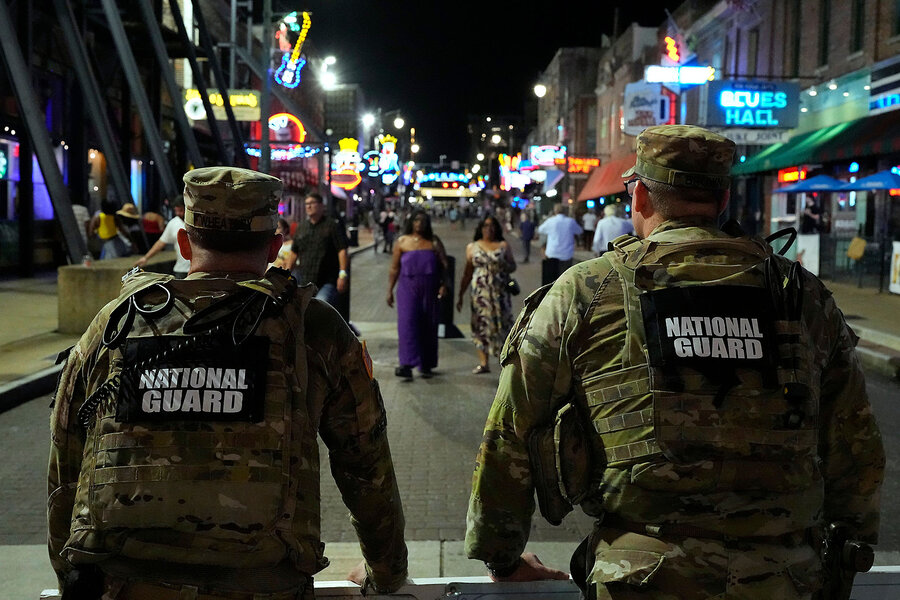
Memphis, Tenn. | Oct. 14, 2026, 5:00 a.m. ET | 5 min read As temperatures inched into the 90s last October, the military marched into Memphis.Ordered into the city by the Trump administration, federal and state law enforcement agencies joined local officers to form the Memphis Safe Task Force, a multiagency operation that, by early 2026, had grown to more than 2,600 personnel and 42 teams across the city.But unlike in Minneapolis, Los Angeles, and Chicago, where federal enforcement efforts had met resistance from local officials, Memphis Mayor Paul Young, a Democrat, said he would support the mission and urged the task force to focus on violent crime rather than immigration enforcement. The city was still struggling with crime and was short hundreds of police officers. Now, at the end of its first year, the combined task force has made some 13,140 arrests and seized 2,201 illegal firearms, according to the U.S. Marshals Service.The Trump administration argues that those numbers prove its approach to public safety works – and that Democratic policies in cities like Memphis don’t. Yet the Memphis, Tennessee, experiment offers a more complicated picture.During the task force’s first year, murders were down 37%, sexual assaults 30%, and robberies 47%, compared with a year earlier, according to the U.S. Marshals Service. Serious crime overall was down nearly 38%. But the decline in crime was already underway well before the task force arrived. The Memphis Police Department had begun chipping away at a backlog of cold cases as early as 2023, even as the department struggled with low staffing. Its Operation HUSH, which ran from January 2023 through June 2025, had already produced 45 indictments, according to the MPD.Murder rates already fallingBetween 2023 and 2024, Memphis homicides fell from a peak of 399 to 301. The decline continued in 2025, when the MPD reported 235 murders, the city’s lowest annual total since the pandemic.Trump administration officials have highlighted the decline as evidence of the task force’s effectiveness, though the downward trend had begun before its deployment. Bruce Newman/AP/FilePresident Donald Trump (center) participates in a roundtable discussion on public safety at a Tennessee Air National Guard Base with (from left) the state's Republican Gov. Bill Lee, Defense Secretary Pete Hegseth, then-Attorney General Pam Bondi, and Gady Serralta, the director of the U.S. Marshals Service, in Memphis, March 23, 2026. While the force was tasked with targeting “the worst of the worst,” as the Trump administration put it, most of its early arrests involved nonviolent offenses, according to an MLK50-ProPublica analysis of arrests from October 2025 through early February 2026.Still, the Trump administration’s surge, starting in the last quarter of 2025, brought more law enforcement resources to help Memphis police pursue older cases and expand investigations. Federal and local agencies helped track down outstanding warrants and fugitives. Meanwhile, the homicide clearance rate – when cases are officially “closed” or resolved – rose to 81% in the second quarter of 2026, up from 47% in the same period in 2025, according to the MPD.“When clearance rates go up, it changes the calculus for professional or semiprofessional criminals,” says Jennifer Gaudette, an assistant professor at the University of California, Riverside’s School of Public Policy.A test of tacticsThe task force’s work has required cooperation among federal, state, and local agencies, as well as rotating teams of officers and agents. These teams execute warrants, conduct investigations and traffic stops, respond to calls, and patrol crime hot spots.Tennessee National Guard members, for example, maintain a visible law enforcement presence on Beale Street, the FedExForum arena, and other high-traffic areas to support local police. While the agencies have generally worked well together to solve some safety problems, they have also, critics say, introduced new ones, such as instances of excessive force, civil rights violations, and immigration raids that frighten neighborhoods without addressing the root causes of crime.Over the mayor’s wishes, the task force has also arrested “more than 800 immigrants, whom law enforcement deemed to be unlawfully present in the United States,’’ according to the MLK50-ProPublica report. It added that only 2% of the task force’s immigration arrests in Memphis were for violent crimes and that 4 in 5 originated from routine traffic stops.Memphis residents have filed at least one lawsuit alleging that task force members harassed, arrested, or mistreated them while they watched or recorded task force activity. The lawsuit challenges Tennessee’s “Halo Law,” which restricts how close observers may get to police. George Walker IV/APEvaniel Johnson poses with a picture of his grandson, Tyrin Johnson, July 6, 2026, in Nashville, Tennessee, after his grandson was fatally shot by two Tennessee National Guard members in Memphis the day before. Meanwhile, at least five people in Memphis have been shot in encounters involving task force personnel, four fatally. In July, two Tennessee National Guard members fatally shot 20-year-old Tyrin Johnson after authorities said he turned toward them with a gun. An autopsy report revealed that Mr. Johnson was shot in the back. The Tennessee Bureau of Investigation is investigating the shooting.Residents “don’t want police to have free rein to do whatever they want,” especially when it comes to profiling or using excessive force, says Professor Gaudette.The MLK50 analysis of task-force arrest records from a two-month period last year found that, among 3,048 people whose race could be classified from available photographs, only 169 – about 6% – appeared to be white. “Traffic stops of moms in minivans isn’t making Memphis safer,” says John Miller, co-owner of Shangri-La Records and a longtime figure in Memphis’ independent music scene. “Racial profiling isn’t making Memphis safer. This has been overkill in every sense of the word.”What’s next?Historians and local residents suggest that while the Trump administration’s surge may be helpful, many of the city’s struggles with crime have to do with systemic issues, such as lax gun laws, slow courts, and repeat offenders.When Memphis’ crime rate began rising in the late 2010s, for example, it was accountability failures – and complicated jurisdiction issues in big cities like Memphis that can confound voters – that contributed to the impression of weak governance, says Justin de Benedictis-Kessner, author of “The Fog of Accountability.” Memphis leaders and residents have clashed with Tennessee’s Republican-controlled legislature over state policies affecting the city.After the National Guard deployment last year, Shelby County Mayor Lee Harris and several other elected officials sued to block it, arguing that state officials had exceeded their authority. A lower court halted the mobilization. But in April 2026, the Tennessee Court of Appeals reversed the order, ruling that the plaintiffs lacked standing. In June, the U.S. Department of Justice announced nearly $300 million in federal grants to be provided through its new Model Cities Initiative. Two to four cities will receive federal funding for comprehensive public safety strategies. If Memphis isn't one of them, the city will have to try to maintain its momentum on public safety without extra manpower. “The jury is still out on whether this was a good or a bad thing,” says the Rev. Earle Fisher, senior pastor of Abyssinian Missionary Baptist Church, a hub for social justice in Memphis. “Maybe it was a bit of both.” ALREADY A SUBSCRIBER? LoginReal news can be honest, hopeful, credible, constructive.The Christian Science Monitor was founded in 1908 to lift the standard of journalism and uplift humanity. We aim to “speak the truth in love.” Our goal is not to tell you what to think, but to give you the essential knowledge and understanding to come to your own intelligent conclusions. Join us in this mission by subscribing.
Trump sent the military to Memphis to fight crime. Here’s what happened.
Full Article
Original Source
Read the full article at Csmonitor →KhanList aggregates and links to publicly available news content. We do not host full articles from third-party sources. Always verify important information with original sources.