
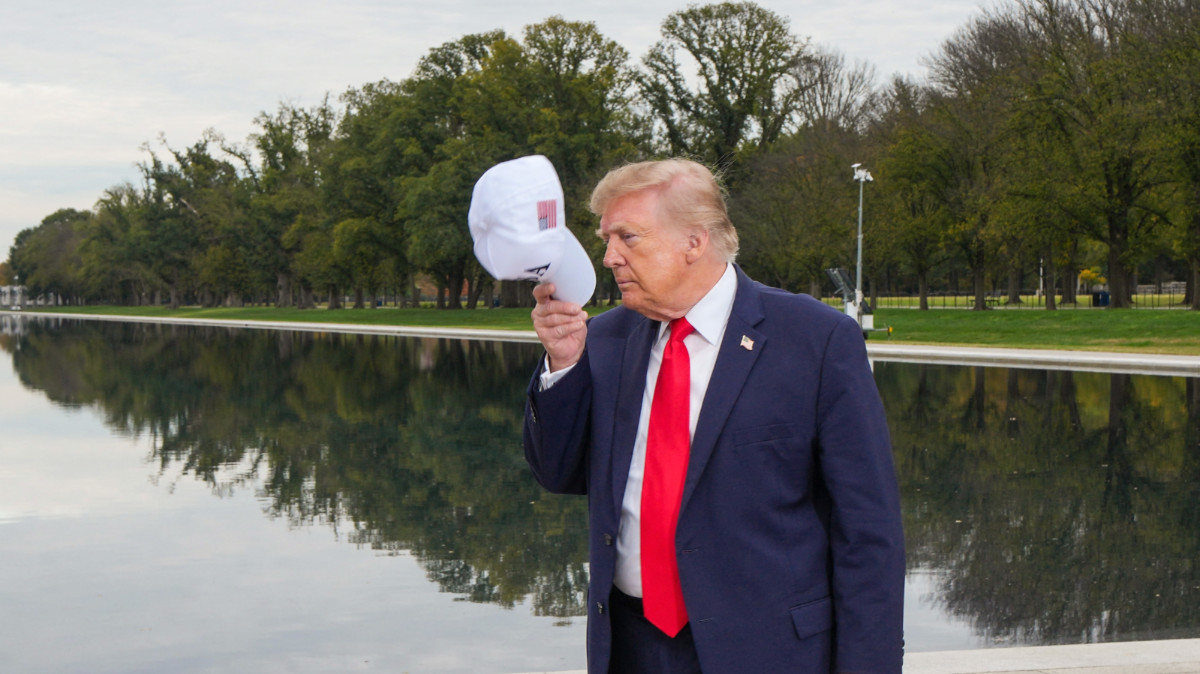
Trump and Iran issue de-escalatory statements as midterms approach and warnings of nuclear war lurk US President Donald Trump departs the Lincoln Memorial Reflecting Pool after delivering remarks, on 2 November 2026 in Washington, DC (Andrew Harnik/Getty Images/AFP) Published date: 2 November 2026 21:33 GMT | Last update: 6 sec ago The US is not going to attack Iran after the midterms, President Donald Trump said on Monday, one day ahead of a hotly anticipated election and following a warning from conservative podcast host Tucker Carlson that Trump was weighing dropping a nuclear bomb. Trump ruled out strikes in a question posed by an NBC reporter during a speech at the Washington Reflecting Pool on Monday, after signalling in other interviews he was in no rush to resume attacking the Islamic Republic. "One way or the other, we will do something, but there is no rush. We crippled them financially. They have no money, no gasoline, and their people are getting very tired of it," Trump told Axios in an interview released on Monday, before his speech. "Iran wants a settlement, as soon as possible. It could happen!" Trump posted on social media separately, ahead of Tuesday's midterm elections. Trump’s remarks come 24 hours before Americans go to the polls to vote in elections that will determine control of the US Congress, with many commentators speculating that the comments could be aimed at calming voters ahead of the polls. New MEE newsletter: Jerusalem Dispatch Sign up to get the latest insights and analysis on Israel-Palestine, alongside Turkey Unpacked and other MEE newsletters Polls predict that Trump’s Republican Party could face a severe setback amid frustration over rising prices that have been caused, in part, by the US-Israeli war on Iran. Carlson also issued a dire warning that had over 70 million views by Monday evening. Carlson has publicly fallen out with Trump but still has ties to administration officials and counts Vice President JD Vance as a close friend. 'Biggest drop in oil history' He wrote on X that Trump was considering using nuclear weapons against Iran at the behest of Israeli Prime Minister Benjamin Netanyahu. Brent, the international benchmark, fell seven percent on Monday to $104 per barrel after rallying over the last few weeks in anticipation of a resumption of US-Israeli strikes on Iran. Experts and diplomats warn that Iran is likely to retaliate to any attack by launching strikes across the energy-rich Gulf region. 'Escalation is coming': Middle East on edge as new Israeli-US attack on Iran looms Read More » “Oil today is down ten dollars, which is the biggest drop in oil in history,” Trump said on Monday. “It’s going to go down a lot further because we are winning with Iran.” Oil prices were already falling after Iranian President Masoud Pezeshkian said that the government had been working with mediators to renew a truce with the US. Qatari mediators have been shuttling between Doha and Iran in recent days, according to media reports and flight-tracking information. Other senior Iranian officials have said Tehran is working to find a return to a ceasefire agreement that would reopen the Strait of Hormuz in return for negotiations over Iran’s nuclear programme. ”Consultations through mediators are very intensive. We have presented our conditions and proposals, and everything depends on the political rationality of Washington," Iranian Foreign Minister Abbas Araghchi said in comments carried by state media outlet IRNA. Iran's foreign ministry spokesperson Esmaeil Baghaei said on Monday that Tehran has a seven-step proposal for a diplomatic solution that could be implemented in two days. The plan would call for the US to end its blockade on Iranian ports, Iran to reopen the Strait of Hormuz waterway, a US waiver on Iranian oil sales, the cancellation of new sanctions on Iran, and then talks on the nuclear file. The US and Iran agreed to a ceasefire in the spring and then signed a 14-point memorandum of understanding to advance talks that was never implemented. The talks collapsed in part over the US’s reluctance to agree to Iran controlling traffic in the Strait of Hormuz. Middle East Eye delivers independent and unrivalled coverage and analysis of the Middle East, North Africa and beyond. To learn more about republishing this content and the associated fees, please fill out this form. More about MEE can be found here.
Trump says he will not attack Iran after midterms
Full Article
Original Source
Read the full article at Middleeasteye →KhanList aggregates and links to publicly available news content. We do not host full articles from third-party sources. Always verify important information with original sources.