
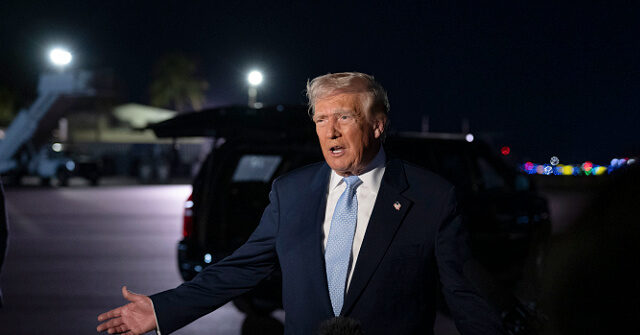
President Donald Trump said Thursday that he would soon decide whether to launch another round of major strikes against Iran, following high-level White House deliberations over the next phase of the conflict. Speaking to reporters in the Oval Office, Trump raised the prospect of further strikes to ensure Iran could never rebuild its nuclear weapons program, even as his administration weighs a possible diplomatic agreement with Tehran. “Now we will make a decision,” Trump said, as he weighed whether the United States should launch further strikes to ensure Iran could never rebuild its nuclear weapons program. Trump indicated that he would prefer to avoid further destruction but was prepared to order additional strikes. “I would rather not destroy the rest of the country if possible, but maybe I’ll have to,” he said. “You’ll know soon enough.” Trump reinforced that warning by highlighting increased American weapons production and the military’s readiness for further operations. “If we have to do the rest of the Iran thing, we’re very much locked and loaded,” he said. Trump’s remarks followed a meeting with his top national security advisers Thursday, their first discussion of Iran since Tuesday’s midterm elections, Axios reported, citing two U.S. officials. Senior administration officials separately told Fox News that White House meetings concerning the possible resumption of military operations had taken place Wednesday and Thursday. The discussions come after Trump had ruled out further major strikes before the elections, with his administration now weighing a renewed large-scale military campaign, continued efforts to strangle Iran’s regime economically through sanctions and the naval blockade, or a negotiated settlement with Tehran. The deliberations come just two days after Republicans suffered major losses in the midterm elections, which Trump acknowledged were partly driven by higher gasoline prices stemming from the Iran conflict. The president firmly defended the U.S.-Israeli campaign, insisting that preventing Tehran from acquiring nuclear weapons justified the political costs and that he would authorize the operation again. Vice President JD Vance, meanwhile, has emerged as a leading advocate of diplomacy rather than renewed strikes. In a lengthy statement Wednesday, Vance directly blamed the Iran conflict for the Republican defeat, arguing that voters who supported Trump in 2024 had turned against the party over the operation. As Washington weighs its military options, diplomatic efforts have intensified, with Qatar leading attempts to broker an agreement that would reopen the Strait of Hormuz and revive negotiations over Iran’s nuclear program. Iranian Foreign Minister Abbas Araghchi held multiple calls Thursday with regional mediators from Qatar, Saudi Arabia, Turkey, the United Arab Emirates, Oman and Egypt. The New York Times reported Thursday that Iran was reviewing concrete proposals conveyed through mediators after weeks of resisting negotiations, according to five officials briefed on the discussions. The diplomatic contacts have included two rounds of talks in Tehran, a third in Doha, and additional discussions with Iranian officials in Armenia. The reported opening comes despite Tehran’s insistence that Washington first meet seven demands, including lifting sanctions, releasing frozen Iranian assets, compensating Iran for damage inflicted during the conflict, and ending the U.S. naval blockade. Several of those demands have previously been rejected by Washington, which has insisted that Iran’s nuclear program must be permanently dismantled. Despite those differences, Iran submitted a nuclear proposal to the United States through Qatar on Thursday, Reuters reported, citing a senior Iranian official. The official indicated that further negotiations remained contingent on Washington meeting Tehran’s conditions, including sanctions relief and an end to the blockade. Mohsen Rezaei, the powerful secretary of Iran’s Supreme National Security Council and a key figure in indirect negotiations with Washington, reiterated Tehran’s hard-line position Thursday after meeting Russian President Vladimir Putin in Moscow. Rezaei declared that Iran would neither end its obstruction of shipping through the Strait of Hormuz nor enter negotiations until the United States fulfilled all seven of its conditions. Privately, however, Rezaei has displayed greater willingness to discuss Iran’s nuclear program than his public statements suggest, according to the Times, citing two Iranian officials and an American official. The discussions have also involved Foreign Minister Abbas Araghchi and Parliament Speaker Mohammad Bagher Ghalibaf. A central obstacle remains Iran’s stockpile of highly enriched uranium, which Trump has demanded Tehran surrender as part of any nuclear agreement. Iranian officials have refused to transfer the material abroad, although previous negotiations have explored diluting it inside Iran under international supervision. Qatari mediators are nevertheless pursuing a possible compromise to overcome the impasse. Under a two-day proposal described by Axios, Washington would initially lift its naval blockade and release some frozen Iranian funds, while Tehran would formally invite International Atomic Energy Agency inspectors to examine nuclear facilities damaged during the conflict. The proposal calls for the Strait of Hormuz to reopen on the second day, paving the way for renewed negotiations over Iran’s enriched uranium stockpile. Neither Washington nor Tehran has announced acceptance of the arrangement. Asked Thursday about reports that Iranian negotiators were reviewing a new nuclear proposal, Trump insisted that Tehran could not proceed with its nuclear program without Washington’s approval. “They’re not doing anything without our approval,” he told reporters. “It doesn’t make a difference what they’re looking at. They’re not going to have a nuclear weapon.” Trump also asserted that American forces now controlled “everything that we’ve wanted to control” in Iran, characterizing the U.S. military’s position as “virtually an occupation.” He estimated that the country could take 25 years to rebuild from the destruction inflicted during the conflict. Meanwhile, American military planning has continued alongside the diplomatic efforts. U.S. Central Command is finalizing preparations for a possible resumption of major combat operations, although it has received no new directive from Washington, according to a U.S. official cited in the report. The USS Theodore Roosevelt carrier strike group is also moving toward the Middle East, where two other American carrier strike groups are already deployed. Its arrival could signal preparations for renewed strikes. The Roosevelt is scheduled to stop in Singapore on Friday and is not expected to enter Central Command’s area of responsibility before mid-November. Joshua Klein is a reporter for Breitbart News. Email him at jklein@breitbart.com. Follow him on Twitter @JoshuaKlein.
Trump Says Decision on Renewed Strikes Against Iran Coming ‘Soon’
Full Article
Original Source
Read the full article at Breitbart →KhanList aggregates and links to publicly available news content. We do not host full articles from third-party sources. Always verify important information with original sources.