
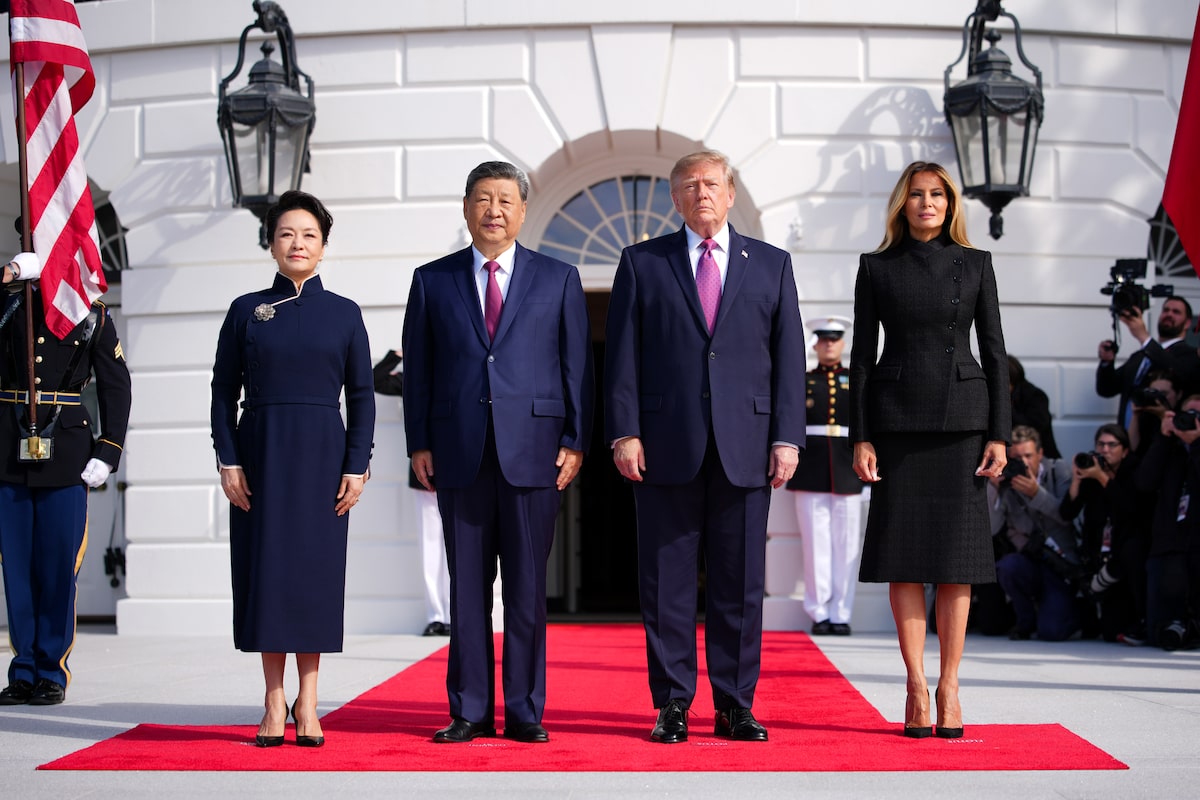
Open this photo in gallery:From left to right: First lady of China Peng Liyuan, Chinese President Xi Jinping, U.S. President Donald Trump, and first lady Melania Trump, during an arrival ceremony at the White House on Thursday.Andrew Harnik/Getty ImagesHosting Chinese President Xi Jinping in Washington this week, U.S. President Donald Trump, who was openly bowled over during two visits to Beijing, was clearly out to impress. But for all the pomp and ceremony − including a supersonic bomber flyover, a brass band and a military review including troops dressed in Revolutionary War era gear − the good vibes expressed by both men could not hide the fragility of the current U.S.-China rapprochement. Mr. Xi’s last state visit to the U.S. was in 2015, when China was still very much a rising power, a country seeking what it saw as its natural place at the table. Today, it is a true superpower, one that fought the U.S. to a stalemate when Mr. Trump launched a trade war last year, matching Washington tariff for tariff until both sides stepped back from the brink and agreed to talk. In remarks Thursday, Mr. Xi presented China as an equal to the U.S., saying that, as the “two major powers,” both countries “bear a historic responsibility to promote human development and progress.” “While China-U.S. co-operation cannot solve every problem in the world, many global issues would be difficult to resolve without it,” Mr. Xi said. “There is no need for China and the United States to shy away from competition. However, such competition should be benign and bounded − a race where we strive to excel alongside one another, rather than a zero-sum gladiatorial contest.” Open this photo in gallery:President Xi is on a state visit to the U.S. from Sept. 23 to 25.AFP Contributor#AFP/AFP/Getty ImagesTurning to his favoured nautical reference, Mr. Xi said it was important to “steer the giant ship of China-U.S. relationship on a steady course toward the future.” But if anything, the main goal of his visit will be maintaining an even keel as the relationship remains in the doldrums and the course seems to be one of gradual decoupling, as both sides shore up their respective economies against a future reopening of hostilities. “Both sides believe they are in the strong position currently and can wait it out,” said Antonia Hmaidi, an analyst at the Berlin-based Mercator Institute for China Studies. “There’s a huge incentive to keep strategic stability going and have regular meetings, but not do anything at them.” Ahead of Mr. Xi’s arrival Wednesday, a trade truce the two leaders struck at a meeting in South Korea last year was extended to early 2027, while a board of trade agreed upon during Mr. Trump’s own visit to Beijing this May became operational. China also agreed to send two pandas to Atlanta, a typical gesture of goodwill by Beijing. Just how the board of trade will work remains unclear, even as Mr. Trump praised the new apparatus Thursday, saying it had already been “unbelievably successful” in creating a “more balanced trade relationship.” But progress on truly contentious issues, including China’s dominance of rare earths and U.S. export controls on cutting-edge computer chips, has been scant. And for all Mr. Trump’s claims that Beijing and Washington were in alignment on AI, the U.S. has been actively seeking to stymie Chinese development of this key technology. Open this photo in gallery:The meeting between the two leaders included a supersonic bomber flyover, a brass band and a military review including troops dressed in Revolutionary War era gear.Andrew Harnik/Getty ImagesWhen Mr. Trump launched his trade war against China last year, it was with the stated ambition of isolating Beijing, using tariffs against other countries to pressure them to limit Chinese exports. Instead, his on-again-off-again global trade war has served to push many countries, including Canada, closer to China, as they seek a counterbalance to an increasingly unreliable and unpredictable U.S. Mr. Trump’s disastrous war in Iran has further strengthened China’s position in much of the world, enabling Beijing to present itself as a beacon of stability and sanity, seeking economic integration rather than disruption. Iran was one of several contentious issues expected to be discussed Thursday. At times, Mr. Trump has suggested he wants to see China do more to pressure Tehran, though what Beijing could do that months of bombing and economic devastation have not is unclear. Taiwan, too, is a major sticking point in the drive toward stable relations. During their bilateral meeting Thursday, Mr. Xi urged Washington to approach the issue of the self-ruled island − which Beijing claims and has threatened to annex − “carefully” and adopt the “correct position” of opposing formal Taiwanese independence. It’s unclear whether Mr. Xi pushed Mr. Trump to cancel a currently suspended US$14-billion arms sale to Taiwan, which the U.S. leader had previously suggested could be a good “negotiating chip,” much to the alarm of officials in Taipei. As Mr. Trump showed Mr. Xi some of the changes he’s making to the White House, reporters asked if they had discussed Taiwan, Iran or jailed Hong Kong publisher Jimmy Lai.Mr. Xi did not respond, while Mr. Trump said they had had a “great meeting,” adding that the Chinese leader “loves granite. He is an expert on stone, among many other things, and loves good granite.”
Trump rolls out the red carpet for China’s Xi as both sides seek stability
Full Article
Original Source
Read the full article at Theglobeandmail →KhanList aggregates and links to publicly available news content. We do not host full articles from third-party sources. Always verify important information with original sources.