
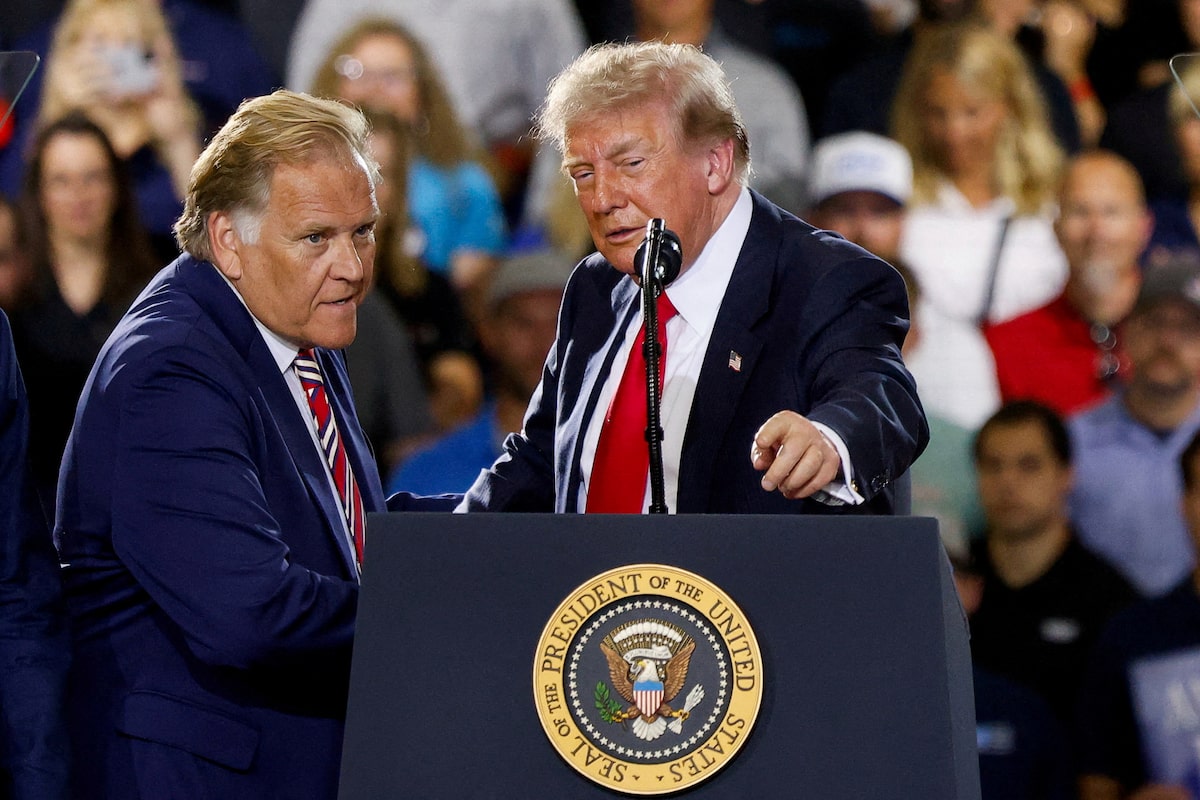
Open this photo in gallery:U.S. President Donald Trump stands with Former U.S. Representative Mike Rogers, as Trump delivers remarks on the economy, at the General Motors Proving Ground in Milford, Michigan, U.S. July 27. In a recent campaign video, Rogers says the war with Iran needs to 'end quickly.'Carlos Osorio/ReutersIt’s not unusual for a war to affect an American election. But it’s highly unusual for an American election to affect a war.Yet that’s apparently the remarkable phenomenon at play while the war between Iran and the United States remains in a quiet phase even as the U.S. midterm-election campaign enters its most contested period.Last week, President Donald Trump said he didn’t expect a peace agreement until after the elections, scheduled for Nov. 3. Over the weekend there were fresh indications that Mr. Trump, who last week rejected an Iranian proposal for a weeklong ceasefire, was holding out the possibility of ordering a new series of strikes after the midterms.The result is a clear tie between American foreign policy and the domestic arena in a tacit, rare acknowledgement of how politics and war have become linked in the Trump era. In his speech at the United Nations last week, the President disavowed any connection between the two, but his emerging policy suggests otherwise.Iran’s President vows not to surrender to U.S., but says country is ready for talksThe war, and the mounting fuel and fertilizer prices it has caused, is a drag on Republican candidates, which is why nearly 20 of them have called for an end to the conflict.One of the more significant appeals came from Mike Rogers, a former chair of the House Intelligence Committee who is now in a tight Senate race in Michigan, a swing state Mr. Trump carried by 1.4 percentage points two years ago. “The war needs to end − and end quickly,” Mr. Rogers said in a campaign video recorded in a grocery store.In an interview after a rally in a barn on a soybean farm in the eastern part of reliably Republican Ohio, former Democratic senator Sherrod Brown, in a close race against Republican Senator Jon Husted, said, “People tell me everywhere they want to talk about this war. They’re really upset about this war.”Open this photo in gallery:U.S. President Donald Trump addresses the 81st United Nations General Assembly at the UN headquarters, Sept. 22. In his speech, Trump disavowed any connection between foreign policy and the domestic arena, but his emerging policy suggests otherwise.Mike Segar/ReutersOn Friday Mr. Husted joined the growing chorus of prominent Republican figures speaking out against the war, saying, “We got to bring the war to a close.” The week’s defectors from Trump war policy also included Representative Ashley Hinson, the party’s Senate candidate in Iowa, which Mr. Trump carried by 11 percentage points. Both she and Mr. Husted cited rising prices, with Ms. Hinson specifically speaking Thursday of “relief at the pump and the checkout line.”These Republicans are motivated by voter concerns that prompted Mr. Husted to air a television ad during the Ohio State football game Saturday that carried the legend: “Focused on Affordability.” Average gasoline prices in the U.S. reached US$4.49 a gallon last week, up from US$3.15 a year ago, according to the American Automobile Association. Diesel prices, which affect the transport of food and other commodities, rose to a record US$6.53 last week. Rates on 30-year mortgages have climbed above 7 per cent.A CNN/SSRS poll released last week found that only 29 per cent of American adults approve of the President’s handling of foreign affairs, a drop from the 42 per cent when he took office again in January, 2025.Analysis: Trump uses UN address to threaten and deride foes and allies alike, as usualThere are very few examples of an overt connection between war policy and electoral politics like this one.Perhaps the only precedent came in 1968, when Democratic President Lyndon Johnson ordered a halt to bombing North Vietnam in an effort to help his vice-president, Hubert Humphrey, in his election campaign against Richard Nixon, who prevailed five days later.U.S. entry into both world wars came the year before the re-election of Woodrow Wilson and Franklin Delano Roosevelt, not during their campaigns.Mr. Wilson took the U.S. into the First World War five months after winning the 1916 election, in part on the slogan “He kept us out of war.” Six days before the 1940 election, Mr. Roosevelt told a campaign rally in Boston, “Your boys are not going to be sent into any foreign wars.” The U.S. joined the Second World War 13 months later, after the Japanese bombed Pearl Harbor − technically an affirmation of the president’s pledge because the attack on Hawaii meant the conflict was no longer a “foreign war.”Setting specific dates at times of war, as Mr. Trump has done, is fraught with risk, for it shapes the decisions of the other side. In his first term, Mr. Trump set out a schedule for U.S. withdrawal from Afghanistan that was never met − then criticized Joe Biden for setting one several months later that was, in fact, met, only to be followed swiftly by the Taliban takeover of the country. Opinion: Iran proposes deal to reopen Strait of Hormuz in seven days if U.S. meets its conditionsRichard Nixon’s “Vietnamization” policy, which shifted the burden of fighting North Vietnam and the Viet Cong from American troops to South Vietnamese soldiers, set deadlines for the drawdown of U.S. military involvement, in essence providing a timetable for the eventual capture of all of Vietnam by Hanoi.The stakes for both the U.S. and Iran are especially high in the midterms, when all 435 seats in the U.S. House of Representatives and 35 Senate seats are being contested. But the implication of the results is difficult to ascertain.For Iran’s theocratic government, the impact of the elections defies easy explanation. Speaking last week amid speculation that Iran may withdraw from the Nuclear Non-Proliferation Treaty, Iranian officials reaffirmed the country’s determination to press forward with its nuclear drive.For Mr. Trump, who has dealt with narrow Republican majorities in both chambers in his second term, the prospect of Democratic control of even one house could narrow his military options − or prompt him to push toward a wider war or a swift resolution to the conflict before Congress acts to stop him.Then again, he has repeatedly demonstrated a refusal to be constrained by political and even legal barriers.
Trump putting Iran war on hold until after midterm elections
Full Article
Original Source
Read the full article at Theglobeandmail →KhanList aggregates and links to publicly available news content. We do not host full articles from third-party sources. Always verify important information with original sources.