
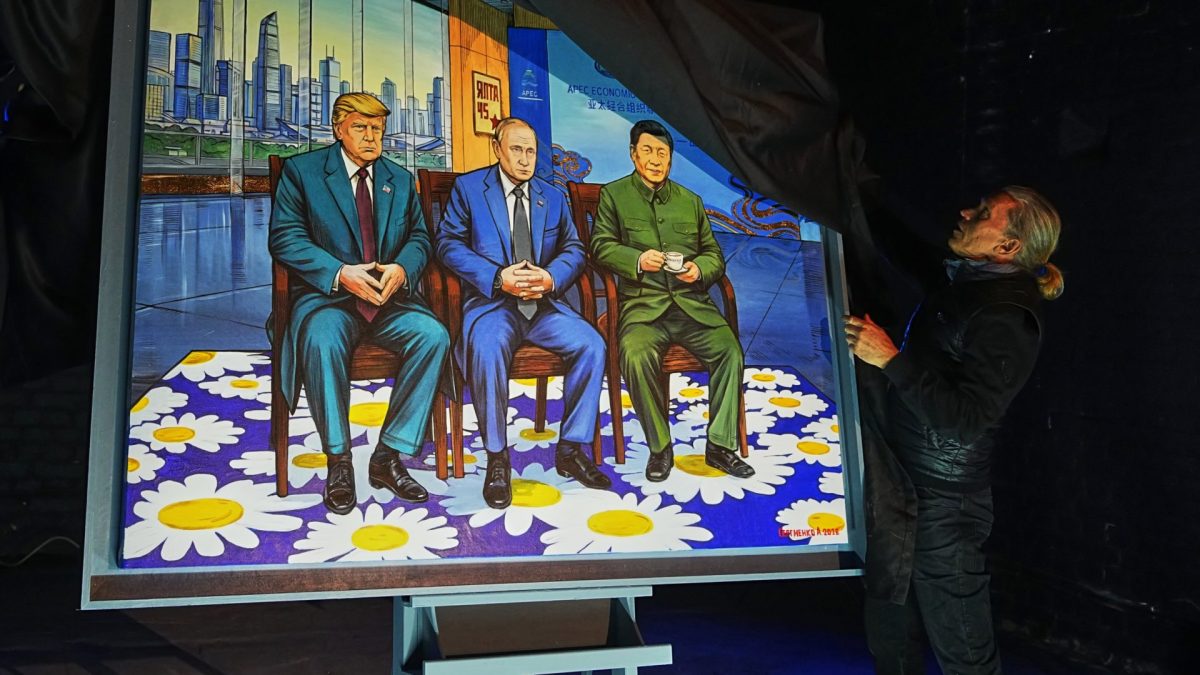
Donald Trump has never been shy in expressing his belief in great power diplomacy. The US President’s distrust of global alliance structures and approach to trade hark back to an era when “might is right” was the dominant philosophy among world leaders. Friday’s confirmation of a three-way meeting between Trump, Vladimir Putin and Xi Jinping, therefore, was unsurprising, not only because US and Russian officials had been openly discussing the prospect for weeks. However, the talks nonetheless represent a major diplomatic coup for Putin and could mark a significant shift in the security of Europe and the Middle East. What will the talks involve and when will they be? According to the White House, Trump, Putin and Xi will meet on the sidelines of the upcoming Asia-Pacific Economic Cooperation (APEC) summit in the Chinese city of Shenzhen. No date has yet been set for the meeting. Trump had already been expected to hold talks with Xi during the leaders’ summit, which will take place between 18 and 19 November, the third such meeting between the pair this year. The President, though, also expressed interest in including Putin, both to discuss nuclear arms control and in an apparent effort to find a solution to the Iran war and soaring fuel prices. Chinese officials were initially unconvinced by Trump’s plan, with Beijing concerned a trilateral summit would overshadow APEC and Xi’s desire to showcase Shenzhen as a growing tech-hub. However, Mao Ning, a spokesperson for China’s Foreign Ministry, confirmed last week negotiations over the talks were progressing with officials “in communication with relevant parties regarding a meeting between the three heads of state”.For Xi, the three-way summit offers an opportunity to cement China’s growing clout on the world stage, as well as to play a role in addressing major international challenges. It also presents the possibility of further swaying Trump’s approach to key issues in its favour, backed by support from Putin. This includes the future oversight and regulation of nuclear weapons, a talking point the US President is expected to raise. Following the expiration of the last nuclear pact – New START – between the US and Russia in February, Trump rejected the Kremlin’s offer of an extension in favour of negotiating a “new, improved and modernised” arrangement which also included China. Trump is also keen to push Putin and Xi to exert greater pressure on Iran as part of his effort to manufacture and end to the war he began in February. Russia and China are two of Iran’s closest allies and both have continued to provide military and economic support to the regime in Tehran throughout the conflict. Why is Europe nervous about the talks? European officials have expressed caution over the talks, hinting at fears Putin could use them to influence Trump’s approach to the war in Ukraine and continental security more broadly. US media, citing an anonymous official briefed on the meeting, have reported Trump is keen to avoid discussing Ukraine, even as Russian media has talked up the prospect of the three leaders finding a solution to the conflict. The prospect of Putin, Trump and Xi unilaterally re-writing Europe’s security framework has raised alarm in Ukraine and elsewhere. Ukrainian officials were quick to warn the talks risked becoming “Yalta 2.0” in reference to the infamous carving up of Europe by the UK, US and Soviet Union in the wake of World War II (WWII). Poland’s Deputy Prime Minister and Minister of Foreign Affairs took to social media to echo that comparison. “The original Yalta agreement acknowledged Soviet dominance over those parts of Eastern Europe that the Red Army controlled,” Radosław Sikorski wrote. “Now, Putin wants to be gifted Ukrainian territories that he is unable to conquer.” Trump is keen to push Putin and Xi to exert greater pressure on Iran (Photo: Contributor/Getty Images) However, some experts have downplayed the comparisons. Writing for the Lowy Institute, Alicja Bachulska, a policy fellow at the European Council on Foreign Relations, argued a repeat of Yalta was “impossible” because the US, Russia and China “do not share the same strategic calculus in trying to carve out their spheres of influence under current geopolitical conditions”. In addition to the agency demonstrated by Ukraine, Bachulska also noted Beijing’s desire to maintain the appearance of opposing what it calls “zero-sum games” and the bullying of smaller nations by larger ones. “In this context, [the] optics of such a meeting – even if a photo-op is the only result – might backfire against China, and Beijing seems to be aware of this risk,” she wrote. In what European leaders may view as a positive sign, Russia has also moderated its own stance. In response to questions from reporters about Yalta comparisons, Kremlin spokesman Dmitry Peskov said the meeting between Trump, Putin and Xi was “extremely significant” before downplaying any similarities with the post-WWII talks. “Let’s not forget that the vision for a global order is that no one tries to impose any particular view of global order, and it should be based entirely on mutual benefit and mutual respect,” he said. Could summit lead to a breakthrough in Iran? Unlike the war in Ukraine, Trump is keen to discuss the ongoing conflict in the Middle East with Putin and Xi. Soaring fuel prices, driven up by Iran’s chokehold on the Strait of Hormuz, have proven economically and politically painful for the US President, who acknowledged the conflict played a role in Republicans’ historic midterm election loses. As key allies to Iran, Russia and China have the ability to exert significant pressure on the regime in Tehran and could help force the country back to the negotiating table. Iranian officials have already hinted Russia is willing and able to act as a mediator in talks with the US, as has Putin. However, the Kremlin has continued to supply Iran with weapons and dual-use technology in recent months, suggesting any intervention in negotiations would likely favour the regime. Meanwhile, China has done little to suggest it will scale back its deep economic ties with Iran, continuing to purchase Iranian oil despite the threat of US retaliation. Beijing has also declined to assist with a fresh sanctions push unveiled by the US, which officials said was aimed at all but collapsing Iran’s economy. With Trump set to become a “lame duck” president for his remaining two years in office, it is unclear what incentives he could offer Putin and Xi to shift their positions.
Trump, Putin and Xi to hold major talks – what it could mean for Europe and Iran
Full Article
Original Source
Read the full article at Inews →KhanList aggregates and links to publicly available news content. We do not host full articles from third-party sources. Always verify important information with original sources.