
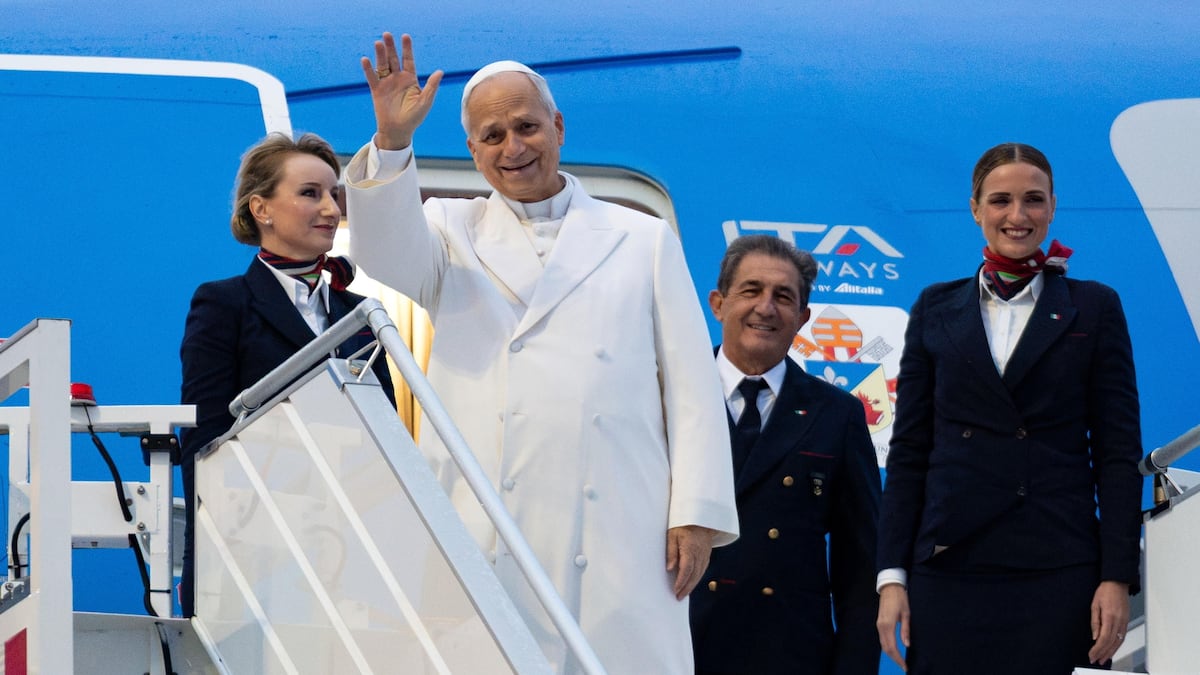
Pope Leo XIV, who holds both U.S. and Peruvian citizenship, departed at 7 a.m. on Friday, bound for the Americas for the first time since his election in May 2025. Born in Chicago and later a missionary and bishop in Peru, he is finally returning to his continent, though not to the United States. Instead, he is heading south on a trip that will take him to Uruguay, Argentina and Peru through November 17.The pope declined an invitation from the White House to visit his native country this summer for the 250th anniversary of the July 4 Declaration of Independence. Instead, he spent that day on the Italian island of Lampedusa, a symbol of the migrant crisis. The pontiff has kept his distance from U.S. President Donald Trump, with tensions between the two at times becoming deeply personal. (“I’m not afraid of Trump,” he said after the president’s attacks in April.) Yet Trump’s shadow will loom large over the trip, as the pope will visit two countries governed by his allies in the region: Javier Milei in Argentina and Keiko Fujimori in Peru.On this trip — his sixth international voyage — Leo XIV will visit countries where the far right and conservative forces aligned with Trump are in power, making it particularly interesting to see what message he delivers. Vatican sources say he will emphasize coexistence and unity as antidotes to polarization. But it is almost inevitable that his message will clash with the dominant discourse Trump has helped shape in the region when he speaks about social justice (Milei, for example, argues that social justice is theft), opposition to neoliberalism, human rights, multilateralism, the defense of immigrants and society’s most vulnerable, or environmental protection.The itinerary itself, which includes visits to impoverished neighborhoods and Church-run social outreach projects, speaks for itself.There are two other issues drawing attention ahead of the coming days: the pope’s health and the weather forecast for the effects of El Niño in Peru.This is the first trip for Leo XIV, 71, since undergoing surgery on October 13 to remove a lung tumor. At one point, there were doubts about whether the journey would go ahead, and it was only confirmed last week. The Vatican insists that no special medical measures are required, that the pope is in good health and that the operation is considered fully behind him. Even so, the trip is a demanding one, including 36 speeches, 14 flights, two of them by helicopter, and a visit to Cusco, which sits at an altitude of 3,400 meters (11,150 feet). Close attention will be paid to his physical condition throughout the tour.The other source of uncertainty is the heavy rain and flooding caused by the El Niño weather phenomenon in Peru. The government has just declared a state of emergency in parts of the country, including the northern coast, where the pope is due to travel and where nearly one million faithful are expected to gather. The affected areas include Chiclayo and the seaside town of Pimentel, where a large outdoor Mass is scheduled for November 13.Leo XIV’s South American tour begins this Friday in Uruguay, the most secular country in the region, where he is due to arrive at 4:30 p.m. local time. Religion has been excluded from the public sphere by law for more than a century, and the proportion of Catholics is lower than in neighboring countries, helping explain the relatively muted anticipation surrounding his arrival on the streets of Montevideo.Yet, somewhat paradoxically, he is likely to find a government more receptive to his message of social justice there than in either Argentina or Peru. Still, as he did during his visit to France last month, he may reopen the debate over what he calls a “healthy secularism” and speak out against euthanasia and abortion. Uruguay became the first country in Latin America to legalize euthanasia a year ago.Uruguay will mark the first papal visit in 38 years, since John Paul II traveled there in 1988. In what could be seen as a response to the pope’s calls for an end to political polarization, Uruguayan President Yamandú Orsi will welcome him alongside the country’s former presidents. Such an image would be unthinkable in Argentina, where only the conservative former president Mauricio Macri, an ally of Javier Milei, is expected to attend one of the religious ceremonies in Buenos Aires. The largest event in Uruguay is expected on the final day of the visit, when Leo XIV travels to the city of Florida to celebrate Mass outside the National Sanctuary of Our Lady of the Thirty-Three, the country’s patron saint.Argentina, the visit Francis never madeThe pope’s stay in Argentina will inevitably be shaped by the legacy of his predecessor, Francis. The Argentine pontiff never returned to his homeland, and many Catholics are now channeling into Leo XIV’s visit the enthusiasm they never had the chance to express for Francis.The pope is expected to pay a brief tribute to him on November 9 at the cathedral in Buenos Aires, the birthplace of Pope Francis and the church where he served as archbishop from 1998 to 2013.Milei’s government rejects the idea that Leo XIV intends to send any message about domestic politics, noting that it was the administration itself that invited him. The opposition, however, believes his words could resonate in a government that has aggressively cut social spending.One of the sites on the pope’s itinerary is the historic Cottolengo Don Orione center for people with disabilities, a reflection of the Vatican’s concern for one of the groups most affected by Milei’s policies. In 2025, the Argentine president vetoed an opposition-backed law declaring a disability emergency, but he was ultimately forced to implement it after lawmakers united in a second vote to override the veto.The most emotionally charged stop on the trip will be the pope’s visit to Peru, his return to the country where he spent 20 years as a missionary working in poor communities in the north, served in the Archdiocese of Trujillo, now a city plagued by extortion and contract killings, and later became bishop of Chiclayo before being called to Rome.“Leo XIV is the Peruvian pope. He’s ours, so his visit is generating enormous joy,” says Peruvian theologian and sociologist José Luis López Guadalupe, who, as interior minister in 2015, signed the naturalization papers of the man then known as Robert Prevost.“He was Father Roberto, someone who ate what ordinary people ate, who traveled by mule along dirt roads to visit the faithful in his diocese. In Chiclayo, where people are famously warm and affectionate and the city is known as Peru’s capital of friendship, the pope will be welcomed with tremendous anticipation. The enthusiasm will be overwhelming,” he says.Leo XIV returns to Peru at a time when the El Niño weather phenomenon is already causing flooding in parts of the country’s north. President Keiko Fujimori has warned that this year’s mega El Niño “is going to be truly dramatic.” Authorities have declared a state of emergency in several regions due to heavy rainfall and have urged those attending large events during the papal visit to take precautions against extreme heat as well.Following in the footsteps of Francis, Leo XIV has made the climate crisis a central concern, particularly as increasingly severe weather events disproportionately affect vulnerable communities. As bishop, Prevost organized relief brigades for people affected by El Niño disasters, and during this trip he will celebrate Mass with Amazonian communities struggling with deforestation and illegal mining.The pope will be arriving in a deeply polarized Peru, where right-wing Fujimori has embraced a law-and-order message focused on combating organized crime and insecurity, in line with the hardline alliance promoted by Trump. Fujimori has just completed her first 100 days in office with her approval ratings in free fall, and she has described the papal visit as “a balm, a gift arriving in the midst of the difficulties we are beginning to face.”Within the Church itself, Leo XIV will also confront the lingering legacy of the Sodalitium, an ultraconservative organization deeply rooted in Peru’s economic elite whose members have been accused by at least 250 people of sexual abuse, land seizures and other crimes. Although the group was dissolved by Pope Francis, the question of reparations for victims remains unresolved. Survivors have asked to meet with Leo XIV, who played a role in dismantling the organization.Sign up for our weekly newsletter to get more English-language news coverage from EL PAÍS USA Edition
Trump looms over Pope Leo XIV’s first visit to the Americas
Full Article
Original Source
Read the full article at English →KhanList aggregates and links to publicly available news content. We do not host full articles from third-party sources. Always verify important information with original sources.