
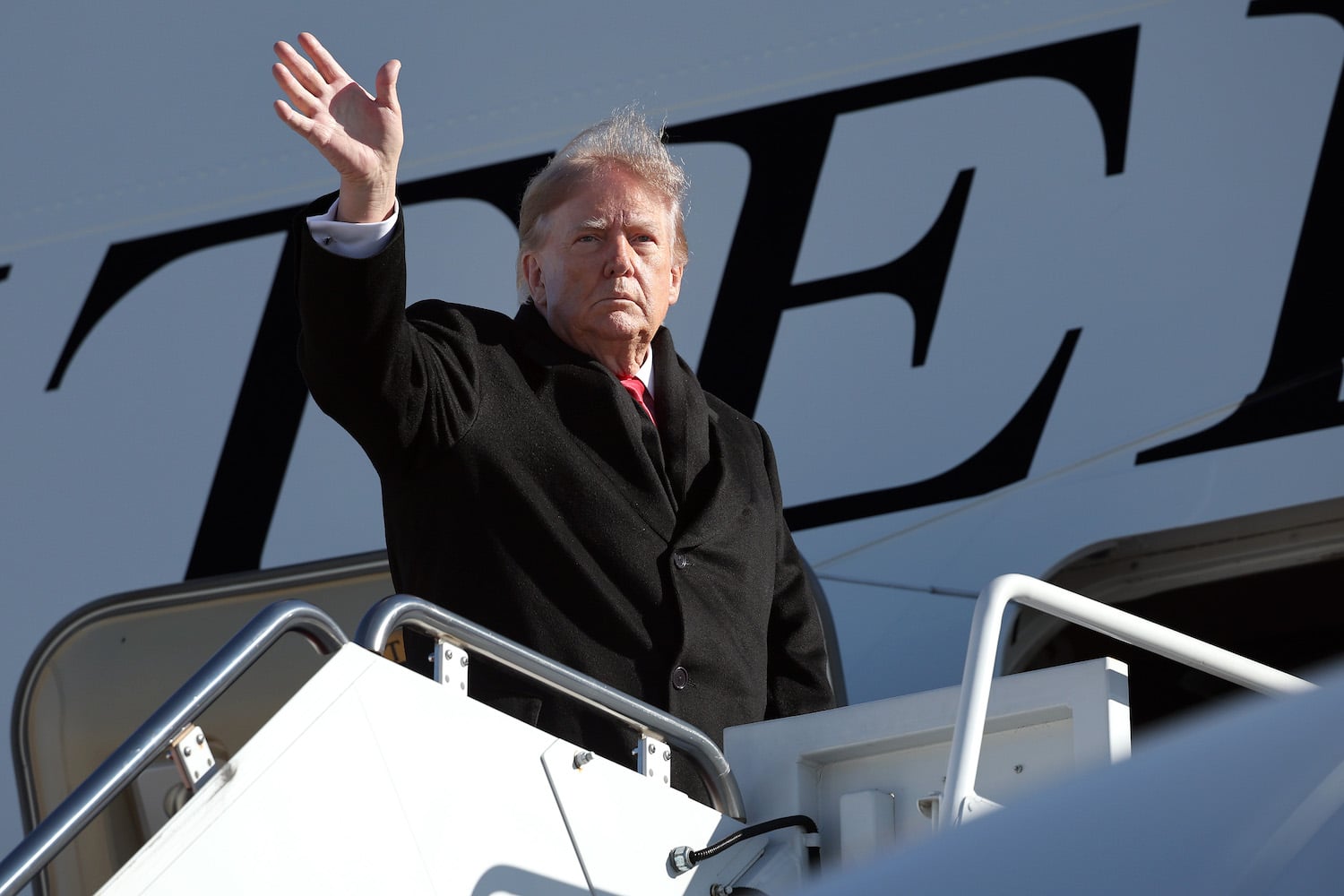
Welcome back to World Brief, where we’re looking at U.S. President Donald Trump’s trip to Asia, European priorities for Russia-Ukraine peace talks, and Houthi territorial gains in Yemen. A Very Busy Week On the heels of a disappointing U.S. midterm election for the Republican Party, President Donald Trump departed Washington on Monday for a week of high-stakes meetings with the Indo-Pacific’s biggest powers. From security talks with old allies to historic summits with foreign adversaries, Trump will be reengaging with a region that has largely been relegated to the back burner during his second term. Trump’s trip kicks off in Manila, Philippines, where he will join leaders of the Association of Southeast Asian Nations (ASEAN) on Tuesday to discuss some of the greatest threats to the region, including how wars in Iran and Ukraine have impacted the bloc’s economic security. During that time, Trump will also hold in-person talks with his fellow Quadrilateral Security Dialogue leaders—Australian Prime Minister Anthony Albanese, Indian Prime Minister Narendra Modi, and Japanese Prime Minister Sanae Takaichi—for the first time since taking office nearly two years ago. Meeting with the Quad will offer several opportunities for pomp and pageantry; however, experts expect little substance to come out of the summit. “I don’t think the president can hide the fact that he’s not terribly enthusiastic about the gathering,” Kurt Campbell, the co-founder of the Asia Group, a Washington-based geopolitical advisory firm, told FP’s Rishi Iyengar. Instead, the talks will likely serve as a box-checking exercise before Trump can turn his attention to other matters—namely, China. After less than 24 hours in the Philippines, Trump will head to the Chinese city of Shenzhen for the Asia-Pacific Economic Cooperation summit. While there, Trump and Chinese President Xi Jinping are expected to meet one-on-one with an eye toward maintaining the status quo. That will likely include talks on critical minerals, artificial intelligence, and their recently extended trade truce. Last week’s Nvidia scandal, though, is almost certainly off the table. The summit’s timing is consequential, as the U.S. midterms reckoning may have shifted Xi’s perception of the Trump administration as it enters its lame-duck period. “Beijing may come to see Trump as a president who remains willing to negotiate on a personal level but is becoming less capable of delivering on major political commitments,” Deng Yuwen argued in Foreign Policy. Trump, however, may be hoping to challenge that perception with several sideline summits. On Thursday, he will meet with Xi and Russian President Vladimir Putin for what China’s Foreign Ministry has called a meeting of “groundbreaking significance.” Although senior administration officials told reporters on Friday that Trump would not bring up the Russia-Ukraine war at the trilateral dialogue, those talks are now expected to discuss the conflict as well as push for denuclearization, though Xi will likely try to rebuff efforts to debate nuclear arms. Trump has also suggested that he might hold a separate bilateral meeting with Putin, reversing previous assurances from his staff that he had no plans to do so. And he has floated a potential meeting with North Korean leader Kim Jong Un during the Shenzhen trip—again, defying past administration claims that talks with Kim were not in the cards. “We might have Kim Jong Un. He may come. I don’t know—that’s up to President Xi,” Trump told reporters on Monday. Such talks would also likely center on Pyongyang’s nuclear program. Today’s Most Read Lame-Duck Trump Heads to Asia by Rishi Iyengar Realism Was Forged in Trauma by Jon Skolnik What Jensen Huang’s Fall Means for U.S.-China Relations by James Palmer The World This Week Tuesday, Nov. 17: Xi separately hosts Canadian Prime Minister Mark Carney and Peruvian President Keiko Fujimori. Takaichi holds bilateral talks with South Korean President Lee Jae-myung on the sidelines of the ASEAN summit. European Union defense ministers convene in Brussels. Israel’s Knesset is set to debate and vote on a new speaker. Thursday, Nov. 19: The International Court of Justice rules in a case accusing Myanmar of committing genocide against the country’s Rohingya Muslims. Friday, Nov. 20: Takaichi hosts Fujimori. Brussels hosts the second EU-U.K. leaders’ summit. Monday, Nov. 23: Polish President Karol Nawrocki begins a five-day trip to Argentina and Chile. What We’re Following Priority No. 1. The European Union accused Russia on Monday of trying to drag out peace talks while continuing to target Ukraine’s power grid ahead of what is expected to be another harsh winter. “We actually don’t have a cease-fire, and they continue to weaken Ukraine and kill people every single day,” EU foreign-policy chief Kaja Kallas said. EU leaders also warned against discussing the future of European security with Russia before an immediate truce is reached, stressed that Moscow should be the one to make concessions since Russia began the war, and insisted that EU leaders are prepared to reject any fresh demands from the Kremlin. “We don’t need a new security architecture. We need to restore the one we have,” Kallas said. “Russia has broken all the treaties that underpin it.” To reiterate that point, the EU imposed new sanctions on Monday targeting nearly 50 Russian financial institutions as well as business executives involved in the energy and oil industries, including Tatyana Kim, the founder of retail giant Wildberries. The bloc also issued fresh asset freezes and travel bans on dozens of people accused of spreading disinformation and pro-Russian propaganda. The EU’s actions come just days after Putin agreed to allow European representatives to join future Russia-Ukraine peace talks. The EU decided on Friday that its delegation will comprise five major military powers—nonmember Britain as well as France, Germany, Italy, and Poland—and EU institutions. Military retreat. Saudi Arabia on Monday replaced the commander overseeing its anti-Houthi operations after its Yemeni allies were forced to withdraw from large swaths of Yemen’s Red Sea coast. The retreat marked a significant blow to the Saudi-backed coalition, as the fighters characterized the move—which they described as a redeployment—as necessary to protect the interim capital of Aden. For months, the Iran-backed Houthis have advanced on the Red Sea and targeted critical energy infrastructure. In October, Yemen’s internationally recognized, Saudi-supported government launched “Dawn of Yemen,” a major counteroffensive aimed at retaking that territory. But the coalition’s successes have been limited. According to Yemen’s military on Monday, the Houthis have now advanced to the southern coastal area of Khor Omairh and are just 16 miles from government lines at the fishing village of Qawah. That has forced Saudi-backed Yemeni fighters to focus their attention on defending their base of operations in Aden as well as breaking the Houthis’ siege on Taiz, Yemen’s third-largest city. Same-day killings. Separate mass shootings in South Africa over the weekend killed at least 17 people, local police confirmed on Monday. Although the country has struggled to rein in violent crime for years, there has been a recent surge in mass shootings with high fatality rates across the country. On Sunday, South African authorities found eight bodies in a “bullet-riddled” vehicle outside the city of Pietermaritzburg; efforts to identify the individuals and establish a possible motive remain ongoing. Hours later, police discovered nine people killed by gunshot wounds inside a shack in the informal settlement of Jeffsville, located near the country’s capital. Gauteng Police Commissioner Tommy Mthombeni said that the Jeffsville killings could be related to a shooting at a nearby settlement last year that killed 12 people and injured 13 others, as one of the people killed on Sunday was a “person of interest” in the previous shooting. The same-day incidents, occurring 330 miles apart, bring the total number of major mass shootings in South Africa to nine since December 2025. Of those, the deadliest was a shooting at a bar in Johannesburg in September that killed 18 people; that killing was one of three mass casualty shootings in the span of a week. South Africa has one of the highest homicide rates in the world. Odds and Ends Fun for the British royal family isn’t just polo matches and chauffeur-driven motorcades. On Monday, Prince William and Princess Catherine kicked off their three-day trip to India with a game of gully cricket in the city of Mumbai. After fielding balls with local children and retired cricketer Sachin Tendulkar, the couple took a ride on the city’s metro rail system to promote the two countries’ close economic ties. This was their first joint visit to India in roughly a decade, and it was the princess’s most high-profile overseas trip since undergoing cancer treatment in 2024.
Trump Kicks Off Asia Tour
Full Article
Original Source
Read the full article at Foreignpolicy →KhanList aggregates and links to publicly available news content. We do not host full articles from third-party sources. Always verify important information with original sources.