
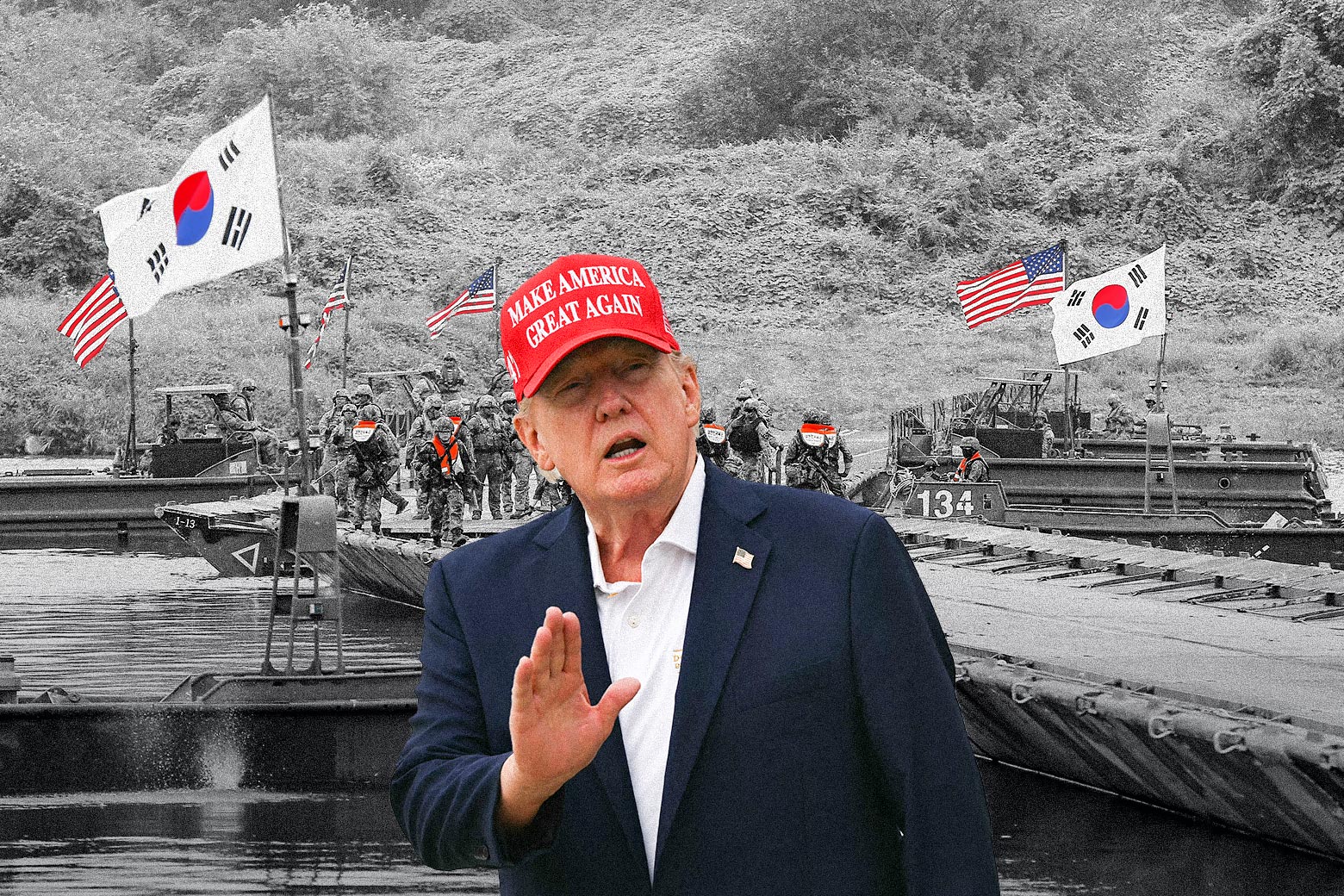
War Stories Trump Is Turning His Back on Most of East Asia—and Embracing Kim Jong-un By Enter your email to receive alerts for this author. Sign in or create an account to better manage your email preferences. Unsubscribe from email alerts Are you sure you want to unsubscribe from email alerts for Fred Kaplan? Aug 17, 20262:14 PM Photo illustration by Slate. Photos by Kent Nishimura/AFP via Getty Images and Seung-il Ryu/NurPhoto via Getty Images. Sign up for the Slatest to get the most insightful analysis, criticism, and advice out there, delivered to your inbox daily. With one action and one statement over the weekend, President Donald Trump has pretty much vaporized the United States’ reputation as a serious power in East Asia—the region that includes China, Japan, and the two Koreas—and with it, possibly, in much of the rest of the world. The statement, which he filed on social media late Sunday afternoon, ordered the Pentagon “to substantially reduce” joint military exercises with South Korea. He gave three reasons for his order. First, the exercises are “costly.” Second, they send a “signal that is totally inappropriate and hostile” to North Korea’s leader, Kim Jong-un, who, “as long as Donald J. Trump has been President, has been unthreatening and respectful.” The third reason for the cutback is that South Korea’s president refused “to join us in the Denuclearization of the Islamic Republic of Iran.” The action that Trump took was to redeploy an aircraft carrier, the USS George Washington, from Japan to the Middle East, where it will replace the USS Abraham Lincoln. Many news agencies have reported the hideous condition of the Lincoln—the exhaustion of its crews, the depletion of basic supplies, the breakdown of everyday equipment—as a result of its overextension within firing range of Iran. The ship certainly needs relief. However, a little-covered fact is that ordering the Washington to the Middle East removes the U.S. Navy’s only aircraft carrier in the entire region known as Asia Pacific. In other words, the Navy now has no significant way to project power in the region—and this is the case for the first time since 1944. As Phillips P. O’Brien, professor of strategic studies at the University of St. Andrews and author of several books on military history, put it in his Substack newsletter Monday, “This is what the end of an era looks like.” Together, Trump’s social-media post and his naval redeployment are telling the world—friends, foes, and powers in between—that the United States values the security of the Middle East more than the security of South Korea, Japan, and Taiwan. And he is saying, explicitly, that he has warmer regards for Kim Jong-un—one of the world’s most vile and murderous dictators—than he has for the democratically elected leaders of South Korea. Trump’s social-media posting is worth scrutinizing, as its details are more disquieting than its alarming enough general drift. The post begins: “Based on my very good relationship with Kim Jong Un of North Korea, I am not happy with the fact that the United States has, long ago, agreed to participate in Joint Military Exercises with South Korea.” Let’s stop there. Trump has no relationship with Kim. In his first term, he was fooled into believing they were dear friends—they met at a jovial summit in Singapore, they exchanged warm emails that Trump publicly described as “love letters,” they held negotiations on North Korea’s then-nascent nuclear weapons program. But this was all a sham. The talks collapsed. North Korea now has an estimated 60 nuclear warheads. Kim has sent Russia’s military more than 10,000 of his troops to bolster the front lines in the war against Ukraine—and 120 ballistic missiles, to kill civilians in Ukrainian cities. Finally, though Trump has signaled a desire to resume talks on a variety of issues, Kim has shown absolutely no interest in responding. In the shrewd balance of his alliance with Moscow and Beijing, he has no need to make any sort of deals with Washington. Trump next writes of the military exercises with South Korea: “These exercises are … costly, with much of these costs paid for by the United States of America (as usual!).” Actually, these things are cheap. Back in 2018, during Trump’s first term, when he canceled a joint military exercise with South Korea, a Pentagon spokesman said it would have cost $14 million. Let’s be generous to Trump’s view and tack on the effect of inflation in the eight years since then—that would bring the cost to $18.6 million. By comparison, Secretary of Defense Pete Hegseth has asked Congress for $37.5 billion to pay for the cost so far of the war in Iran. The war in Iran has accomplished nothing. Military exercises in South Korea arguably help prevent a much larger war. Finally, Trump writes: “While somewhat unrelated (?), I recently asked the President of South Korea if they would like to join us in the Denuclearization of the Islamic Republic of Iran, and they said, ‘No thanks!’ ” I should note that the strange parenthetical “(?)” is in Trump’s message; it’s not a snarky insert from me. But his complaint is bogus on three points. First, given its remote geography and the threats it faces on its border, South Korea wasn’t in any position to send much to the Middle East. Second, back in March, Trump redeployed to the Middle East many of the sophisticated weapons the U.S. had long maintained in South Korea—especially the Terminal High-Altitude Area Defense system. Even while many security officials in Seoul groused, President Lee Jae Myung noted that the U.S. had its own security needs and assured his Cabinet ministers that South Korea had enough weapons of its own to deter an attack. Second, as he has done many times, Trump characterized his war on Iran as a campaign of “denuclearization.” But this too makes no sense. In June 2025, U.S. B-2 stealth aircraft dropped earth-penetrating bombs on three enriched-uranium sites buried inside Iranian mountains, an attack that Trump said at the time “obliterated” Iran’s nuclear capability. Some reports have since suggested that Iran had moved some of the uranium elsewhere before the attack. But Trump has not ordered attacks on those sites at all. In fact, since the current war began six months ago, the United States has attacked more than 13,000 targets in Iran, with shifting rationales—to topple the regime, destroy Iran’s missiles, sink its navy, force the reopening of the Strait of Hormuz. He has failed to accomplish any of those goals (and it’s worth noting, once again, that the strait was free and open before the war started). The point here, though, is that none of those 13,000 targets have had anything to do with Iran’s nuclear program. To say that opponents of his war are fine with Iran getting nuclear weapons—as Trump once said about the pope—is nonsense. Trump ends the post with his usual sign-off: “Thank you for your attention to this matter.” Yes, do pay attention to this matter. It is becoming clearer by the day that President Trump is wrecking American power and making a mockery of any American leaders’ words. Donald Trump Foreign Policy Iran Military North Korea Kim Jong-un South Korea
Trump Just Took a Wild Stance on North Korea
Full Article
Original Source
Read the full article at Slate →KhanList aggregates and links to publicly available news content. We do not host full articles from third-party sources. Always verify important information with original sources.