
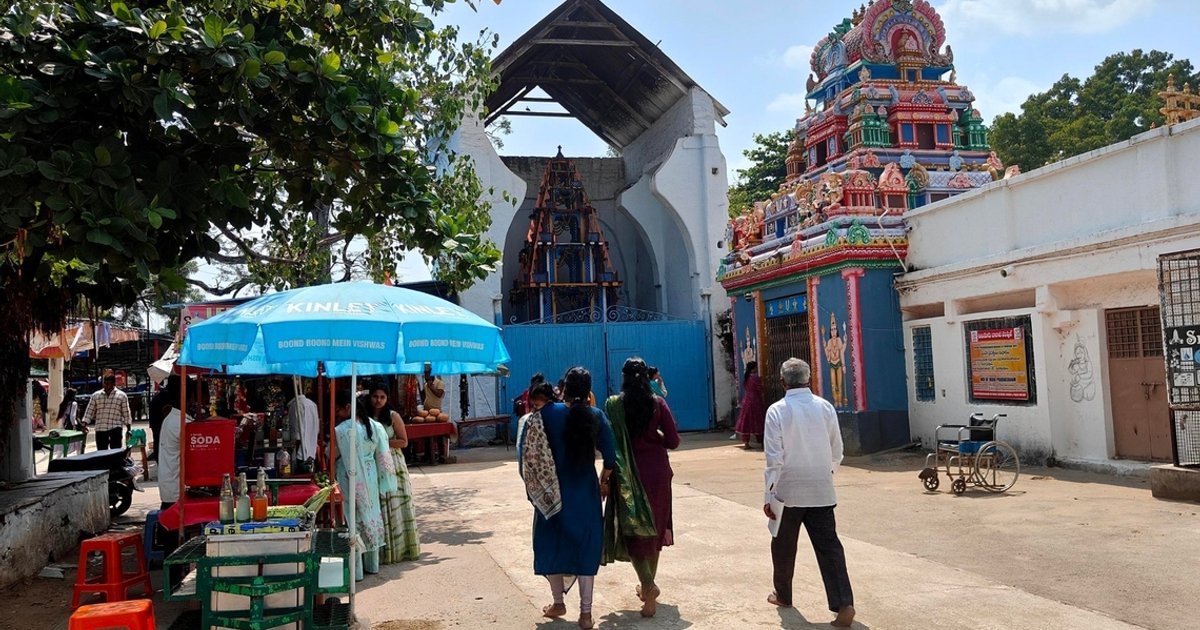
HYDERABAD – The Chilkur Balaji Temple, like any other temple, commands loyal devotees. Among the pious here are childless couples praying for children, professionals seeking promotions, and those hoping for elusive inner peace.But there’s another group of devotees here who are chasing something unusual – a visa to study or work abroad.For several decades, Indians wishing to emigrate have come to the temple at Chilkur, a village on the outskirts of Hyderabad in the southern state of Telangana, hoping Vishnu, the temple’s presiding deity, will bless their visa applications with success.The temple has enjoyed cult status as a “visa temple” since the 1990s, when students from nearby engineering colleges prayed for visas here and had their wishes granted. As word spread about this claimed boon, the temple deity became popularly known as “Visa Balaji”.Balaji is a widely worshipped incarnation of Lord Vishnu, known as the universe’s protector in Hindu mythology.Devotees continue to come to the 500-plus-year-old temple, now with increasingly fervent pleas to Balaji for help, as immigration-related restrictions rise in the US and elsewhere.Trump has made staying more difficultAmong such devotees at the temple on Oct 8 was Vaishnavi R, a 26-year-old software engineer from Bengaluru, nearly 600km away, seeking Balaji’s blessings for a visa she plans to apply for in 2027 to work in the US.“I want to improve my career, my confidence level, and I want to become independent,” she told The Straits Times about her decision to migrate to the US. She said achieving all this in India was difficult, with safety concerns for women limiting even her ability to travel alone.Vaishnavi spoke as she walked in a circle around the temple complex's inner shrine, part of the ritual here for devotees, while I kept up with her fast pace. Devotees are expected to circumambulate the shrine 11 times while making their wish, then return to express gratitude by circling the shrine 108 times if their wish is granted.But Vaishnavi was putting in extra legwork that day, circling the shrine more than 108 times in about two hours, just to ensure her future visa application would succeed in these trying times.“It has become more difficult to emigrate to the US, so I am making these extra rounds,” she added, as faint beads of sweat glistened on her forehead.It is no surprise that Hyderabad would be the location of a “visa temple”. The city is a key hub for India’s tech industry, with several American multinationals, including Microsoft and Google, either having their headquarters or a major operational presence here.Hyderabad and its adjoining areas are also home to many engineering schools producing tens of thousands of tech graduates each year who dream of working at these American companies in the city and, if luck has it, possibly even in the US.When India overtook China as the top country sending students to American universities in the 2023-24 academic year, Telangana and Andhra Pradesh powered the surge. Nearly 56% of Indian students who packed their bags for the US in 2023 were from these two states.Meanwhile, in the US, the number of Telugu speakers, a language widely spoken in Telangana and Andhra Pradesh, also jumped fourfold between 2016 and 2024, growing from 320,000 to 1.23 million.But this good run has hit rough weather since Trump was reelected as the US president in November 2024. His administration – in an ostensible attempt to crack down on illegal immigration – has either announced or implemented restrictions on opportunities for migrants seeking to study or work in the US.A blow was dealt on Oct 8 when the US suspended eight tech firms, including Microsoft and several major IT outsourcers with strong India connections, from hiring skilled international workers on a permanent basis through the Permanent Labor Certification Program or PERM, a widely used visa pathway for Indians.A day earlier, it had also proposed hiking charges for international students who plan to work in the US after graduating, requiring them to pay US$70,000 for on-the-job training, known as Optional Practical Training (OPT), and US$30,000 for any additional work training. Current enrollees are expected to pay around US$500.The OPT is a temporary employment programme that lets students gain hands-on work experience directly related to their field of study.The OPT programme is also the usual route from a US degree to a job in the country on an H-1B visa, a visa category for specialist workers that Indians have traditionally benefited most from. Fees for this visa rose dramatically in 2025 to encourage American companies to hire locally.Also at the temple that day was Akash Akkiraju, 26, a software developer in New York, who graduated in computer science from the University of Michigan in 2022. His OPT experience helped him land a job at Amazon, where he still works today.Akash Akkiraju, a software developer in New York, came to the Balaji Temple in Chilkur to pray to the deity to help him tide across the challenging times in the US. ST PHOTO: DEBARSHI DASGUPTAAkkiraju was in his hometown, Hyderabad, to have his new H-1B visa stamped on his passport by the local US consulate. An earlier visa-stamping appointment in 2025 was cancelled after the US announced additional screening protocols for beneficiaries, which worried him.With his visa safely secured, Akkriraju was finally looking forward to flying back to the US on Oct 10, but not before thanking Balaji for his continued benevolence and seeking his blessings, as was a longstanding family tradition.The deity’s support was more needed now than ever, he told ST, so that he can negotiate the challenging times in the US. “It is not the best time to be a software engineer (in the US),” said Akkiraju.Praying for more than visasThe temple draws over 5,000 people on weekdays, with the numbers surging to around 20,000 on the weekends. Pathways leading to the temple are lined with stalls selling coconuts and garlands of holy basil leaves or souvenirs from the region.Inside, devotees quietly circle the shrine, letting out periodic chants of “Govinda, Govinda” (a reference to the all-encompassing cosmic form of Lord Vishnu) in response to mantras being read through a loudspeaker.There is no estimate of how many devotees come to the temple seeking visas, but they encompass the width of India’s global diaspora.Soniya Joshi (right) was at the the Balaji Temple in Chilkur on Oct 8 to pray that her visa application to move to Australia and join her husband is successful. ST PHOTO: DEBARSHI DASGUPTAI met a woman praying for a visa to join her husband in Australia, and a young man there to thank the deity for helping him secure a visa to live and work in Canada.In fact, C. S. Rangarajan, a former biomedical engineer who serves as the head priest at the temple, dislikes the “visa temple” label and argues that “almighty” Balaji is “capable of everything”, not just ‘granting’ visas. “He is omnipotent,” said the 60-year-old.The priest claimed there has been no impact on attendance as a consequence of Donald Trump’s immigration policies, arguing that the deity was more powerful than any mortal being. “Donald Trump is temporary; Balaji is permanent,” he added.
‘Trump is temporary, Balaji is permanent’: Devotees at India’s ‘visa temple’ pray harder for visas
Full Article
Original Source
Read the full article at Straitstimes →KhanList aggregates and links to publicly available news content. We do not host full articles from third-party sources. Always verify important information with original sources.